Expectations surrounding developments in artificial intelligence and the upcoming earnings season are supporting investors’ appetite for risk in global markets despite the risks posed by high bond yields and tensions in the Middle East.
High borrowing costs remain a major concern for economies over the medium and long term, while expectations surrounding deals in the artificial intelligence sector pushed these risks into the background in the short term. Data released in the United States last week pointing to a slowdown in the labor market also contributed to a weakening of hawkish expectations regarding the Federal Reserve.
AI stocks rise
Reports that OpenAI is in talks with investment funds in the United Arab Emirates and asset management company BlackRock for a $30 billion funding round strengthened optimism toward the artificial intelligence sector.
Shares of companies linked to artificial intelligence led the gains. SpaceX shares rose 7.6%, Nvidia shares gained 2.1%, Meta shares increased 1.9% and Microsoft shares rose 1.5%.
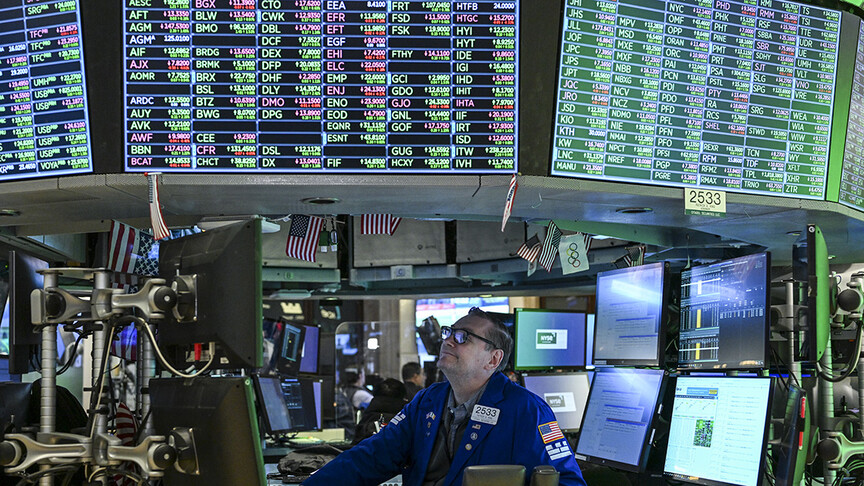
New York stocks close at record high
Ten of the 11 major sectors making up the S&P 500 rose on the New York Stock Exchange. Only the real estate sector declined, while analysts said the average interest rate on 30-year home loans in the United States exceeding 7% was putting pressure on the sector.
The Institute for Supply Management’s services Purchasing Managers’ Index in the United States fell to 54.9 in September, below expectations, signaling a slowdown in growth in the services sector.
While rising fuel prices in the United States kept inflation concerns alive, US President Donald Trump signed a decision allowing red diesel fuel used in vehicles operating off-road to be temporarily used on roads and postponing payment of the federal excise tax until the end of the year.
The US Treasury Department warned that foreign financial institutions continuing to do business with Iran or Iran’s financial sector could face sanctions without prior notice.
The yield on the US 10-year Treasury note stood at 5.33%, while the dollar index ended the previous day at 102.2, up 0.2%. Gold fell 0.5% to $4,121 per ounce, while the price of December Brent crude rose 0.6% to $100.9 per barrel.
The S&P 500 gained 0.66%, the Nasdaq rose 1.05% and the Dow Jones advanced 0.18% on the New York Stock Exchange. The Nasdaq closed at a record high, while US stock index futures started the day higher.
France diverges from European markets
European markets rose except for France. Financial concerns, political uncertainty and turmoil continued in France, while the rise in borrowing costs appeared to slow somewhat amid expectations that the European Central Bank could intervene.
France’s 10-year bond yield fell by about 5 basis points to 4.85%. In France, one of the euro area’s major economies, rising concerns about debt sustainability led investors to demand a higher risk premium for euro-denominated assets and caused the euro to lose value.
The dollar’s strength also increased pressure on the euro. The euro-dollar exchange rate fell to 1.1161, its lowest level since May 2025.
The euro area’s composite Purchasing Managers’ Index rose to 53.1 points in September, reaching its highest level in 41 months. The Producer Price Index also increased 1.9% month on month in August.
The FTSE 100 in the United Kingdom rose 0.34%, Italy’s FTSE MIB 30 gained 0.66% and Germany’s DAX 40 increased 0.09%. France’s CAC 40 fell 0.80%. European stock index futures also started the week higher.
South Korea diverges negatively in Asia
While Chinese markets remained closed for a holiday, optimism surrounding the artificial intelligence sector continued to influence Asian markets. Shares of South Korean semiconductor company SK Hynix fell 3% amid questions about the company’s structure ahead of a possible initial public offering of its US subsidiary, Solidigm.
Japan’s two-year bond yield rose by about 3 basis points to 1.93%, while its 10-year bond yield climbed to 3.10%. The Nikkei 225 rose 0.9% and Hong Kong’s Hang Seng Index gained 0.6%, while South Korea’s Kospi index fell 1.2%.
BIST 100 rises
Buying dominated trading on Borsa Istanbul. The BIST 100 index ended the day up 1.42% at 12,443.92 points. The October futures contract based on the BIST 30 index on Borsa Istanbul’s Futures and Options Market traded flat in the evening session compared with the regular-session close.
Domestic annual inflation fell to 29.73% in September, dropping below 30% for the first time since November 2021. Treasury and Finance Minister Mehmet Şimşek said leading indicators pointed to a continued decline in rent inflation and announced a gradual phaseout of the sliding-scale fuel tax mechanism for gasoline to limit the impact of rising oil prices on inflation.
The dollar/TL exchange rate ended the previous day at 49.1400. The exchange rate traded at 49.1780 at the opening of interbank trading, up 0.1%.
In Türkiye, the real effective exchange rate and monthly price developments report will be followed, while abroad, Germany’s factory orders, euro area retail sales and the US trade balance will be monitored. Analysts view 12,600 and 12,700 points as resistance levels for the BIST 100 and 12,300 and 12,200 points as support levels.



















