In her article on the welcoming of leaders by the Mehteran team at the Presidential Complex during the NATO Summit in Ankara, Bulgarian author Sophia Proneikos drew attention to the historical role of the mehter and Turkey's connection with its past.
Proneikos noted that history almost never vanishes, it merely learns to present itself gracefully, and added: “That is exactly why the most captivating scene of the NATO Summit in Ankara did not take place around the negotiation table.”
According to the author, the leaders of NATO, founded in 1949 as a symbol of the post-war world, stepped into the Presidential Complex to the music of the mehter, whose roots stretch back to the 13th century. Proneikos said, “The mehter was never an ordinary military band; it was a weapon.”
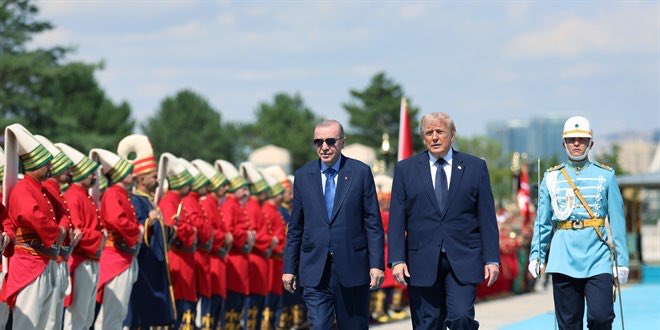
Recalling that the first thing heard when Ottoman armies advanced on Belgrade, Constantinople, Rhodes, Mohács or Vienna was the booming of the huge kös drums, Proneikos stressed that the music's purpose was not to entertain soldiers but to convince the enemy, even before battle began, that an empire was marching upon them.
Noting that after Europe's encounters with the Ottoman Empire, it was no coincidence that Western armies adopted Ottoman drums, cymbals and later the ‘Turkish style’ (Alla Turca) that even infiltrated the music of Mozart, Haydn and Beethoven, Proneikos wrote: “History sometimes does not conquer a civilization with the sword. A rhythm is enough.”
Proneikos stated that what she found fascinating about the ceremony was not an attempt to revive the Ottoman Empire, but that Turkey knows something great civilizations have always understood: “The past is not a burden, it is a language, and nations that know how to speak this language never recount their history only through speeches; because sometimes a few drumbeats are enough.”