İŞKUR is supporting 1 million young people in LGS and approximately 2.5 million in YKS, along with their families, with field data during the challenging preference process. Students and parents will no longer leave their career choices to chance, instead making decisions by looking at Labor Market data. The İŞKUR Consultant Information System (DABİS) has been made accessible to students and parents via the İŞKUR Mobile app.
With the transfer of DABİS to the İŞKUR Mobile app, students, parents, and graduates will be able to directly access labor market indicators related to vocational fields and university departments. During the high school and university preference period, young people will be able to make more informed decisions about their education and careers. How will DABİS contribute?
Thanks to DABİS, which is offered through İŞKUR Employment and Vocational Counselors and guidance teachers affiliated with the Ministry of National Education, users will be able to obtain comprehensive information about vocational fields and university departments.
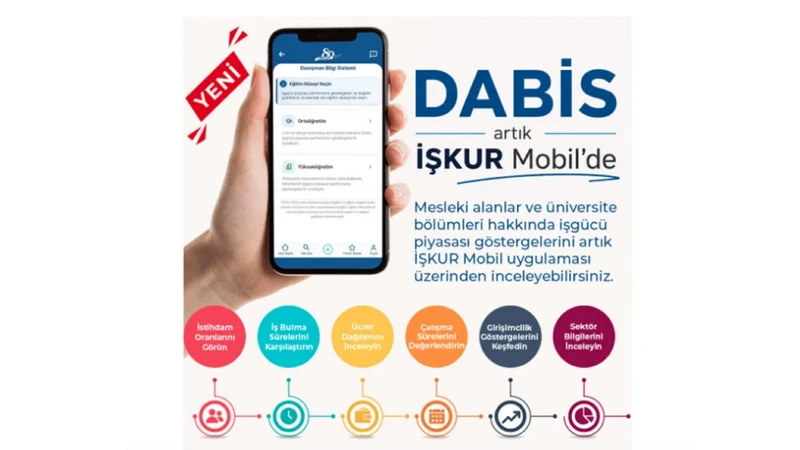
The system provides a reliable career guidance infrastructure that allows for the evaluation of educational preferences not only based on current educational options but also by considering the labor market conditions that may be encountered after graduation. How many indicators can be seen?
DABİS, which presents various aspects of the transition from education to working life for graduates of vocational fields and associate and undergraduate programs, serves as a comprehensive career information system.
The system includes 14 indicators for those choosing a vocational field, such as job-finding duration, wage distribution, average number of workplaces, employment rate, entrepreneurship rate, venture lifespan, rate of working in academia, and sectoral distribution; and 15 indicators for those choosing a university department. How was the database created?
The indicators provided in DABİS are based on the analysis of micro data sets created by anonymizing and matching high school and university graduate data from the Council of Higher Education (YÖK) and the Ministry of National Education (MEB) with employee data from 2010–2024 from the Social Security Institution (SGK). Can job entries be monitored?
The indicators for vocational high school and higher education graduates reveal not only whether graduates have found a job but also their continuity in working life and their occupational mobility.
While the employment rate indicator calculated by vocational field and university department allows viewing the current-year employment rates of graduates, the regional employment rate indicator by vocational field also allows examining the employment situation of graduates in the province where they received their education. Is the job-finding duration available? The time to find the first job stands out as one of the topics young people are most curious about during the preference process.
DABİS shows in detail how long it takes graduates to settle into their first jobs. In this context, it separately evaluates those who start working within six months before graduation, those who find a job within the first six months after graduation, those who find a job between six and twelve months, and those who take longer than twelve months.
Thus, students can examine how quickly those who graduate from the vocational field or university department they are considering transition to working life. Can graduates be tracked? Indicators for higher education graduates are calculated by university and department. The system presents a multidimensional view of the labor market situation for graduates of associate and undergraduate programs.
The entrepreneurial status of university graduates is also included as a separate indicator in the system. The rates of graduates who start their own ventures in the six months before graduation and during their post-graduation working life are calculated by department and university. Is there also transition time to a new job?
Through DABİS, one can also examine the transition time to a new job after leaving a previous job, how long the ventures they established continue operating, the sectors they work in, and the sizes of the enterprises. Thus, for a given department, one can see not only the employment rate of graduates but also which sectors and what sizes of enterprises they concentrate in during their working lives.
Does it provide a forecast for work? DABİS is not a system that makes decisions for young people. The indicators in the system do not offer a guarantee of a specific job or wage on their own. It provides a general labor market outlook based on aggregated data from past graduates. How can students and parents access the system?
To access the system, users must first download the İŞKUR Mobile app from the IOS and Android stores, create a profile, and then enter the Consultant Information System and select the 'Secondary Education' tab for vocational fields and the 'Higher Education' tab for university departments. Thus, those making LGS and YKS preferences can make accurate choices with real field data through DABİS.
What kind of working life awaits after graduation? DABİS provides answers not only to the question 'Which department can I get into?' but also to 'What kind of working life might await me when I graduate from this field?'
Users can compare job-finding durations, work continuity, wage distributions, entrepreneurial tendencies, and the sectors where graduates predominantly work for the vocational field or university department they are considering. Thus, education preferences can be made more data-driven and more consciously.
When was the transfer to İŞKUR made? Can everyone access?
The DABİS platform was transferred to İŞKUR by the Presidency in July 2025. Following the transfer, the system began to be actively used by İŞKUR Employment and Vocational Counselors and guidance teachers affiliated with the Ministry of National Education serving in 81 provinces.
With the İŞKUR Mobile app, this service has now become directly accessible not only through counselors and guidance teachers but also by students, parents, and graduates. Does it aim to support all young people?
With DABİS, the aim is to reach broader audiences with data-driven career guidance services, increase access to accurate and reliable information during preference processes, and support young people's decisions regarding education and working life in light of labor market data.














