In a statement marking Railways Week, Uraloğlu said the railway journey in Anatolia began on Sept. 23, 1856, with the construction of the İzmir-Aydın line.
Uraloğlu said railways became one of the main instruments of Türkiye's economic, social and geographic integration with the establishment of the Republic following the Ottoman period. He said the process that began with the granting of the concession for the İzmir-Aydın Railway had now entered a new phase through high-speed rail lines, modernized conventional railways and international corridors connecting Türkiye with Asia and Europe.
Uraloğlu said the railway journey that began 170 years ago had developed into an extensive transportation network directly affecting Türkiye's logistics capacity and international trade links.
Rail network reaches 13,919 kilometers
Uraloğlu said Türkiye had undergone a major transformation in railways over the past 25 years, announcing that the rail network had expanded from 10,948 kilometers to 13,919 kilometers.
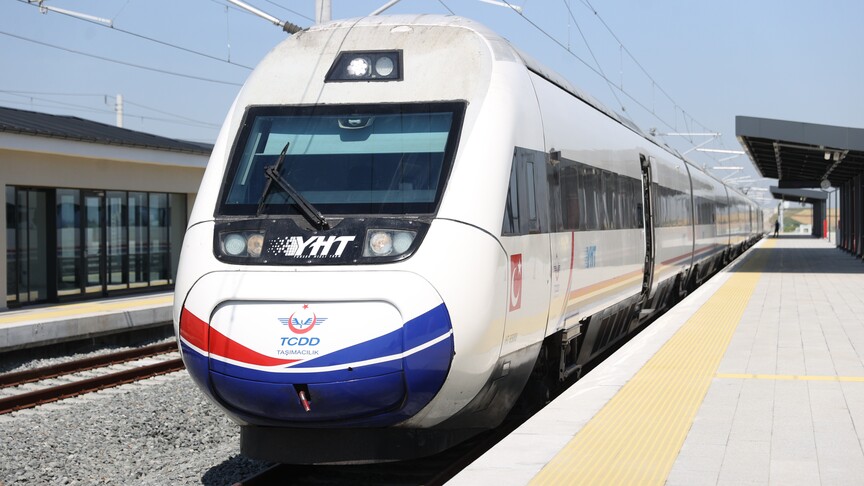
Uraloğlu said 2,251 kilometers of high-speed rail lines had been built from scratch during this period, adding that existing railway infrastructure had also been renewed and modernized alongside the construction of new lines. He said 61 percent of the lines had been equipped with signaling, while more than half had been electrified.
Uraloğlu said expanding the high-speed rail network was at the center of investments planned for the coming period, adding that the number of provinces directly connected by high-speed rail was targeted to rise from 11 to 27 by 2028.
Uraloğlu said work was continuing on the Ankara-İzmir, Halkalı-Kapıkule, Bandırma-Bursa-Yenişehir-Osmaneli, Mersin-Adana-Osmaniye-Gaziantep, Yerköy-Kayseri, Kırıkkale-Çorum and Karaman-Ulukışla lines. He said construction work was continuing on a 4,158-kilometer rail network in line with the 2053 targets.
Uraloğlu announced that the total rail network was planned to reach 17,287 kilometers in 2028, while the number of logistics centers was set to increase from 12 to 25.
Railways defined as a state policy
Uraloğlu said railways were a state policy, adding that investments had been increased to make up for the interruption in the railway drive that began during the early years of the Republic and to make railways a priority sector again.
Uraloğlu said the annual average of railway construction had fallen to 18 kilometers, but had risen to an annual average of 135 kilometers through new investments.
Middle Corridor connection to be strengthened
Uraloğlu said Türkiye's international and regional importance in railways would increase as the planned projects were completed, adding that the country aimed to secure a larger share of the approximately $75 billion transportation volume between Europe and Asia.
Uraloğlu said investments to strengthen Türkiye's position along the Middle Corridor were continuing. He added that intercontinental transportation times, which can reach up to 45 days by sea, could be reduced to 18 days by rail via Türkiye.
Uraloğlu said the railway connection between Asia and Europe had been strengthened with the launch of Marmaray, adding that Türkiye's connection to the Middle Corridor would be further reinforced once the Kars-Iğdır-Dilucu Railway Line was completed.
Uraloğlu said railway investments were being considered not merely as transportation projects connecting cities in Türkiye, but as part of a broader logistics strategy aimed at making Türkiye an important hub for international freight transportation.
Domestic production of railway vehicles expanded
Uraloğlu said domestic production was being prioritized in railway investments, adding that TÜRASAŞ facilities had been renovated and their production capacity increased.
Uraloğlu said the E5000 National Electric Locomotive, the National Electric Train and suburban train sets had entered mass production, adding that production of the National High-Speed Train Set had also begun. He said work was continuing to develop railway vehicles using domestic resources in parallel with the expansion of railway infrastructure.
Uraloğlu said railway policy aimed to connect cities, particularly Ankara, İstanbul, İzmir, Bursa, Konya, Kayseri, Çorum and Gaziantep, with high-speed rail networks. He added that Türkiye's railway connection between Asia and Europe was also targeted to be strengthened through the Baku-Tbilisi-Kars railway and planned new lines.
Uraloğlu said significant transformation had taken place in the railway journey extending from 1856 to the present, adding that railways had regained greater weight in the transportation system through investments ranging from the railway drive of the Republic's early period to high-speed rail lines, Marmaray and international railway corridors.



















