- BIST10011,477+4.11%
- USD50.03+0.05%
- EUR56.26+0.56%
- GOLD4,145.40+1.78%
- INTEREST36.00%-1.00
- BITCOIN80,289-0.17%
- November 5, 202612°
- BIST10011,477+4.11%
- USD50.03+0.05%
- EUR56.26+0.56%
- GOLD4,145.40+1.78%
- INTEREST36.00%-1.00
- BITCOIN80,289-0.17%
- November 5, 202612°
Mutlu-Pakdil, discoverer of the “Burçin Galaxy,” wins $2.5 million FirstLight award
Turkish astrophysicist Dr. Burçin Mutlu-Pakdil is one of five scientists to receive the FirstLight Awards, presented for the first time this year by Schmidt Sciences. Mutlu-Pakdil, who works at Dartmouth College in the US, will spend five years searching for the smallest and faintest galaxies in the universe with up to $2.5 million in funding.


Turkish astrophysicist Dr. Burçin Mutlu-Pakdil, a faculty member in the Department of Physics and Astronomy at Dartmouth College in the US, has achieved a significant success in the international scientific community. Mutlu-Pakdil was selected as one of five young scientists to receive the FirstLight Awards, presented for the first time this year by Schmidt Sciences, founded by former Google CEO Eric Schmidt and his wife, Wendy Schmidt.
Schmidt Sciences announced the awards on November 3 from Florence, Italy. The recipients were selected from more than 100 applications from around the world through a three-stage evaluation by independent expert panels. Each awardee will receive up to $500,000 per year for up to five years, or a total of up to $2.5 million, to establish and lead their own research team.
“We will discover galaxies we have never been able to see before”
Mutlu-Pakdil shared the good news with her followers on social media. Quoting a post on X in which Schmidt Sciences introduced the awardees, the young scientist wrote: “I am incredibly excited to use this amazing observatory system to answer fundamental questions in astronomy.”
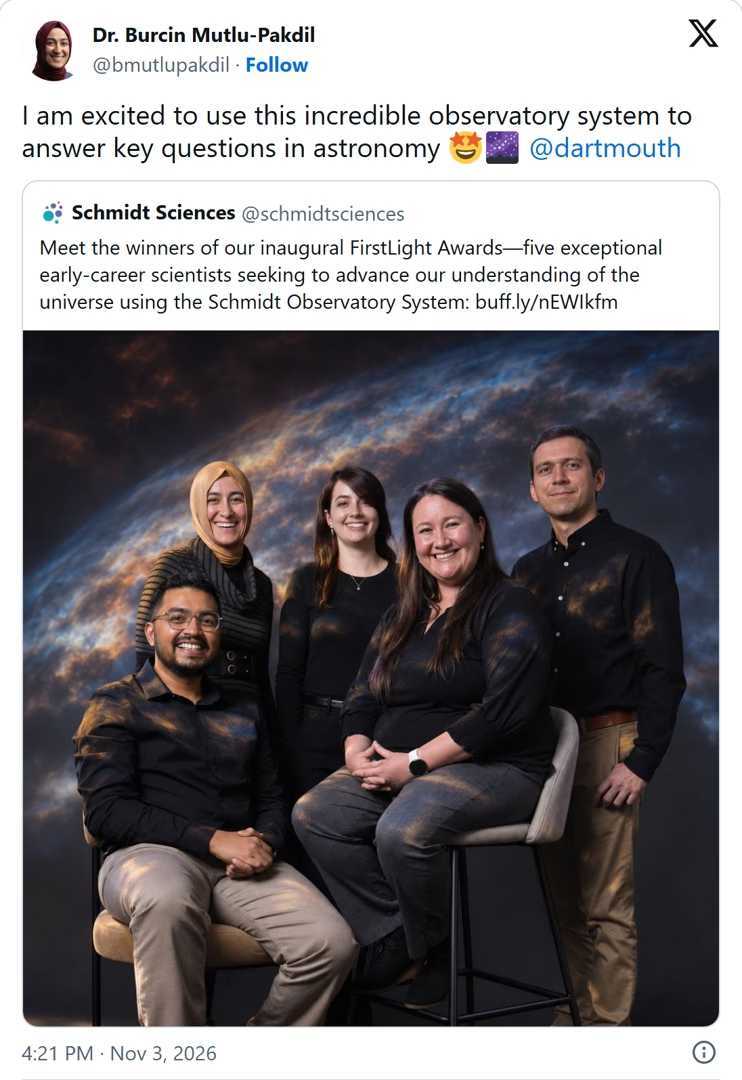
In a Turkish-language post on Instagram, Mutlu-Pakdil wrote: “I want to share some wonderful news! I have been selected as one of five scientists to receive the FirstLight Award, presented for the first time this year by Schmidt Sciences!” She continued: “This award, worth a total of $2.5 million, will support our research over the next five years as we seek to discover the smallest and faintest galaxies in the universe. By combining next-generation telescopes, radio and optical observations, and artificial intelligence, we aim to discover galaxies we have never been able to see before, better understand how galaxies form and learn more about the nature of dark matter.”
She will trace the nature of dark matter
Mutlu-Pakdil's award-winning project is titled “A Paradigm Shift in Near-Field Cosmology with the Schmidt End-to-End Dwarf Galaxy Discovery (SEEDD) Pipeline.” The project will search for dwarf galaxies, the smallest, faintest and most numerous type of galaxy in the universe, to test existing knowledge about dark matter and galaxy formation. Mutlu-Pakdil will conduct the project with David Sand of the University of Arizona in the US and Kristine Spekkens of Queen's University in Canada.
The research will use the new Eric and Wendy Schmidt Observatory System, comprising four observatories—Argus, Lazuli, LFAST and DSA—that operate at optical, infrared and radio wavelengths. Under the terms of the awards, the teams will make their research, the software they develop and the data they obtain publicly accessible. Students and postdoctoral researchers joining the teams will also receive the title of “FirstLight Fellow.”
Arpita Roy, director of the Schmidt Sciences Center for Astrophysics and Space, said: “Building four new observatories is an extraordinary scientific undertaking, but their true value lies in the discoveries researchers will make with this system. Through FirstLight, we are investing early in the people who will turn these new capabilities into significant scientific results.”
From the “Burçin Galaxy” to today
Mutlu-Pakdil first attracted worldwide attention while she was a doctoral student through her work identifying PGC 1000714, a rare elliptical galaxy with two rings. Known as the “Burçin Galaxy,” the celestial object was described as the first example of its kind and challenged existing explanations for the formation of ring galaxies. Mutlu-Pakdil graduated from the Department of Physics at Bilkent University in 2009 and completed her doctorate at the University of Minnesota in the US in 2017. She was selected as a TED Fellow in 2018 and a TED Senior Fellow in 2020.
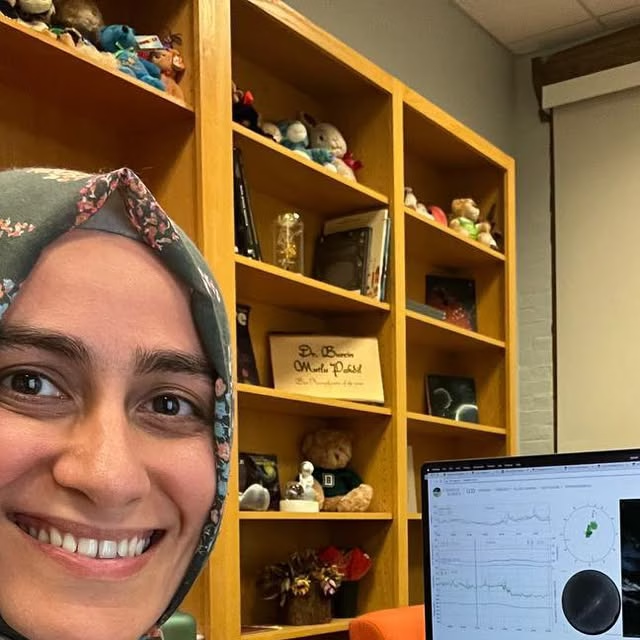
Mutlu-Pakdil, who frequently shares images from observing nights on social media, wrote during an observation with the Magellan telescope at the Las Campanas Observatory in Chile: “It will be a long night. Unfortunately, we could not collect very good data last night because of the clouds. Hopefully, we will make up for it tonight.” With the FirstLight award, the young scientist has become one of a select group of researchers who will help shape how an entirely new network of observatories is used.
Photos: social media; X/@bmutlupakdil; Instagram/@burcinmutlupakdil
Have a story, event or announcement of your own?Send us your news on WhatsApp
Spotted an error in this story?Report it on WhatsApp
Share on all social platforms
Sponsored Ads
Featured Listings
Loading featured properties...
Stay Updated with The Turkiye Times
Subscribe to be informed about special news, developments and announcements. We will keep you informed.
By signing up, you agree to our Privacy Policy