- BIST10012,151-0.94%
- USD49.220.00%
- EUR55.21+0.28%
- GOLD4,195.90-0.48%
- INTEREST37.00%-1.00
- BITCOIN82,797-1.05%
- October 13, 202619°
- BIST10012,151-0.94%
- USD49.220.00%
- EUR55.21+0.28%
- GOLD4,195.90-0.48%
- INTEREST37.00%-1.00
- BITCOIN82,797-1.05%
- October 13, 202619°
Security efforts at UN General Assembly shaped by shared risks and diverging priorities
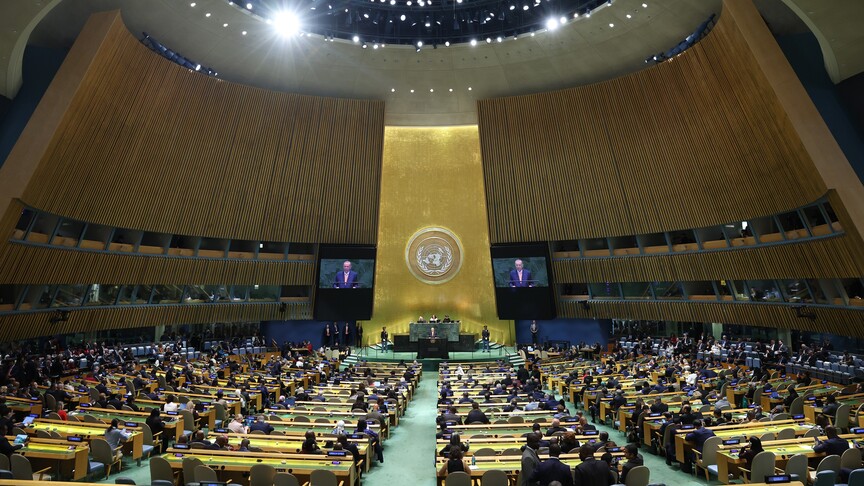
Professor Murat Yeşiltaş, a faculty member at Ankara Social Sciences University and Director of Foreign Policy at the SETA Foundation, assessed the 81st session of the UN General Assembly.


Professor Murat Yeşiltaş, a faculty member at Ankara Social Sciences University and Director of Foreign Policy at the SETA Foundation, assessed the speeches delivered at the 81st session of the United Nations General Assembly within the framework of the transformation of the security order. Yeşiltaş said there was broad agreement that the old security order had lost its effectiveness, but that differing approaches had emerged over which model should replace it.
Security approaches are diverging
According to the assessment, U.S. President Donald Trump defines security through power and bargaining, while French President Emmanuel Macron advocates strengthening international law and institutions. Qatar proposes an inclusive regional collective security system, while Syrian President Ahmed al-Sharaa is seeking a new Levantine order based on the sovereign state and the state's monopoly on weapons.
Iran argues that no country can be secure on its own. Türkiye's approach, meanwhile, rests on a multilayered framework that addresses the reform of international institutions, regional ownership and strong national deterrence together. This picture shows that international security has not disappeared, but is increasingly acquiring a regional character.
Multipolarity alone does not offer a sufficient explanation
Yeşiltaş said it was not sufficient to explain these developments solely through the concept of multipolarity. While multipolarity explains how power is distributed among different actors, it does not on its own answer how security is defined, who produces it or which instruments are considered legitimate.
The debates at the UN General Assembly revealed divisions not only over Gaza, Iran, Ukraine and Syria, but also over security itself. Some actors associate security with superior capabilities and deterrence, while others emphasize law and institutions. Some countries seek regional collective security, while others view the restoration of the sovereign state's strength as the fundamental solution.
African countries are expanding the security agenda beyond war, while Latin America also lacks a common approach. Argentine President Javier Milei's criticism of the UN and his raising of the Falkland/Malvinas issue were cited as examples of this divergence. Nevertheless, the region retains a strong tendency to prioritize sovereignty and opposition to intervention while remaining as autonomous as possible from great-power rivalry.
Two approaches based on power and rules
In Trump's understanding of security, military power, economic pressure, technological superiority and diplomatic bargaining stand out as instruments of the same strategy. The approach that Iran will not be allowed to acquire nuclear weapons, along with the willingness to act before threats grow, is assessed within this framework.
In Washington's China policy, trade, Taiwan, semiconductors, critical minerals and artificial intelligence are becoming elements of a broader strategic rivalry. For this reason, the approach is viewed not merely as American isolationism, but as an effort to turn the United States' military, economic and technological superiority into a more direct bargaining capacity.
The European approach represented by Macron, by contrast, emphasizes the importance of rules that limit the use of force and institutions that protect those rules. The Russia-Ukraine war has strengthened the view that military, economic and technological capabilities are also necessary to enforce the rules.
Within this framework, law, multilateral institutions, deterrence and resilience are becoming elements of the same security agenda. The war in Ukraine has brought defense capabilities to the forefront, energy crises have highlighted economic resilience, disinformation and cyberthreats have raised the issue of societal security, and technological competition has placed strategic autonomy on the agenda.
Search for regional collective security in the Middle East
Although Iran and Qatar have different security concerns, they share the view that lasting stability cannot be achieved by basing one state's security on the constant insecurity of the countries around it. In Iran's postwar rhetoric, the indivisibility of regional security and the search for common security with neighboring countries have become more visible.
Qatar's approach lists sovereignty, territorial integrity, noninterference in internal affairs, the peaceful settlement of disputes and the state's legitimate monopoly on weapons as principles of an inclusive regional security system. This approach brings to the forefront the question of whether the states of the region can jointly produce security on the basis of common principles.
While collective defense refers to the solidarity of certain countries against a common threat, collective security seeks to prevent conflict by keeping rivals within common rules. The future security architecture of the Middle East could move toward a layered structure in which national deterrence, defense partnerships and inclusive regional mechanisms operate together.
Israel's security approach at the center of the regional debate
Israel's security approach was also addressed as one of the central issues in the regional debate. The approach was described as having taken shape after October 7 around broader military freedom of action, suppressing threats beyond national borders and preventing potential threats from developing capabilities.
This security approach was said to narrow the areas of sovereignty and security available to Jordan, Syria, Lebanon and Iran. Thus, the classic security dilemma has re-emerged on a regional scale, as steps taken by one actor to increase its security raise the threat perceptions of other actors.
Sovereign state-centered approach in Syria
In Syrian President Ahmed al-Sharaa's approach, the sovereign and functional state stands out as the basic unit of security. Syria's security problems are linked not only to external threats, but also to fragmented sovereignty, non-state armed groups, problems with border control and Israel's freedom of action on Syrian territory.
Damascus's pursuit of a security arrangement with Israel while maintaining its position on the Golan Heights and sovereignty brings together two elements of this approach. Sovereignty, state capacity, the monopoly on weapons, border control and negotiated external security are viewed as complementary issues.
Africa expands the security agenda
African countries' demand for stronger representation on the UN Security Council is not viewed solely as a demand concerning the institution's structure. It also represents an objection to which issues are considered matters of international security.
The war in Sudan, fragile state structures in the Sahel, conflicts in the Congo, food security, debt, climate change and economic inequality constitute security problems for African societies. The approach of Kenyan President William Samoei Ruto also reflects Africa's view of security as extending beyond war and military threats.
Within this framework, debt sustainability, climate vulnerability, development finance, food and energy security, and state capacity stand out as components of the security agenda.
Artificial intelligence is reshaping the strategic power arena
Artificial intelligence, advanced semiconductors, computing capacity, data, critical minerals and digital infrastructure are becoming strategic resources that directly affect states' military capabilities, economic resilience and sovereignty.
In the nuclear age, strategic capacity was largely under the control of states, whereas in the age of artificial intelligence, a significant portion of this capacity is found in the models, processors, data centers and digital infrastructure of technology companies. UN Secretary-General Antonio Guterres's assessment that power is shifting from states to private companies and from humans to machines points to the political dimension of this transformation.
Trump highlights the United States' lead in artificial intelligence as an element of strategic power and takes a cautious approach to calls for comprehensive regulation. In the new security order, the fundamental question is not only which country will possess more advanced technology, but also who will control strategic technological capacity and who will set the rules for its use.
Türkiye's multilayered security approach
Türkiye's approach addresses within a single framework the restoration of trust in the international system, enhancing the UN's functionality, enforcing international law, regional ownership, diplomacy, national capacity and technological independence.
The first layer of this approach consists of international law and reformed global institutions. The second layer involves regional actors assuming greater responsibility for resolving their own security problems, while the third consists of national defense capacity and deterrence. Development, connectivity and technological capacity are also viewed as elements that extend security beyond the military sphere.
Türkiye's approach is interpreted not as an effort to abandon the existing international system, but as an attempt to repair international governance so that it can adapt to changing power realities.
Stay Updated with The Turkiye Times
Subscribe to be informed about special news, developments and announcements. We will keep you informed.
By signing up, you agree to our Privacy Policy
















