Pros&Cons Security and Risk Analysis Director Prof. Dr. Serhat Erkmen assessed the “Four Seas Initiative,” which aims to fundamentally alter the Middle East energy equation for the United States, for AA Analysis. Erkmen stated that the initiative seeks to link the Persian Gulf, Caspian Sea, Mediterranean and Black Sea in order to undercut the influence of rivals such as China, Russia and Iran.
Origins of the Four Seas Initiative
The project stands out as an expanded version of the “Three Seas Initiative,” announced by US President Donald Trump at the 2017 G20 Summit. The Three Seas Initiative brought together 12 countries along the Baltic, Adriatic and Black Sea axis in an effort to reduce Russia's influence in Europe. The name Four Seas Initiative was first uttered at the Atlantic Council's US-Syria Energy Symposium in Washington on March 26, 2026, by then-US Ambassador to Ankara and Special Envoy for Syria Tom Barrack.
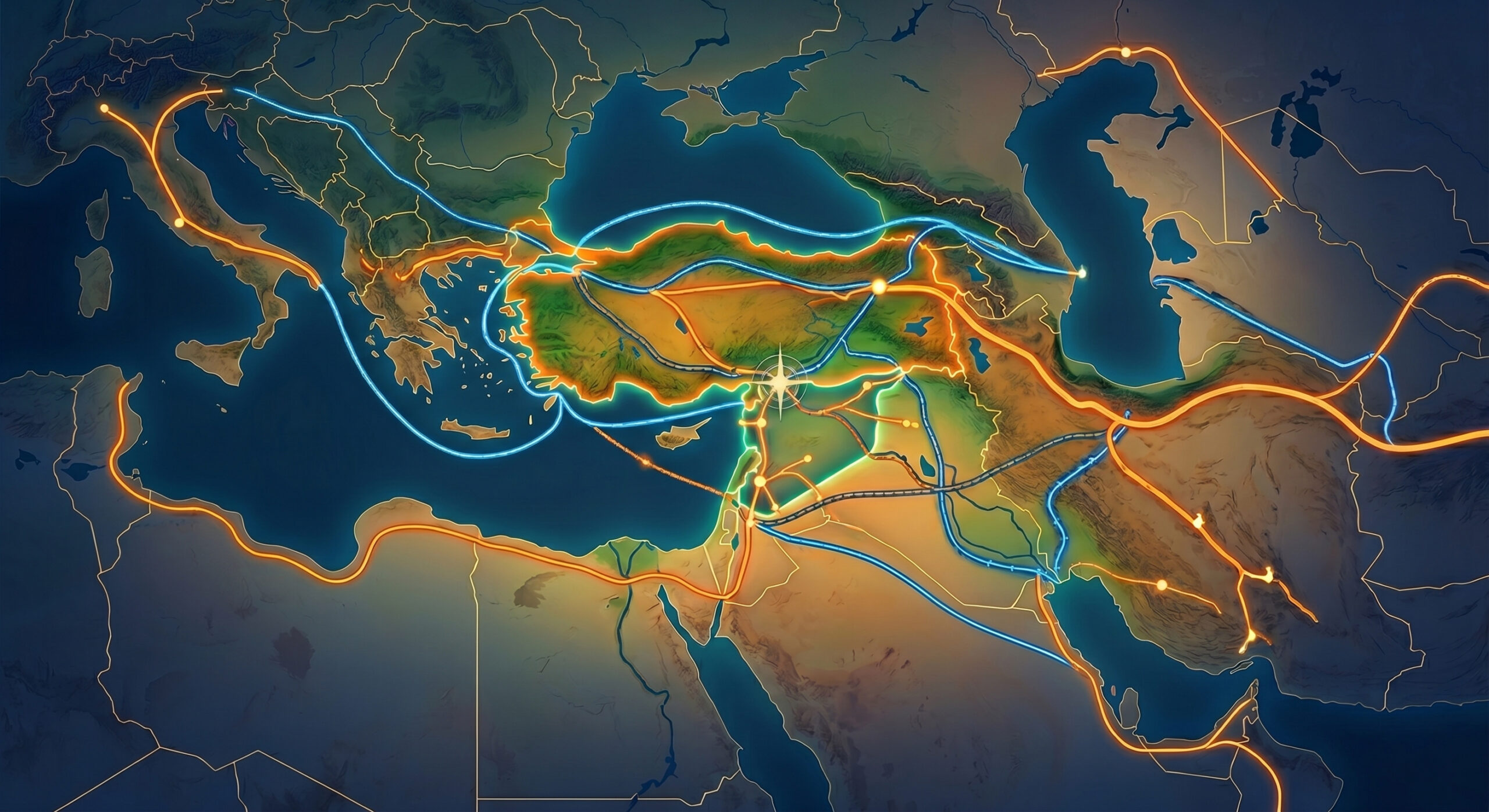
According to Erkmen, the project rests on the assumption that “the current energy equation in the Middle East runs counter to the economic interests of the United States.” In this framework, it is argued that volatility in oil and natural gas prices negatively affects the US and its allies, while China's Belt and Road Initiative reaching Europe poses a risk to the US. The initiative aims to rearrange energy transmission lines and trade routes in the Middle East, Caucasus and Central Asia in favor of the United States.
Four corridors
The initiative envisions four main corridors:
- Gulf-Mediterranean Corridor: This line, involving the transfer of oil from Saudi Arabia, Kuwait and the UAE via Jordan to Syria's Tartus Port, is described as a project to revive the old Trans-Arabian Pipeline, aiming to provide an alternative to the Strait of Hormuz and the Suez Canal.
- Iraq-Syria Corridor: It foresees rebuilding the Kirkuk-Baniyas oil pipeline, closed in 1979, with a capacity of 1.5 million barrels per day, aiming to reduce Iraq's dependence on the Basra terminal and to link Iraq and Syria economically.
- Caspian-Mediterranean Corridor: Adds a Syria connection to the existing route that carries Azerbaijani and Turkmen natural gas to Europe via Turkey through TANAP, planning an additional line from Turkey to Syria.
- Arab Gas Pipeline Modernization: Focuses on transporting Egyptian natural gas to Europe via Jordan, Syria and Turkey.
First step: Iraq-Syria connection
According to Erkmen, the most feasible leg of the project at present is the Iraq-Syria Corridor. He noted that the US is actively using diplomatic pressure and economic tools to prevent a government close to Iran from taking office in Iraq, and that the new Iraqi government is openly supporting Washington's initiatives in the oil sector.
Erkmen said that companies listed as financiers in the project report released in June — Chevron, Hunt Oil, HKN, ConocoPhillips and Qatar Energy — have secured significant gains in Iraq over the past two months and have signed deals to operate natural gas and oil fields in Syria, and that these firms are playing a decisive role in building the Kirkuk-Baniyas pipeline. The start of rehabilitation work on the M4 international highway from Iraq to Syria is being viewed as a complementary piece of energy cooperation.
Turkey's place in the project
Erkmen pointed out that after Syria, Turkey is the second key country in the Four Seas Initiative. He noted that with this project, the Trump administration seeks not only to curtail Iran's influence in the Persian Gulf and Iraq but also to block China's Belt and Road Initiative from reaching Europe. In this context, Turkey sits at the center of international transport lines from the Caucasus and Central Asia.
Erkmen stated that the Iraq-Turkey Development Road could be expanded to include northeastern Syria, making Turkey a critical junction for natural gas pipelines to Europe alongside road transport. These routes are expected to distance Europe from its dependence on Russian natural gas.
Chances of success
Describing the probability of the project being fully realized as “virtually nil,” Erkmen said that the effects already felt on Iraq and Syria nevertheless demonstrate that the initiative should be taken seriously. He recalled that no state has volunteered to provide financial backing, that the main market for Gulf countries is Asia, and that Saudi Arabia has alternative refineries on the Red Sea, which is why the four corridors are not being pursued simultaneously but rather the Iraq-Syria leg is being prioritized.
The views expressed in this assessment written by Prof. Dr. Serhat Erkmen for AA Analysis are the author's own.