The historic buildings and visitor areas in the Istanbul Archaeological Museums complex have been reorganized through extensive restoration and renovation work. The project covered the main neoclassical museum building, the Museum of the Ancient Orient, the Çinili Kiosk, the courtyard and Gülhane Square.
Türkiye's Minister of Culture and Tourism Mehmet Nuri Ersoy said the project's main objective was to preserve the buildings' original architectural character while introducing contemporary museum practices.
Restoration carried out in stages
Restoration of the main museum building began in 2011 and continued in stages. Following structural reinforcement, conservation and exhibition work, the building reopened to visitors in 2021.
The final phase of the project, which began in January 2023, focused on the Museum of the Ancient Orient and the Çinili Kiosk. At the Museum of the Ancient Orient, the concrete and vaulted ceilings and masonry walls were reinforced; the roof was renovated, while the decorative elements and sculptures on the façade underwent conservation.
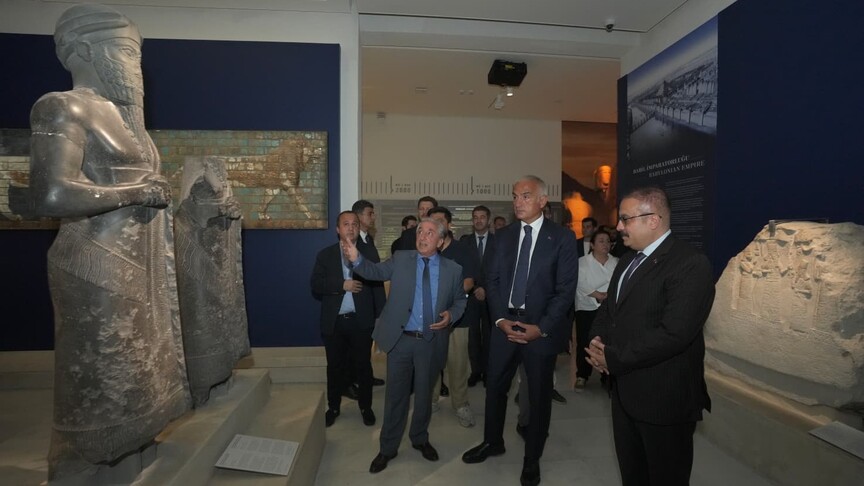
The museum's Assyrian, Sumerian, Sumerian-Akkadian, Arabian, Babylonian, Hittite, Urartian and Egyptian galleries were reorganized with new display and lighting systems. The museum reopened on July 6.
Nearly 54,000 tiles examined at the Çinili Kiosk
As part of the conservation work at the Çinili Kiosk, roof sections added to the building later were removed, and the old lead coverings were replaced with materials compatible with the original structure.
The team catalogued nearly 54,000 tiles on the building's exterior and prepared a separate conservation plan for each one. The tiles were cleaned, reinforced, repaired and recolored.
The exhibition layouts of the İznik, Kütahya, Çanakkale, Early Ottoman and Seljuk galleries at the Çinili Kiosk were also updated.
New visitor areas added to the complex
The work was not limited to the museum buildings. The complex's main entrance was moved to Gülhane Square, where a new visitor reception center was established.
Thirty-eight archaeological artifacts began to be displayed along Osman Hamdi Bey Slope, which connects the square to the museum. Approximately 140 artifacts were placed in the redesigned courtyard.
Ersoy said they view the museum complex not merely as a place where artifacts are displayed, but as a living cultural space where visitors can engage with history, art, architecture and culture.
















