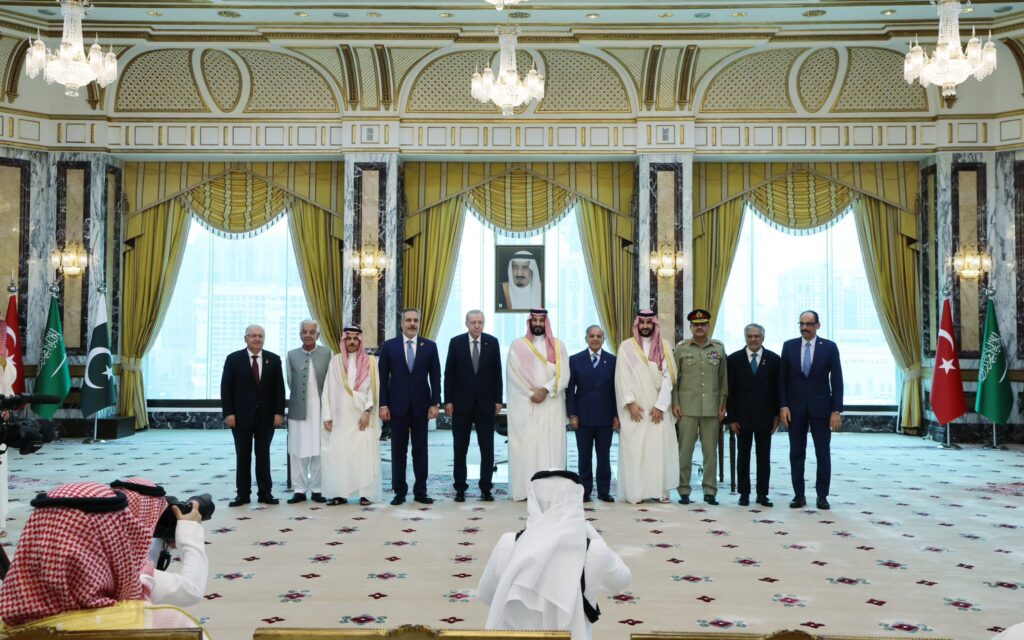
The Mecca Joint Defense Agreement signed by Türkiye, Saudi Arabia and Pakistan on August 7 is entering a new phase in which concrete military and political mechanisms will be established following the signing ceremony.
According to new details announced by Türkiye's Ministry of National Defense, the three countries will establish high-level political and military coordination mechanisms to implement the agreement.
The plans will extend beyond diplomatic consultations. Türkiye, Saudi Arabia and Pakistan are expected to conduct comprehensive joint military exercises across land, air, maritime and cyber domains.
They also aim to expand joint development and production as well as technology transfers in the defense industry.
An attack on one country will be considered an attack on all three
The most notable provision of the Mecca Joint Defense Agreement is its collective defense commitment.
Under the agreement, an armed attack against Türkiye, Saudi Arabia or Pakistan will be considered an attack against all three countries.
Because of this provision, the agreement is being compared with the collective defense mechanism set out in Article 5 of the NATO treaty.
Türkiye's Foreign Minister Hakan Fidan also said the agreement technically embodies a principle similar to NATO's Article 5.
However, Ankara, Riyadh and Islamabad emphasize that the agreement is not an offensive alliance formed against any country and that its primary purpose is defense and deterrence.
Joint exercises across land, air, maritime and cyber domains
The new details announced on the implementation of the agreement show that the scope of military cooperation among the three countries will be broad.
According to Türkiye's Ministry of National Defense, the parties plan to conduct comprehensive joint exercises across land, maritime, air and cyber domains.
The cooperation is also expected to cover modern military technologies such as unmanned systems, electronic warfare and artificial intelligence.
In addition, the countries aim to expand joint development and production projects and technology transfers in the defense industry.
This framework brings together Türkiye's advanced defense industry capabilities, Pakistan's large and experienced military structure, and Saudi Arabia's economic strength within the same security mechanism.
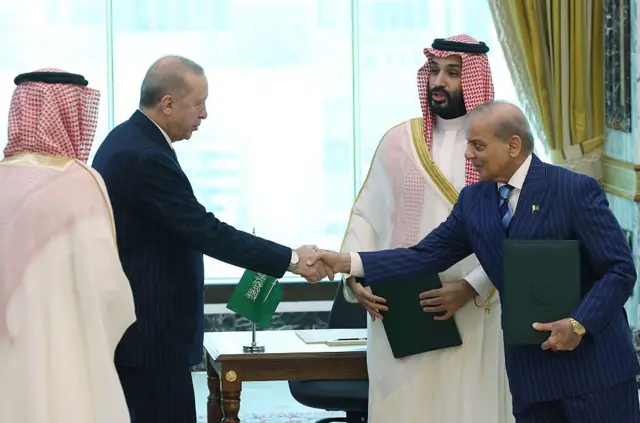
High-level political and military mechanisms will be established
The agreement also calls for a more institutionalized framework among the three countries' foreign and defense authorities.
The aim is for senior political and military officials to meet regularly, coordinate on regional threats and conduct military planning through joint mechanisms.
Türkiye said the agreement's primary purpose is to make defense and military relations among the three countries more “institutionalized and sustainable.”
Egypt may also join the agreement
One of the most important developments concerning the future of the Mecca Agreement is the possibility that the framework may not remain limited to the three countries.
Türkiye said the agreement could later be opened to other countries in the region.
The country mentioned most prominently in this context is Egypt.
Egyptian Foreign Minister Badr Abdelatty said Cairo is seriously considering potentially joining the Mecca Defense Agreement.
However, the Egyptian government wants to examine the legal and constitutional obligations arising from the agreement before making a decision.
Cairo's participation has therefore not yet been finalized.
Erdoğan seeks a broader framework
Statements indicate that Türkiye's long-term objective is not to leave the agreement as merely a trilateral defense mechanism.
President Recep Tayyip Erdoğan wants other countries in the region to join the framework in the future, while Ankara is particularly receptive to Egypt's participation.
Türkiye is encouraging Cairo to join the agreement.
If Egypt becomes a member, the framework could bring four of the region's largest military powers—Türkiye, Saudi Arabia, Pakistan and Egypt—together in the same defense mechanism.
An alternative to the United States and NATO?
One of the main questions raised by the agreement is how the new framework could affect the United States' traditional security role in the Middle East.
Saudi Arabia has maintained extensive military and security ties with the United States for decades. Pakistan has long-standing defense relations with both China and the United States. Türkiye has been a NATO member since 1952.
For this reason, the establishment of a collective defense mechanism among the three countries may signal that regional countries are seeking to provide more of their own security through their own capabilities.
However, the available information does not indicate that the Mecca Agreement will replace NATO or existing security relations with the United States.
Türkiye has emphasized that the new framework is not an alternative to existing alliances, while Pakistan has said the agreement is entirely defensive and does not target any particular country.
Debate over a new security architecture in the Middle East
The regional implications of the Mecca Joint Defense Agreement have become the subject of intense discussion in international security circles only days after it was signed.
The agreement may signal that regional countries are seeking to establish more independent security mechanisms among themselves.
At the same time, the framework's actual military weight, how the collective defense provision would be applied during a crisis, and whether other countries will join the alliance have not yet been clarified.
Egypt's decision will therefore be one of the first important tests for the agreement's future.
If Cairo also joins, the Mecca Agreement will take an important step toward becoming a broader regional security mechanism beyond trilateral defense cooperation among Türkiye, Saudi Arabia and Pakistan.