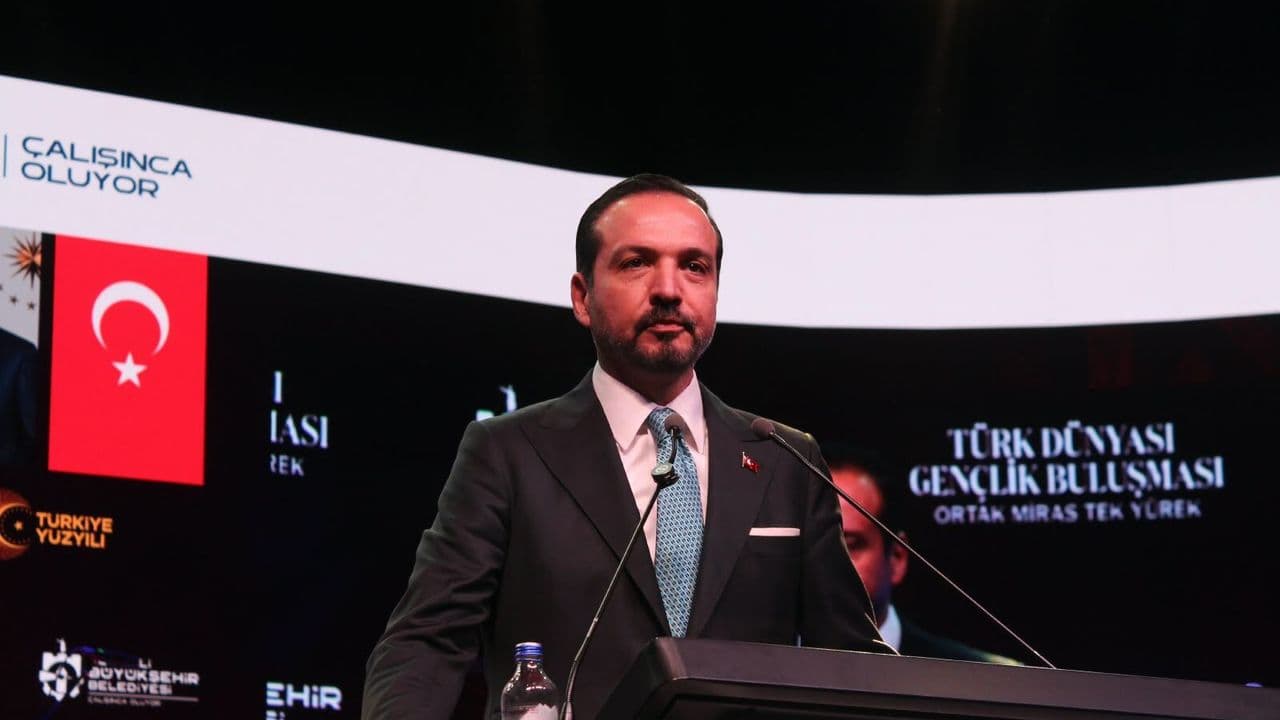
COP31 President and Minister of Environment, Urbanization and Climate Change Murat Kurum attended the second meeting of the Energy Transition Dialogue, organized in partnership with the COP31 Presidency and the International Energy Agency, on the second day of events within London Climate Action Week.
The meeting included International Energy Agency Executive Director Fatih Birol, Minister of Energy and Natural Resources Alparslan Bayraktar, COP29 President and Special Representative of the President of Azerbaijan on Climate Issues Mukhtar Babayev, COP30 President Andre Correa do Lago, COP32 President and Ethiopian Foreign Minister Gedion Timothewos, and ministers from many countries.
In his speech, Minister Kurum emphasized cooperation with the International Energy Agency during the COP31 Presidency process. Minister Kurum said, "It is very important that the data power of the International Energy Agency and the political will of our COP31 Presidency come together on the same line. Because the greatest need of climate diplomacy now is measurable roadmaps rather than ambitious sentences.
These high-level dialogues are of great importance in terms of strengthening the common will on the road to COP31 and shaping the plan on which we will advance together."
"We cannot separate electrification from finance"
Minister Kurum recalled that electrification, one of the COP31 Action Agenda titles, came to the fore at the first meeting held in Paris. Stating that electrification is one of COP31's fundamental approaches, Minister Kurum said, "We can never address electrification by separating it from finance, finance from the right to development, renewable energy from grid investments, cities from industry, or buildings from daily life. COP31's fundamental approach is to unite these pieces under the same light.
Therefore, we consider the '35 percent by 2035' target not just a technical ratio, but a holistic call that addresses energy security, clean production, urban transformation, and fair development together."
"Our expectation is to prepare a report setting out the pathways to the target"
Recalling that they shared the '35 percent by 2035' electrification target with the public two weeks ago in Bonn, Minister Kurum said, "We told the whole world 'we will be open, we will be transparent,' we said 'we will not leave room for surprises,' and we clearly stated what we think and what we want to do.
This target foresees that 35 percent of final energy consumption will be met by electricity by 2035. We considered all parameters when setting this target. The International Energy Agency also provided valuable contributions at this point. Our expectation now is for it to prepare a special report that will set out the pathways to this target.
The work of both the International Energy Agency and the International Renewable Energy Agency says, 'If countries want to achieve the Net Zero Emissions Target, they must realize this.' Within the framework of our strategic partnership with the International Energy Agency, we will clearly present the necessity of this to all countries in the light of science with a special report.
It is very valuable for us that this report serves not just as a general assessment for countries, but as an applicable, measurable, and trackable roadmap."
"Companies foresee transforming their operations around electrification"
Minister Kurum noted the strong support for the '35 percent by 2035' target from countries, international organizations, and the business world, adding: "Recent surveys also clearly show that the business world is moving in this direction.
Ninety percent of the companies surveyed foresee substantially transforming their operations around electrification by 2035. This picture should encourage us as it shows that the real economy is ready for this target and that there is strong ownership behind this transformation.
However, for this ownership to turn into lasting success, we cannot allow electrification to become a race for countries with access to technology. The clean energy transition is also a matter of fair development. If this transition is not supported by financing justice, the climate solution could turn into a new development inequality. Our fundamental sensitivity as the COP31 Presidency is this: This transition must be both ambitious and fair."
"The transition to clean energy cannot weaken the right to access energy"
Minister Kurum underlined the need to focus on two important realities while reaching the electrification target: "First, we must meet the increasing electricity demand by rapidly expanding clean and renewable energy supply.
Second, we must ensure that developing countries can access the necessary financing to implement investments that expand energy access. Because the transition to clean energy cannot weaken the right to access energy.
Unless developing countries' access to technology, grid investments, renewable energy capacity, and appropriate financing is secured, our common goals cannot achieve genuine success on a global scale. For us as the COP31 Presidency, the issue is very clear: Fulfilling past promises is an indispensable condition for reaching our common goals.
We want to make COP31 a summit where promises are not repeated, but where these promises are implemented. That is why we say 'Implementation COP,' that is why we say 'result,' that is why we say 'time for action.'"
"Our target is to halve the increase in waste by 2035"
Minister Kurum also spoke about energy consumption in buildings and waste management, both part of the COP31 Action Agenda, as follows: "We have two more major targets. To reduce energy consumption intensity in buildings by 25 percent by 2035. The second is to halve the increase in waste by reducing it by 50 percent by 2035.
We see cities, buildings, production, consumption, and daily life as parts of the same transformation chain. As Türkiye, under the leadership of our President Recep Tayyip Erdoğan, we have gained significant experience in many areas, from urbanism to disaster management, from renewable energy to Zero Waste, from industrial transformation to resilient infrastructure. And we want to carry this experience we have gained to the collective wisdom of COP31."