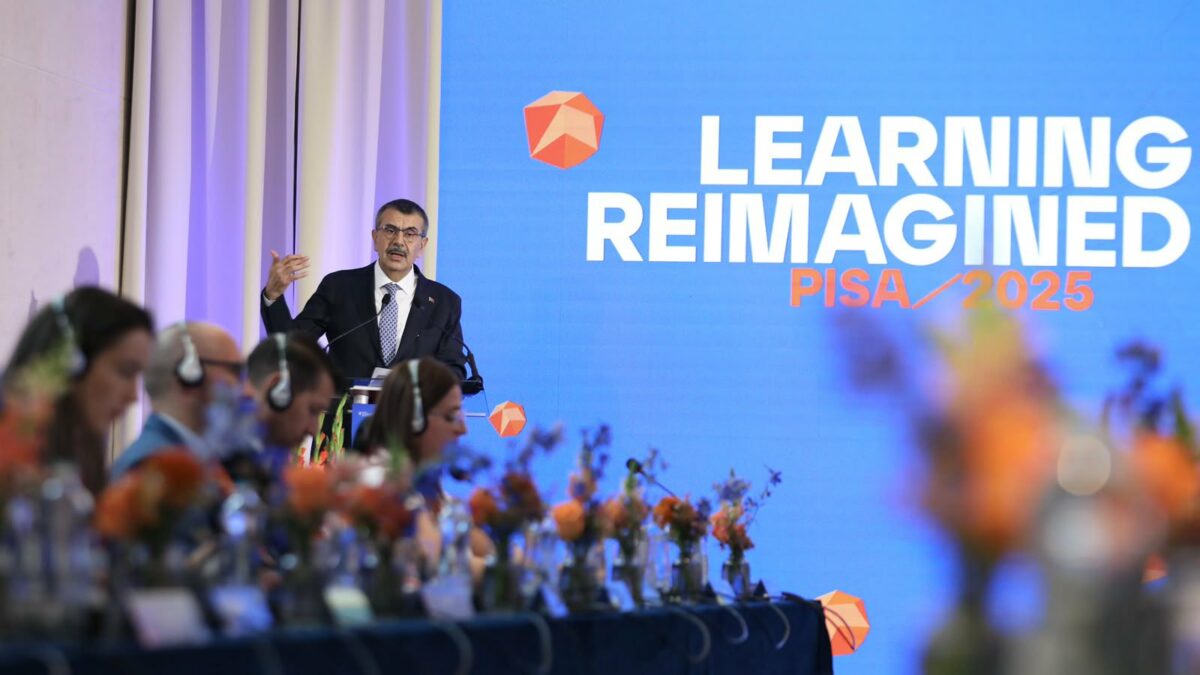
Minister of National Education Tekin answered journalists' questions in Bratislava, the capital of Slovakia, following the PISA 2025 results. Assessing Türkiye's rise in the results, Tekin said they aimed to place among the top five OECD countries and make that position permanent.
Tekin says curriculum and oversight underpin the rise
Tekin said Türkiye's progress in education could not be explained solely by increases in the number of classrooms and teachers. He argued that the influence of private tutoring centres on education policy should be reduced and that the Ministry of National Education's curriculum should be the basis for educational institutions.
Tekin said the programmes of private teaching courses must be approved by the Board of Education and Discipline, making it possible to monitor the curricula. The minister said measures requiring the use of textbooks and preventing the imposition of supplementary materials were also continuing.
Tekin said he had asked Andreas Schleicher, the OECD's Director for Education and Skills, to explain Türkiye's rise after 2015 to other countries. Tekin said the benefits of infrastructure investments in education became possible by reducing the factors that overshadowed those investments.
Curriculum reduced by 35 percent under the Türkiye Century Education Model
Tekin said the curriculum had been reduced by 35 percent under the Türkiye Century Education Model, adding that teachers should not face content so extensive that it cannot fit into lesson hours. The minister said reducing content unsuitable for students' ages allowed teachers to devote more time to activities.
Tekin said the schools and students participating in the PISA study were selected by the OECD and that Türkiye did not intervene in the selection process. He said private schools were also included in the study, adding that schools in earthquake-affected areas and areas considered socioeconomically disadvantaged were also on the list.
Addressing physical improvements in the education environment, Tekin said the number of students per classroom in secondary education had fallen to 12–13. He said Türkiye had 660,000 interactive whiteboards in 660,000 classrooms and that teachers could access content approved by the Board of Education and Discipline through EBA.
Family participation in education to increase
Tekin said one of the issues they had focused on since 2023 was involving families in the education process. The minister said families should cooperate with teachers and take part in activities that complement the education provided at school, adding that a nine-hour programme called 3x3 had been launched for this purpose.
Tekin said the programme included recommendations on academic achievement, supporting the school environment and positive parenting. He added that reduced parental engagement with their children's education was not a problem unique to Türkiye.
Number of schools admitting students through exams to be reduced
Tekin said the pressure exerted by exams on the education system needed to be reduced. He said assessment in Turkish and Turkish Language and Literature classes had begun to be conducted across four skills, and that a similar practice was being implemented in foreign-language exams.
Tekin said the number and capacity of secondary education institutions admitting students through exams should be reduced, adding that a gradual policy was being pursued on the issue.
Link established between economic development and education
Tekin said there was a close relationship between improving the quality of education and economic development. The minister said higher levels of education could increase the human resources producing in fields such as engineering, business administration and the defence industry, adding that this would contribute to national income in the long term.
Security and belonging in schools
Assessing Türkiye's below-OECD-average results on students feeling safe, their sense of belonging at school and loneliness, Tekin pointed to the impact of social media and cyberbullying on the problems students experience. He said measures were also being implemented with the relevant institutions on physical security.
Tekin said he had presented the PISA results to President Recep Tayyip Erdoğan and that Erdoğan had congratulated the education community. The minister also said the teamwork of the education community had contributed to the results.