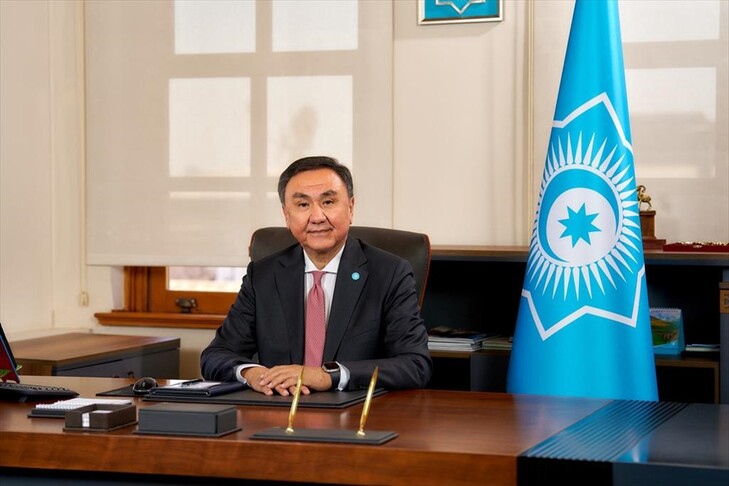
Organization of Turkic States Secretary General Omuraliev called the OTS’s 2026 period a year of implementation, transformation and institutional deepening. Omuraliev said the organization had 64 cooperation mechanisms spanning political dialogue, the economy and trade, security and space technologies.
Omuraliev said October 3 was more than just an anniversary of the organization’s founding for the Turkic world. He described the date as a historic turning point when shared ties of history, language, culture and kinship were transformed into a common determination to shape the future.
Omuraliev said the leaders of the Turkic states first met in 1992, and that the summit process launched by that meeting contributed for nearly 20 years to the development of political dialogue, mutual trust and the will to act together.
The institutionalization process
Omuraliev said the Nakhchivan Agreement, signed in 2009, marked an important stage in turning the political will that had developed over the years into institutional capacity. He recalled that the agreement established the Cooperation Council of Turkic-Speaking States.
Omuraliev said the institutionalization process reached a new stage at the 2021 Istanbul Summit, when the Turkic Council was renamed the Organization of Turkic States and the Turkic World Vision 2040 was adopted.
Omuraliev said the OTS had moved beyond its initial framework of consultation and dialogue to become a more comprehensive, implementation-oriented organization. He said 32 new cooperation mechanisms had been established since 2023. Omuraliev said this figure equaled the total number of mechanisms created by the end of 2022, emphasizing that political coordination and the will to act together had also strengthened significantly.
Cooperation in common areas
Omuraliev said political consultations had become more comprehensive and networks among institutions had grown stronger. He said the Turkic world had begun to project a more visible and stronger common voice internationally, citing developing relations with the United Nations system and other international organizations, the OTS+ format and public diplomacy initiatives such as Turkic Week as parts of this transformation.
Omuraliev said the progress made on the Common Turkic Alphabet carried particular significance for passing the shared linguistic and cultural heritage on to future generations. He also described cultural and social rapprochement as important for the organization.
Assessing activities in 2026, Omuraliev said Azerbaijan’s successful chairmanship had given momentum to the organization’s agenda. He said the period stood out for its intensive political and sectoral agenda, new initiatives and the more effective operation of existing cooperation mechanisms.
Omuraliev said significant progress had been made in the economic sphere and that connectivity remained among the strategic priorities. He said the OTS was moving toward stronger cooperation in the fields of the future, including health. Omuraliev said the organization was moving toward a structure that translates decisions into implementation, agreements into projects and a common vision into concrete results.
Deeper integration as the future goal
Omuraliev said the Turkic World Vision 2040 would remain the main reference point for the OTS’s future goals, adding that deeper integration was one of the key concepts of the next stage.
Omuraliev said this goal involved strengthening economic, transport, energy, digital and people-to-people connectivity while respecting the sovereignty and national priorities of the states. He said they aimed to move from cooperation toward deeper integration, from agreements toward implementation, and from individual projects toward a more interconnected economic, digital and human space.
Omuraliev announced that he was approaching the end of his term as secretary general, which began in 2022, and said it had been a great honor and responsibility for him to serve the Turkic world in this position for four years. Omuraliev emphasized that strengthening ties among the Turkic states, the will to act together and the capacity to deliver results in line with common goals were important for the OTS’s future.