Developed against FPV and kamikaze drones that have become widespread on the battlefield during the Russia-Ukraine war, Drone Shield brings together different capabilities of the Turkish defense industry in a single system. Four companies working in rifle manufacturing, robotics, mechanical engineering, algorithms and electro-optics, along with a university, contributed to the project led by Turaç.
The system will be displayed for the first time at the 21st MÜSİAD EXPO, to be held at the Istanbul Expo Center from September 23 to 26. The project was developed with the aim of creating a low-cost physical destruction solution against low-cost aerial threats.
Two rifles operate on the same turret
Two 12-gauge semi-automatic Derya MAX rifles developed by Derya Arms can operate simultaneously on the pan-tilt turret. The turret also contains Lasersan’s electro-optical sensor package and acoustic detectors.
Lasersan, which developed the robotic turret and imaging systems, is among the project’s main technology partners for system integration. The company’s sensor package enables the target to be detected, identified and continuously tracked by the turret.
The rifles, which feature gas-operated mechanisms and 76-millimeter magnum chambers, can fire in rapid succession using 10- or 15-round magazines. This capacity was designed for use against multiple drones approaching consecutively or in swarms. Work continues on updating the rifles’ barrel length and effective range as part of the project.
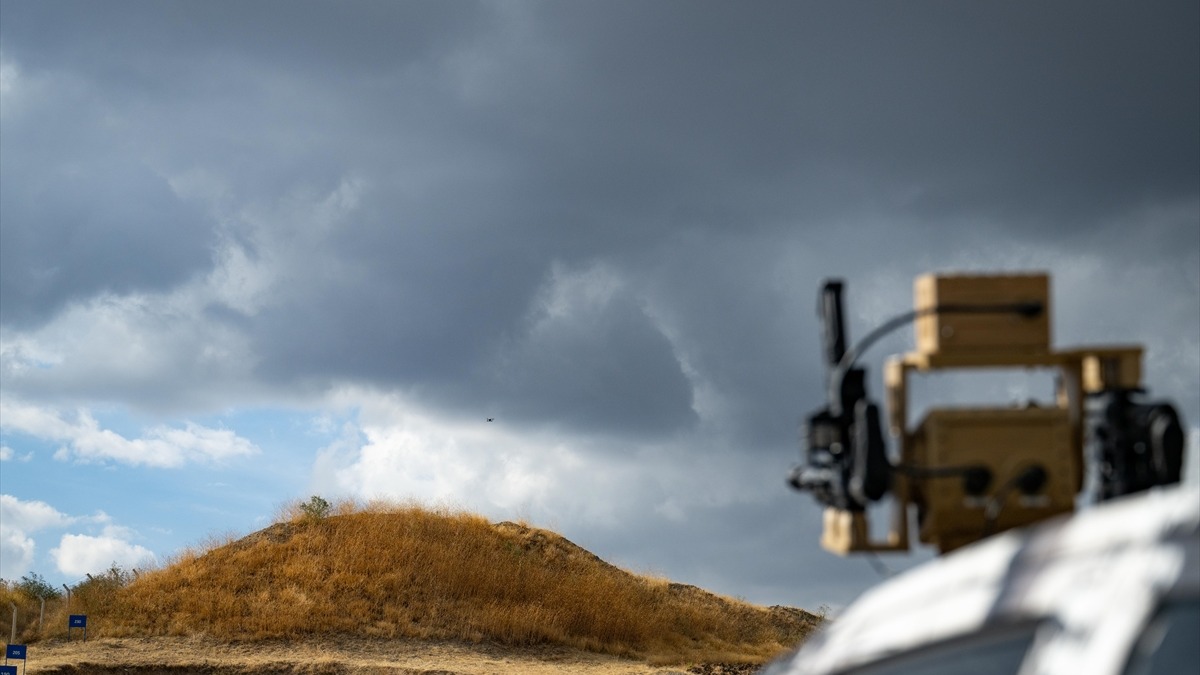
Imaging and acoustic sensors detect targets
Urban Savunma is carrying out the mechanical integration of the turret with vehicles. The company, whose manufacturing history in Ankara dates back to the 1970s, works not only on the production of barrels and weapon systems but also on integrating weapon systems with remotely controlled and unmanned platforms.
The 12-gauge magnum anti-drone cartridges produced by Turaç under its Sterling brand are designed to create a wide metal cloud along the target’s flight path. Artificial intelligence algorithms based on imaging and acoustic sensors handle target detection, classification, tracking and the calculation of the firing solution.
The passive operation of both sensors is intended to ensure that the system leaves no trace during missions. This approach also helps reduce the turret’s weight, power consumption and cost.
The artificial intelligence algorithms used in the system were developed through work conducted with Istanbul Technical University’s Center for Application and Research in Aviation and Space Technologies. The algorithms have been used in drone-versus-drone combat and tested in exercises and trials.
Tracking from 600-800 meters, firing at 150 meters
Drone Shield begins tracking targets scanned by different types of sensors from a distance of 600-800 meters. At 150 meters, the system fires simultaneously, creating a metal cloud approximately 2 meters in diameter, with the aim of physically destroying the target.
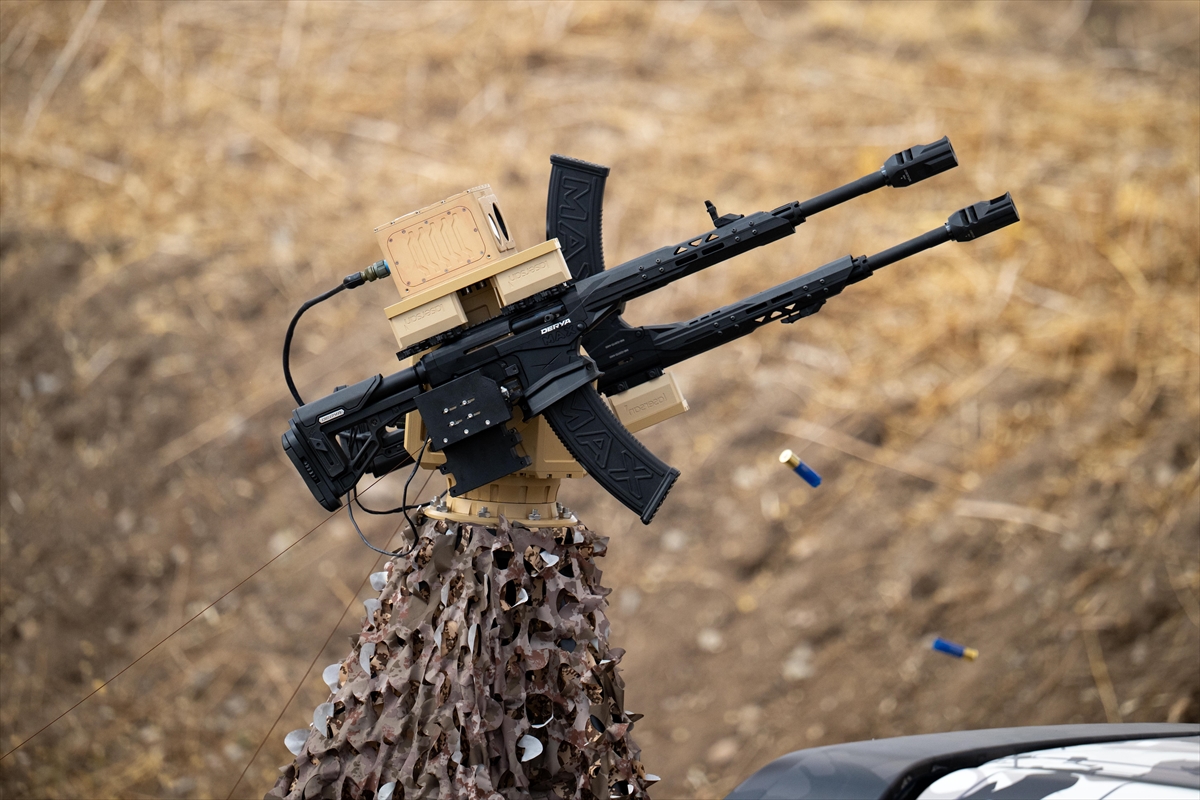
Designed to be lightweight and compact, the system can be integrated into land and naval vehicles, fixed facilities and unmanned ground vehicles. Turaç General Manager Fatih Altunbaş said the solution could be mounted on all military vehicles and used on ships.
Altunbaş said the system can operate with 500 amperes and 220 volts of power, and could also be deployed on 4x4 vehicles for patrol duties around critical facilities. The system was designed to detect and engage threats autonomously.
Physical destruction approach against fiber-optic drones
Altunbaş said the drone threat entered the company’s agenda in 2018 and that the first anti-drone cartridges were developed in response to the needs of security forces. He said physical destruction solutions gained importance after drones controlled by fiber-optic cables proved unaffected by electronic jamming.
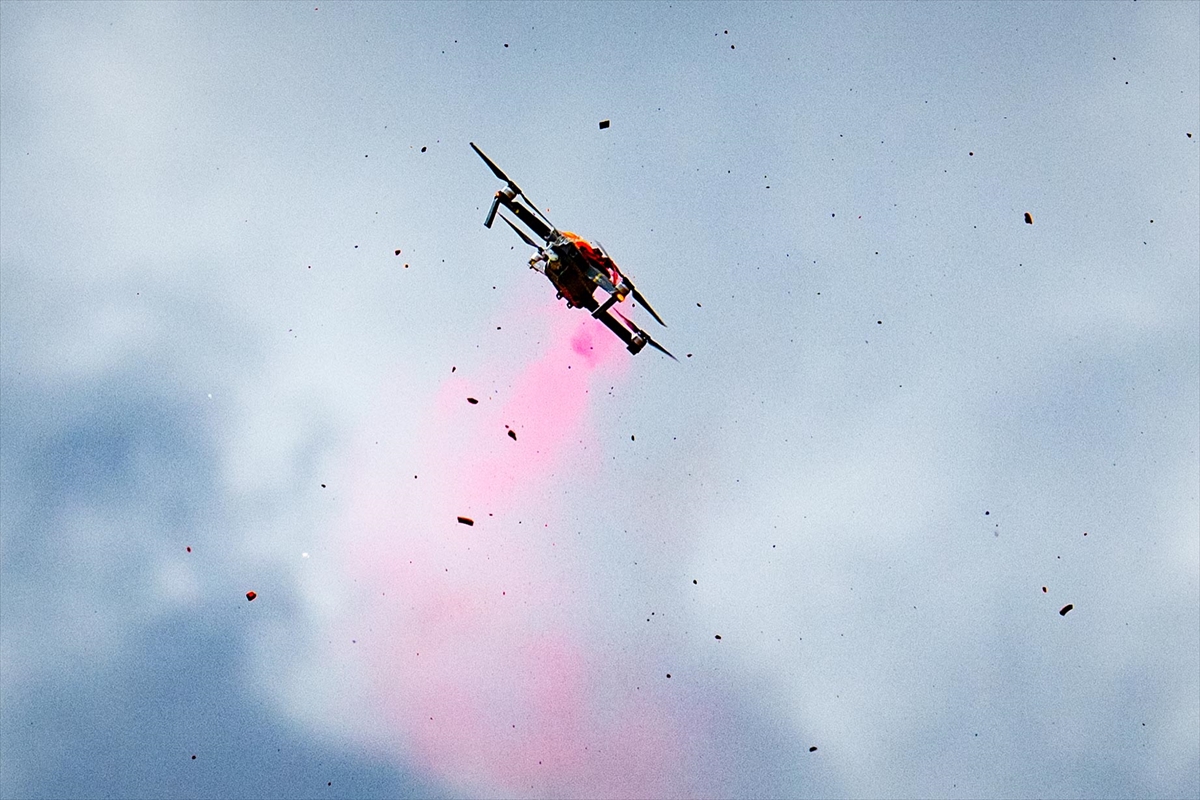
Altunbaş said Turaç had completed its 12-gauge cartridge series and had developed tungsten cartridges not produced in Türkiye, which can create a metal cloud 2 meters in diameter at a range of 140 meters. The company has also developed 40-millimeter anti-drone ammunition that deploys a net.
According to Altunbaş, there is an average of six seconds to intervene against FPV drones reaching speeds of 180 kilometers per hour and drones traveling at 120 kilometers per hour when carrying mortars. For this reason, the system is intended to turn and fire as soon as a threat is detected.
Serial production preparations to be completed before year-end
Altunbaş said the project was developed as a cost-effective solution that could be installed on vehicles priced between $200,000 and $2 million. He said the prototype had been completed and work was continuing to reduce the cost further.
Turaç exports to more than 90 countries, while its status as a supplier to the NATO Support and Procurement Agency provides market access for the new system. Drone Shield was designed with an export target from the outset.
Altunbaş said five partners were involved in the project and that development work was continuing to make the system operate faster. The system is targeted to be ready for deployment and serial production before the end of the year.