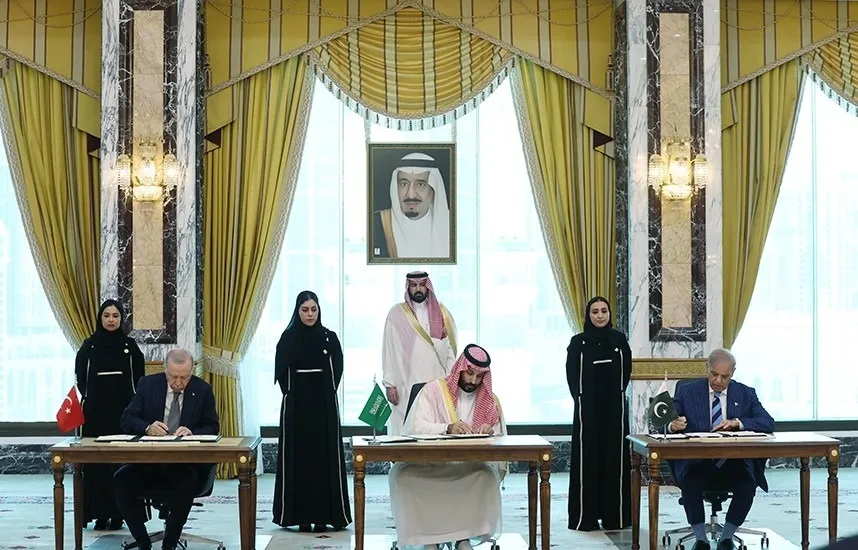
The Joint Defense Agreement signed by Türkiye, Saudi Arabia and Pakistan in Mecca on August 7 establishes a framework that could take relations among the three countries beyond traditional cooperation and political coordination.
The agreement states that an armed attack against any one of the parties will be considered an attack against all three countries and that defense cooperation will be strengthened. Dr. Rashed M. Aba-Namay, president of the National Law Center in Riyadh, said the framework could increase regional deterrence if it is developed institutionally.
The choice of Mecca and the agreement’s limits
The signing of the agreement in Mecca gives the arrangement a symbolic meaning beyond its military dimension. Mecca stands out as the shared spiritual center of the Muslim world.
At the same time, it would not be accurate to describe the agreement as a completed “Islamic NATO” from its first day. The real strength of an alliance depends on the clarity of its obligations, the speed of decision-making, its joint command and control capacity, common training and standards, and its ability to act in a crisis.
The three countries’ complementary capabilities
Saudi Arabia is seen as an important hub because of its religious and political influence, energy resources, investment capacity, ports on the Red Sea and Persian Gulf, and location between Asia, Africa and Europe. Türkiye is positioned as the western flank of the structure because of its armed forces, defense industry and geographic location providing access to the Mediterranean, Black Sea and Europe.
Pakistan’s large human-resource base, military experience, defense industry and nuclear capability are also cited as factors giving the trilateral structure strategic weight. However, Pakistan’s nuclear capability does not automatically create a shared nuclear umbrella under the agreement; the text made public contains no such commitment.
From defense cooperation to an economic corridor
Cooperation among the three countries should not be limited to arms purchases and joint exercises. Joint research and development, defense production, technology transfer, the harmonization of supply chains and the development of skilled human resources are among the proposed areas.
This approach could reduce costs, expand domestic production and help the countries move beyond being consumers of systems purchased from abroad. Security and the economy cannot be considered separately; protecting trade routes can make industry, investment and trade more secure and sustainable.
Under the proposed economic corridor, Türkiye is positioned as a strategic hub linking Asia and Europe as well as the Mediterranean, Black Sea, Caucasus, Central Asia and European markets. Saudi Arabia’s port, logistics and investment capacity, together with Pakistan’s ports providing access to the Arabian Sea and its South Asian connections, could combine with Türkiye’s access to Europe to create a flexible network of maritime, rail, road, energy and digital infrastructure.
Under this framework, cargo departing from Pakistan’s ports of Karachi and Gwadar could be transported to Saudi Arabia’s Gulf or Red Sea ports and then through Jordan and Syria to Türkiye and European markets. Such a structure could create a complementary regional network rather than compete with the China-Pakistan Economic Corridor and the Belt and Road Initiative.
Jordan and Syria’s role in the connection
The Istanbul-Tehran-Islamabad railway line has significant connectivity potential, but infrastructure gaps, operational problems, differing regulations and political uncertainties have made it difficult to turn the line into a regular trade corridor. A multimodal alternative developed under the Mecca Agreement could strengthen the connection between Pakistan and Türkiye without making it dependent on a single country or route.
Jordan and Syria are identified as decisive countries along this land connection. Jordan links northern Saudi Arabia to the Levant, while Syria is described as a natural bridge to Türkiye and the eastern Mediterranean.
Establishing stability in Syria, strengthening sovereign institutions and implementing reconstruction could create regional economic opportunities. More firmly integrating Jordan into transportation, energy and investment networks is also considered one element of regional stability.
Modernizing historic routes
The idea of the historic Hejaz Railway is proposed for reconsideration through a contemporary network approach. This would involve rebuilding the connection from Istanbul to the Hejaz via Damascus and Amman with high-standard railways, highways, logistics centers, energy transmission lines and data cables.
The historic route of TAPLINE could also be considered a strategic corridor for new oil, natural gas or hydrogen pipelines, electricity transmission lines, fiber-optic cables, railways and highways. Reopening the former oil pipeline would require comprehensive assessments covering engineering, environmental, financing and security issues.
The need for institutionalization
To make the agreement permanent, proposals include a high-level defense council that meets regularly, a joint risk-assessment and early-warning center, and joint exercises in air, missile, naval and cyber defense. Joint programs for defense technology and production, along with an investment fund to support transportation and infrastructure projects, are also included in the framework.
In addition to agreements facilitating trade, customs procedures, visas, capital flows and the movement of skilled labor, a timetable is needed to connect ports, railways, energy lines and data networks. Partnerships that combine defense with economic benefit, industry, technology and mutual interests among peoples may have a better chance of lasting.
Türkiye’s NATO membership and economic ties between the West and the East, Saudi Arabia’s relations with the United States, Europe, China and India, and Pakistan’s multifaceted connections with China, the Gulf countries, the United States and South Asia are also noted. For this reason, the Mecca Agreement could offer its parties a basis for establishing more balanced relations with different actors rather than creating a closed bloc that forces them to choose sides.