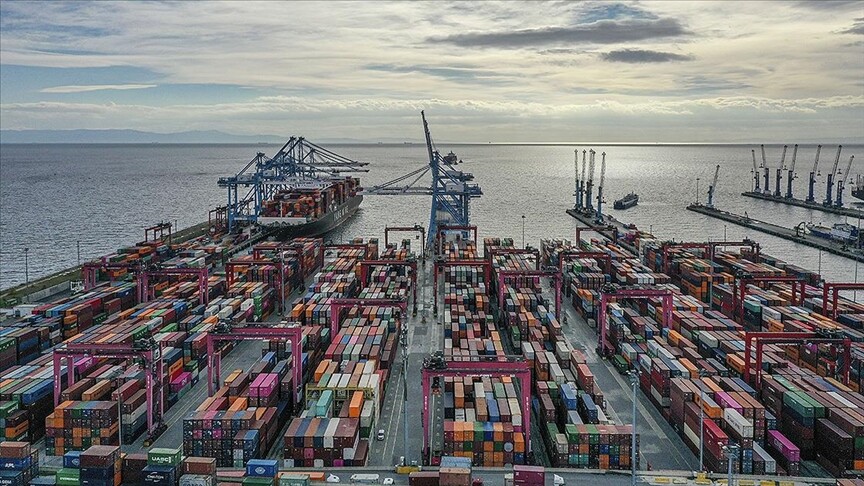
Vice President Cevdet Yılmaz assessed Türkiye’s export performance at the opening of MÜSİAD EXPO 2026 in Istanbul. Yılmaz said goods and services exports had approached $400 billion in 2025, setting a record.
Yılmaz said goods exports stood at $36 billion in 2002 and had risen 7.6-fold to $273.2 billion last year. He said goods exports had reached $280 billion on an annual basis as of August 2026.
Record in goods and services exports
Yılmaz said Türkiye’s goods and services exports stood at around $50 billion in 2002 and had increased eightfold to nearly $400 billion in 2025.
Yılmaz said Türkiye’s exports had maintained their resilience despite a marked deterioration in regional and global conditions. He said the global economy and trade were experiencing volatility amid geopolitical tensions, rising protectionism, and the impact of the green and digital transitions.
Yılmaz argued that the war between Israel, the United States and Iran had negatively affected expectations for goods and services trade in 2026. He said logistics costs had risen and inflationary pressure had increased through commodity prices, particularly energy prices.
National income and per capita income figures
Yılmaz said national income had risen from $239 billion in 2002 to $1.6 trillion in 2025. He said national income was expected to exceed $1.8 trillion by the end of this year.
Yılmaz said per capita income was $3,600 in 2002 and had exceeded $18,000 in 2025. He said this figure was projected to reach approximately $20,000 by the end of the year.
Export markets targeted for diversification
Yılmaz said global growth and trade rates had declined, particularly in Europe and the Middle East and North Africa. He said these two regions accounted for markets receiving approximately 70 percent of Türkiye’s exports.
Yılmaz said strategies to develop trade with distant countries, Islamic countries and African countries were continuing in order to increase exports. He said they aimed to diversify goods and services exports.
Yılmaz said Türkiye aimed to increase its influence over trade flows along the east-west and north-south axes. In this context, he pointed to new railway connections such as the Development Road, the Middle Corridor and the Zangezur Corridor.
Yılmaz also highlighted the importance of the Hejaz Railway. He said Türkiye was approaching this route from a new perspective in light of current global conditions and believed the line could make a significant contribution to regional stability.
Assessment of the budget and current account deficit
Yılmaz said political stability was strong in Türkiye and that the country had a determined administration. He said macroeconomic fundamentals were also solid and that the budget deficit stood at around 3 percent, with minor year-to-year variations.
Yılmaz said the current account deficit had recently remained below 2 percent. He said it could rise slightly above 2 percent this year due to the impact of energy prices but would remain at manageable levels.



















