- BIST10012,151-0.94%
- USD49.34+0.24%
- EUR55.21-0.01%
- GOLD4,200.50+0.24%
- INTEREST37.00%-1.00
- BITCOIN82,749+1.22%
- October 13, 202617°
- BIST10012,151-0.94%
- USD49.34+0.24%
- EUR55.21-0.01%
- GOLD4,200.50+0.24%
- INTEREST37.00%-1.00
- BITCOIN82,749+1.22%
- October 13, 202617°
Young people from around the world meet at Bosphorus Diplomacy Forum 2026
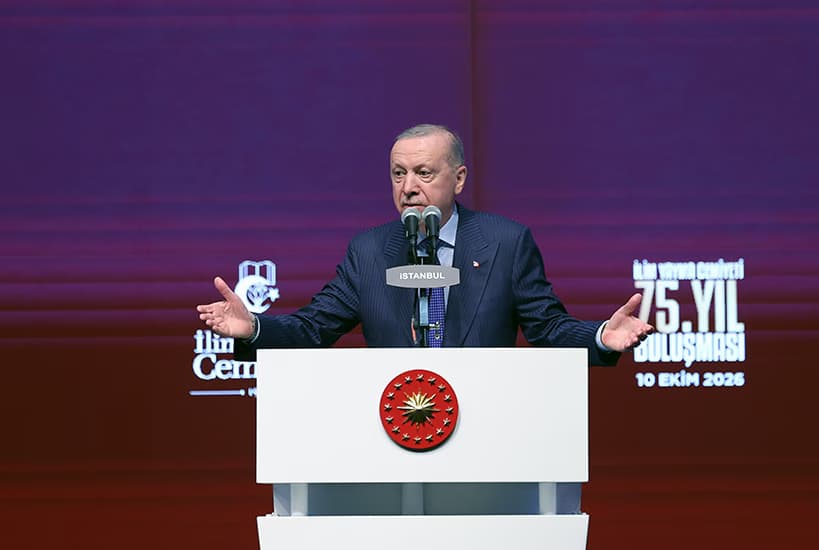
Bosphorus Diplomacy Forum 2026 began on Democracy and Freedom Island under the theme “Humanitarian Diplomacy in an Age of Crises.” Speaking at the opening, Necmeddin Bilal Erdoğan, chairman of the board of trustees of the İlim Yayma Foundation, said that approximately 350,000 international students are studying in Türkiye.


The 2026 Bosphorus Diplomacy Forum, organized by the Young Diplomacy Association under the theme “Humanitarian Diplomacy in an Age of Crises,” brought together young people from different countries around the world on Democracy and Freedom Island.
Forum opens with education diplomacy panel
The forum opened with the panel “Bringing Different Geographies Together: Education Diplomacy,” attended by Necmeddin Bilal Erdoğan, chairman of the board of trustees of the İlim Yayma Foundation. During the panel, Erdoğan answered questions from Young Diplomacy Association Chairman Selman Bilir, BDF’26 Operations Chairman Yiğit Emir Cantemür and BDF’26 Academy Chairman Shamam Musa.
Erdoğan said education diplomacy was closely linked to academic exchange, which gains momentum each year, and that science diplomacy stood at a more advanced stage of this process. He said science diplomacy encompassed research, inter-institutional relations and communication networks, as well as joint technology projects, adding that bringing young people from different countries together was one of the key elements of education diplomacy.

“Türkiye has approximately 350,000 international students”
Erdoğan said Türkiye held an important position in attracting international students and that approximately 350,000 international students were studying in the country. He said feedback from international students indicated a high level of satisfaction with Türkiye.
Erdoğan said 100,000 to 150,000 new international students came to Türkiye each year, describing them as voluntary ambassadors who contributed to promoting the country accurately. He said international students should not be assessed solely for their economic contributions, adding that a student who stayed in Türkiye for 10 months brought the country at least 10 times the foreign currency left by an average tourist.
Erdoğan said students educated in Türkiye became closely acquainted with the country’s universities, social life and relations between communities, and that this experience helped them promote Türkiye when they returned to their home countries. He said the fact that Türkiye-educated students went on to hold important positions in different countries demonstrated the impact of education diplomacy, noting that the speaker of Somalia’s parliament was a Türkiye graduate and that a Türkiye graduate who ran in municipal mayoral elections in Cameroon had also visited him.

Emphasis on networks for international students and young people
Erdoğan said Türkiye had strong ties not only with Western countries but also with the Balkans, the Middle East, North Africa and the Turkic world. He said students from these regions aimed to study in Türkiye and work in the country afterward. Erdoğan said Türkiye’s brain drain should also be taken into consideration, emphasizing that international students represented an important opportunity.
Erdoğan said international students enabled young people from different countries to meet at universities. Drawing on his own educational experience, he said having friends from different parts of the world was an important gain. He said steps should be taken at universities to help international and domestic students integrate, adding that these networks were also valuable for young people’s future careers.
Universities, dormitories and cultural heritage
Erdoğan said Türkiye’s strength in education diplomacy was not limited to universities. He said universities contributed to the development of academic capacity in Anatolia, adding that having a university in every city supported the participation of academic circles in local decision-making processes and helped introduce different regions of Türkiye to the world.
Erdoğan also addressed the standing of Türkiye’s universities in international rankings, noting that the number of universities in Türkiye ranked among the top 500 and top 1,000 in rankings such as QS and Times had increased. Regarding accommodation for higher education students, he said Türkiye had a dormitory system with a capacity of more than 1 million.
Erdoğan said a strong university and dormitory infrastructure was not sufficient on its own, adding that Türkiye’s historical and cultural heritage was also an important source of its appeal in education diplomacy. He said this heritage enabled Türkiye to offer the world an understanding of how different nations can live together in peace.
“A signal of Türkiye’s future diplomatic strength”
Speaking after the panel, Erdoğan said the Young Diplomacy Association had brought high school and university students interested in diplomacy together for the second time on Democracy and Freedom Island as part of BDF’26. He emphasized the importance of young people from different countries around the world and different regions of Türkiye coming together around shared values and issues.
Erdoğan said young people’s interest in international issues was important for Türkiye’s future diplomatic capacity. He said the gathering in Türkiye of strong high school and university students to discuss global issues was a sign of the country’s future diplomatic strength. Erdoğan added that greater participation by young people in international work and diplomacy would strengthen Türkiye’s representation in international organizations, institutions and bodies.
More than 400 participants attend the forum
The opening of the forum, organized in cooperation with the Presidency for Turks Abroad and Related Communities, the Turkish Cooperation and Coordination Agency, the Zero Waste Foundation and the Türkiye Maarif Foundation, was also attended by Istanbul Governor Davut Gül, Zero Waste Foundation Chairman Samed Ağırbaş and Türk Telekom General Manager Ebubekir Şahin.
BDF’26 is being conducted in four languages: Turkish, Arabic, English and French. Negotiations in six committees address key items on the global agenda, particularly foreign policy, the economy, energy and human rights, from the perspective of young people.
This year’s forum was designed around the concept of humanitarian diplomacy that Türkiye has highlighted in recent years through its aid and mediation activities. The participating young people reflect the official positions of the states they represent with an awareness of institutional responsibility, while developing proposed solutions within the framework of international law, balances of power and humanitarian responsibility.
Unlike conventional diplomacy simulations, the forum is based on the ministry-centered institutional functioning of states and is being held as a comprehensive diplomacy simulation. Twenty-five international students from various countries, particularly in the Americas, Europe and the Balkans, and 100 high school students selected from different provinces of Türkiye are representing their countries in six committees.
More than 400 participants, including 50 international participants, are taking part in the forum.
Stay Updated with The Turkiye Times
Subscribe to be informed about special news, developments and announcements. We will keep you informed.
By signing up, you agree to our Privacy Policy