- BIST10011,722-2.89%
- USD49.42+0.06%
- EUR55.41+0.20%
- GOLD4,186.70+0.40%
- INTEREST37.00%-1.00
- BITCOIN81,464-0.05%
- October 17, 202611°
- BIST10011,722-2.89%
- USD49.42+0.06%
- EUR55.41+0.20%
- GOLD4,186.70+0.40%
- INTEREST37.00%-1.00
- BITCOIN81,464-0.05%
- October 17, 202611°


Industry and Technology Minister Mehmet Fatih Kacır to CNN Türk: Moon lander to launch in 2027, making Türkiye the first Muslim country to reach the Moon
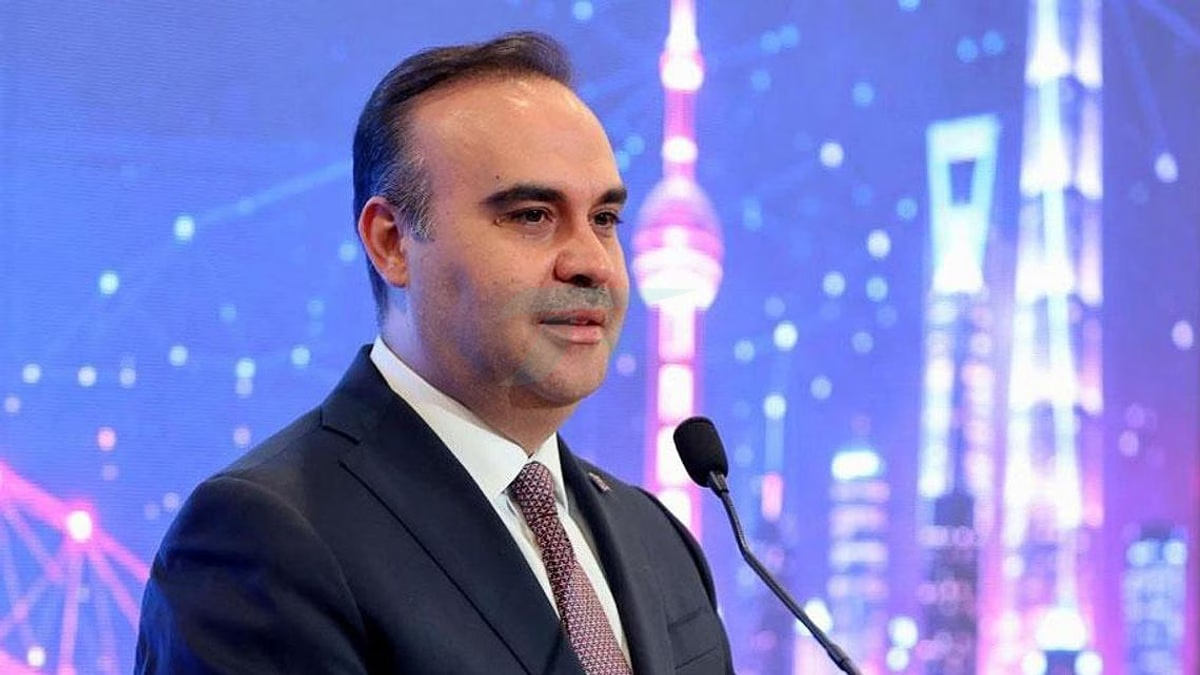
Speaking on CNN Türk on September 28, Türkiye's Minister of Industry and Technology Mehmet Fatih Kacır described the country's space journey, saying the 87 percent domestically built lunar spacecraft will launch in the first months of 2027. He also discussed the İMECE and Türksat 6A satellites, the spaceport in Somalia, the International Astronautical Congress in Antalya and artificial intelligence goals.
Türkiye's space journey
How did Türkiye's space adventure begin, and how did it get to where it is today?
In recent years Türkiye has truly made tremendous progress in advanced technology fields such as the defence industry, aviation and space technologies. Behind this progress lies the strong infrastructure built since the early 2000s under the leadership of our President. In fact, space work is something Türkiye began dreaming about around 40 years ago.
In the mid-1980s, our late President Turgut Özal, foreseeing that Türkiye would one day have satellites, was concluding international agreements to secure their orbital rights and at the same time ordering preparations for those satellites to be developed by Turkish engineers in the future. The first research infrastructure in this field was set up in the mid-1980s on the campus of Middle East Technical University.
Unfortunately, Türkiye wasted that period, especially the 1990s, on political and economic instability. That was the time of the computer revolution and the internet revolution in the world. But from the 2000s, thanks to our President's will to make this field a priority, Türkiye began a new journey in space technologies as in many other areas, and with the BİLSAT, RASAT, GÖKTÜRK and İMECE satellites it developed its own means and capabilities in imaging satellites.
Where does Türkiye stand in satellite production today?
During the imaging satellite process, Türkiye built its infrastructure — infrastructure able to develop and produce a satellite and complete all ground tests with its own means. And in each project, the share of domestic components rose above the previous one.
When we talk about our İMECE satellite, we are talking about a satellite of about 600 kilograms operating at 600 kilometres and capturing images at sub-metre resolution. Its most critical component is its electro-optical camera. We developed and produced that domestically too, and after İMECE we also exported it to another friendly country.
At the same time we made a breakthrough in communications satellites. With Türksat 6A, Türkiye became one of 11 countries that produce their own communications satellites. This time we are talking about a 4,250-kilogram product, a communications satellite operating in geostationary orbit at 36,000 kilometres — the highest-value technological product Türkiye has ever produced. Türksat 6A was likewise developed and produced with a very high domestic share, above 80 percent.
The Moon mission: “In the first months of 2027”
The most anticipated goal of the National Space Program is the Moon mission. What is the latest?
TÜBİTAK Space and its partners have completed very dedicated work to send to the Moon a lunar spacecraft that Türkiye developed and produced with its own means and capabilities. Production of the spacecraft is complete. Last week it was sent to the Satellite Systems Integration and Test Centre at TUSAŞ (Turkish Aerospace) to complete all its tests. We are now in the final stage.
We are aiming for a launch in the first months of 2027. Of course, the launch window starts out fairly long and narrows as the date approaches.
How domestic is the spacecraft, and where will this mission take Türkiye?
This lunar spacecraft was produced with a domestic share of 87 percent. All of its software is domestic — 100 percent of the software is domestic. Many critical hardware components were developed domestically: thermal components, control components, control systems, structures.
When we succeed, Türkiye will become one of nine countries able to send a spacecraft to the Moon. This is an important goal for us. We will be the first Muslim country to send a spacecraft of our own making to the Moon.
Türkiye is making a big claim. It is not just about joining the nine countries — though that is a source of pride. Being among a number of countries in the world that you can count on your fingers is of course a source of pride for Türkiye. It is a demonstration of capability in high technology.
What will the spacecraft do at the Moon?
After launch from Earth, our spacecraft will enter lunar transfer orbit and then orbit the Moon. We expect the mission to last between three months and a year and a half. During that time it will study the effect of solar wind on the Moon and the water deposits on the Moon.
We will use our own hybrid engines for this burn; this technology will be used in deep space for the first time. We will also control our spacecraft domestically. Türkiye reaching the Moon and achieving its deep-space goal is a big step.
Why are countries turning to the Moon again?
In 1959 the Soviets succeeded in sending the first spacecraft to the Moon; at the time there was a space race between the US and the Soviets, run on huge budgets. In recent years humanity has again begun to take an interest in the Moon and space. Rockets can now be recovered and flown again, thousands of satellites are being launched, and there is a launch almost every day.
In 2009 water ice was discovered on the lunar surface. If rocket fuel can be produced from it, the Moon could be used as a station. A lunar economy is therefore emerging, and many countries are turning to the Moon. We set these goals when the Turkish Space Agency was founded, and we are achieving them one by one.
We want a bigger share of the growing global space market. Last year 600 billion dollars was spent in this field, and the figure is expected to reach 1 trillion dollars.
The spaceport in Somalia and the congress in Antalya
Why does the spaceport project in Somalia matter?
Our spaceport in Somalia is important to us. We set it up in Somalia because Türkiye's geography is not suitable for these launches. In a world where there is a launch every day, besides using it ourselves we will be able to offer its services to other countries. Thanks to Somalia's location, launches can be carried out at lower cost, and in the coming decades it will become one of the leading spaceports.
Türkiye is hosting the 77th International Astronautical Congress. What do you expect?
The 77th International Astronautical Congress will be held in Antalya from October 5 to 9. Close to 10,000 space professionals will come together, and we expect participation from 100 countries. Visitors from all over the world will see our steps up close, and our new-generation space start-ups will step onto the world stage. A ministerial-level meeting will also be held the day before the congress.
Artificial intelligence and young people
What are the goals in artificial intelligence?
Training human resources is important. Within two years we will provide artificial intelligence training to 5 million citizens and expand publicly supported AI programmes.
Competitions are being held in high schools, middle schools and even primary schools; we see young people competing with AI projects, and we support and reward them. Our young people take part in competitions not only in Türkiye but around the world and achieve great success. Türkiye has broken out of its shell. The success in unmanned aerial vehicles was in fact a turning point and inspired our young people. The way to raise our per capita income to around 50,000 dollars runs through science and technology.
Featured Listings
Sponsored
Similar Interviews


Energy Minister Bayraktar to Anadolu: The Development Road could become an $80 billion-a-year energy corridor
Anadolu Ajansı
- 10/6/2026


Defence Minister Yaşar Güler to Global Business Press: 2035 goals, KAAN and Türkiye–Azerbaijan defence cooperation
Global Business Press
- 10/4/2026


Justice Minister Akın Gürlek to Sabah: assets seized in the investment fund probe will go to victims
Abdurrahman Şimşek (Sabah)
- 10/4/2026
Featured News


Job Listings
Stay Updated with The Turkiye Times
Subscribe to be informed about special news, developments and announcements. We will keep you informed.
By signing up, you agree to our Privacy Policy











