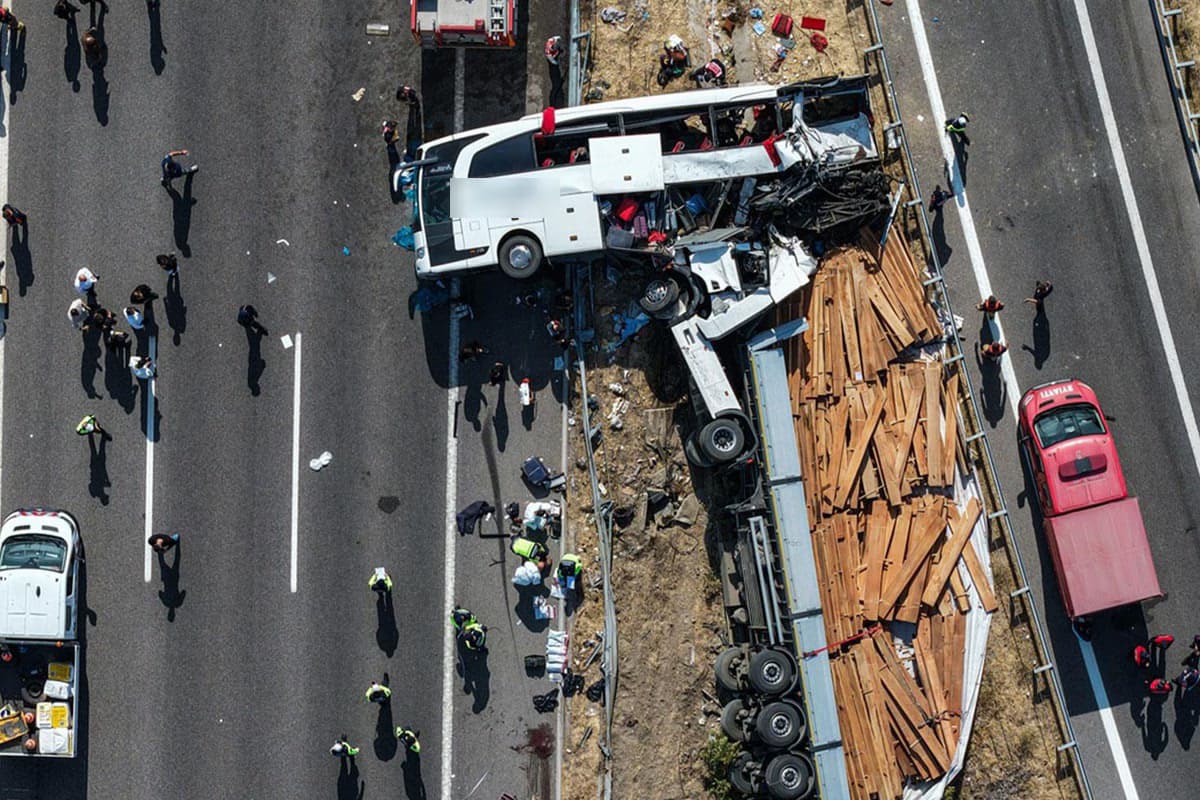
The migration crisis in the Spanish-administered city of Ceuta (Sebta) has shaken the Schengen free movement area, one of Europe's most important achievements. After approximately 50,000 irregular migrants entered the city, Italy announced it was suspending the Schengen agreement with Spain and introduced temporary border controls for those arriving by air and sea.
The crisis was not limited to Italy. France tightened checks on its border with Spain, while Portugal increased its security presence on its southern border. These developments have reopened the debate on the balance between the European Union's border security and the seamless mobility that is the continent's most important tourism advantage.
Schengen: The Cornerstone of European Tourism
The Schengen Agreement is not only a legal framework that removes internal border controls, but it has also become one of the most powerful tourism products with which Europe markets itself to the world. Instead of promoting individual countries, the continent presents itself as a single destination where tourists can travel between dozens of cities and countries without visa or passport checks.
According to Eurostat data, the number of air passengers across the European Union rose by 4.9 percent in 2025 compared to the previous year, reaching 1.093 billion. In the last quarter of 2025 alone, EU airports served 255 million passengers. Spain topped the list with 272.1 million passengers, followed by Germany with 207.2 million and Italy with 193.3 million. These three countries, now at the center of the crisis, also constitute Europe's largest travel markets.
Critical Warnings from Experts
Tourism and hospitality expert Abdüsselam Ali al-Kiyali noted that the debate over suspending Schengen coincides with the peak summer holiday season. According to al-Kiyali, the psychological impact on travelers is greater than the practical effect. Most visitors from Gulf countries and distant markets do not plan to visit a single European country, but rather design itineraries covering France, Italy, Spain, Switzerland, and Austria, relying on the ease of movement within the Schengen area.
Tourism expert Eymen al-Kudve stressed that multi-destination travel and the ease of transit between the 29 Schengen member states are among Europe's most important attractions. Al-Kudve stated that land-based tourism would be most affected by any prolonged border restrictions, as this sector is directly dependent on border crossings by bus and private vehicle.
Economist Kamil al-Sari offered a different perspective, stating that inspection procedures are not the sole determining factor in a tourist's decision, and that for many, a sense of security may be more important than speed of passage. Al-Sari said European countries are aware that tourism accounts for around 12 percent of gross domestic product in some economies, and therefore they are careful to ensure that security measures do not become a permanent barrier to travel.
$45.4 Billion Risk
A study by the World Travel and Tourism Council (WTTC) revealed that long waiting times at Schengen borders directly affect travel decisions. According to the research, if waiting times regularly reach 3 to 4 hours, up to 41 million tourist visits and $45.4 billion in tourism spending could be at risk.
In a survey of more than 2,500 travelers from the UK, US, Canada, and Australia, approximately 33 percent of respondents said their willingness to visit Europe would decrease if long queues became a permanent part of the Schengen entry experience. On the other hand, 65 percent of respondents supported the new European entry-exit system after learning about it, and 87 percent said they were prepared to tolerate some congestion if it would facilitate future travel.
Temporary or Permanent?
The reintroduction of internal border controls within the EU is not a new phenomenon. Many countries resorted to this mechanism during the 2015 migration crisis, after terrorist attacks, and during the COVID-19 pandemic. However, the repeated use of this measure raises the risk that the exception could become the rule.
Al-Kudve predicted that as long as the current measures are temporary and clearly defined, the economic impact will remain limited, but if the practice continues or spreads to additional countries, tour operators may have to redesign their itineraries or redirect some demand to alternative destinations. Al-Kiyali stressed that scenarios of Spain leaving Schengen or the agreement collapsing are unrealistic, because Schengen is not just a travel arrangement but part of the integrated European system.
Al-Sari argued that the sustainable solution lies in technological development. He stated that the widespread adoption of biometric passports, smart gates, and artificial intelligence technologies would allow security checks to be tightened while maintaining passenger mobility without slowing it down.