- BIST10011,425-0.47%
- USD50.05+0.05%
- EUR56.25-0.01%
- GOLD4,079.10-0.84%
- INTEREST36.00%-1.00
- BITCOIN76,091+0.14%
- November 6, 202611°
- BIST10011,425-0.47%
- USD50.05+0.05%
- EUR56.25-0.01%
- GOLD4,079.10-0.84%
- INTEREST36.00%-1.00
- BITCOIN76,091+0.14%
- November 6, 202611°
Democrats reach 253 seats in U.S. House as 43 seats change hands
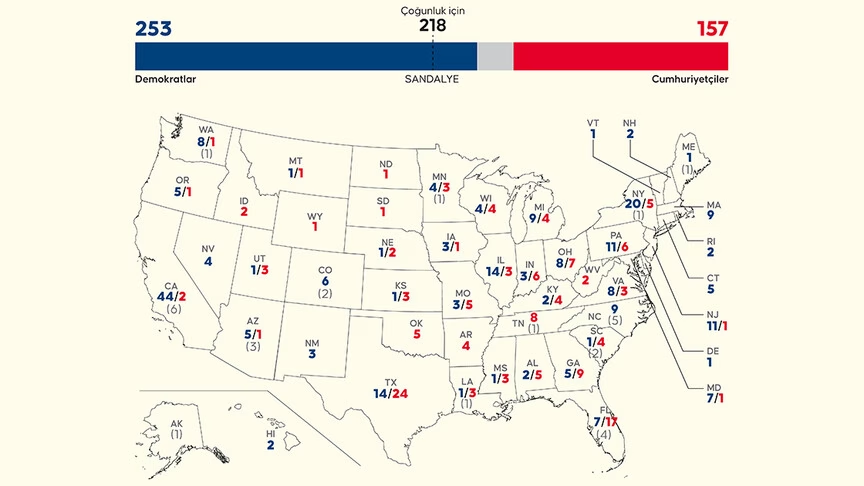
As vote counting continues after the Nov. 3 midterm elections in the United States, unofficial results show Democrats winning 253 seats and Republicans 157 in the House of Representatives. Forty-three seats held by Republicans shifted to Democrats, while the winners of 25 races have not yet been determined.


The picture in the U.S. House of Representatives began to take shape after the midterm elections held on Nov. 3. As results came in from states where vote counting is continuing, the number of seats won by Democrats reached 253, while Republicans remained at 157. Unofficial results show that the winners of 25 of the 435 seats in the House have not yet been determined.
A majority in the House requires 218 seats. Democrats have surpassed that threshold by 35 seats. Forty-three seats held by Republicans before the election shifted to Democrats. U.S. broadcaster CBS News said that, in contrast, two congressional districts shifted from Democrats to Republicans. The broadcaster projected that Democrats could finish with approximately 256 seats in the House. The party currently holds 214 seats in Congress.
State-by-state picture
The most striking result emerged in California. In the state, which has 52 seats, Democrats won 44 and Republicans won two, while the results for six seats are still pending. Democrats led Republicans 20 to 5 in New York, 11 to 1 in New Jersey and 14 to 3 in Illinois. In Pennsylvania, Democrats won 11 seats and Republicans six, while the result was 8 to 7 in Ohio and 9 to 4 in Michigan.
Republicans led in Texas by 24 to 14, in Florida by 17 to 7 and in Georgia by 9 to 5. However, CBS News said Democrats also won in areas in southern Texas that have been considered to have shifted toward Republicans in recent years. A significant portion of the races whose results have not yet been determined are in California, Florida and Arizona.
Republican campaign chief also loses seat
One of the election's notable results came from North Carolina's 9th Congressional District. Richard Hudson, chair of the National Republican Congressional Committee, which led the Republicans' House election campaign, lost to Democratic candidate Richard Ojeda. In New York's Hudson Valley, two-term Republican Representative Mike Lawler also lost his seat to Democrat Cait Conley.
New Congress to take office in January
The elected members will take the oath of office and begin serving on Jan. 3, 2027. Unofficial results show that Democrats also took the majority from Republicans in the Senate, where 35 seats were contested. As a result, U.S. President Donald Trump will have to work during the final two years of his term with a Congress whose two chambers are controlled by the opposition.
Trump told Politico on election night that they would work with Democrats, while before the polls closed he told CBS News, "I have the greatest power, and it's called veto." According to CBS News, a red hat bearing the word "VETO" was on the president's desk in the Oval Office at the White House on Thursday.
Cover: Wikimedia Commons (archive). Infographic: Anadolu Agency
Stay Updated with The Turkiye Times
Subscribe to be informed about special news, developments and announcements. We will keep you informed.
By signing up, you agree to our Privacy Policy