Turkish Foreign Minister Hakan Fidan said other countries in the region want to join the Mecca Defense Agreement signed on Friday by Türkiye, Pakistan and Saudi Arabia. Fidan said the agreement does not target any country.
Fidan made the remarks during a meeting with editors in Ankara on Saturday. He said the Mecca Defense Agreement is technically similar to Article 5 of NATO, which governs collective defense.
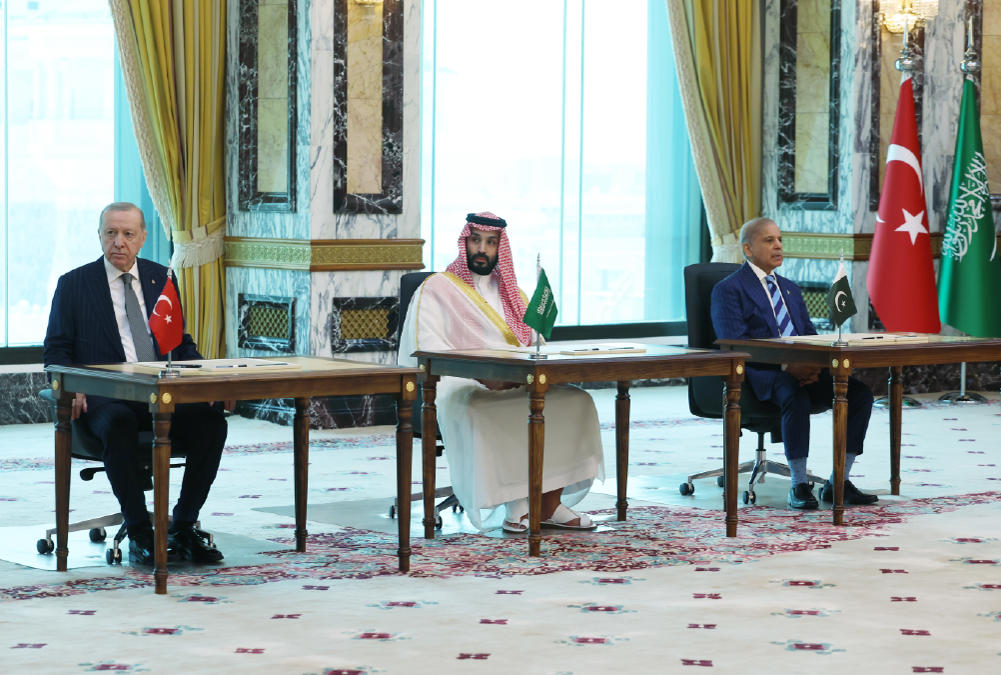
The agreement aims to strengthen regional security
Fidan said the countries of the region should establish more institutional structures for one another’s security, economic stability, development and prosperity. He said dominant powers from outside the region often aggravate problems rather than resolve them, creating high costs.
Fidan said Türkiye has good relations with the countries of the region, but noted that these ties had long depended on prevailing conditions and political assessments. He said the relationships should become more structural, professional and self-sustaining.
Fidan said the problems of war, occupation, displacement and instability in the region had continued for years. He said economic and social integration could not advance without security and added that greater integration was needed to reduce regional instability and improve the prosperity of the people.
Preparation took two years and eight months
Fidan said work continued for two years and eight months to transform the Mecca Defense Agreement from an idea into a conceptual framework and then into the text of an agreement. He said consultations were held with partners and other countries in the region during the process.
Fidan emphasized that the signing of the agreement was not the end of the process and announced that a secretariat is planned to oversee the implementation of the defense agreement between the three countries. Political and military committees are expected to turn the vision set out by the leaders into decisions and carry out the necessary work.
Fidan said the assistance mechanism would be activated at the request of the country under attack and that the country concerned would determine the nature of the assistance. He said intelligence, logistical support, ammunition or, at a later stage, military units could be requested, adding that the support would be structured in stages according to the scale of the threat.
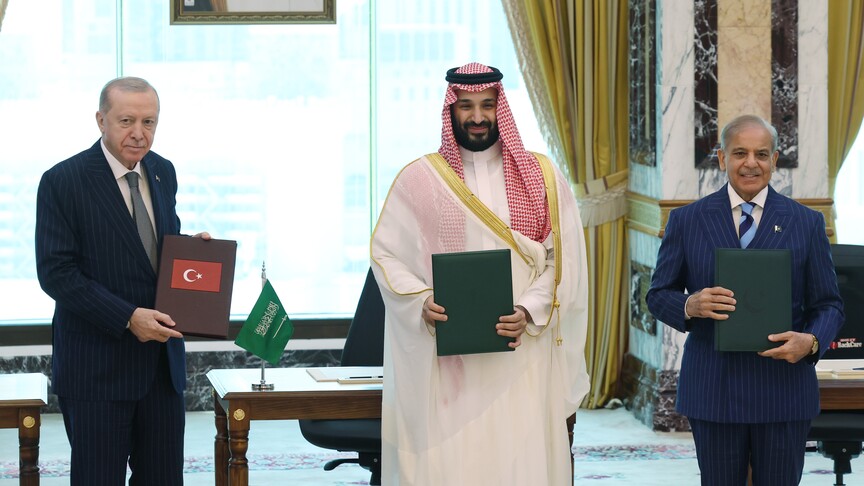
Three countries discuss cooperation in the defense industry
Fidan said cooperation in the defense industry was one of the issues discussed most extensively during the leaders’ talks on Friday. He said the agenda included countries benefiting from one another’s defense technologies, interoperability, mutual training, logistical support, threat analysis and intelligence sharing.
Fidan recalled that Türkiye has many years of experience as a NATO member and emphasized that the Mecca Agreement was not offensive in nature. He said the agreement establishes a framework of solidarity in which the signatory countries pledge not to pose a threat to one another and to contribute to one another’s security.
Fidan specifically said that the agreement does not target Iran. He said no state that does not attack the signatory countries is targeted under the agreement and added that the joint defense structure would contribute to regional stability.
The agreement is planned to open to other countries in the region
Fidan said Türkiye’s vision was for the agreement not to remain limited to three countries and for all countries in the region to be able to join the Mecca Agreement if necessary. He said the agreement aims to establish lasting stability in a region long associated with instability.
Fidan said Türkiye evaluates different conditions together across strategic areas linking the Middle East, the Caucasus, the Black Sea, the Mediterranean, the Balkans and Europe. He said security and economic structures for these regions should be developed in cooperation with the countries of the region, rather than through an approach based on dominance.
Fidan said the ceasefire in the Caucasus was holding, that Armenia and Azerbaijan were moving toward a permanent peace agreement and that Türkiye supported this process. He said similar security or economic structures could be established in the Caucasus and Central Asia if needed.
Assessment of the Red Sea and Strait of Hormuz
Fidan said Saudi Arabia addressed Red Sea security at a meeting attended by the chiefs of staff of 40 countries, focusing on global trade and the security of the Bab el-Mandeb Strait. Fidan said Türkiye was directly affected by trade flows in the Red Sea, adding that the president had given the necessary approvals and that Türkiye attended the meetings.
Fidan recalled that the Red Sea opens onto the Mediterranean through the Suez Canal and said Türkiye should have a say in the security structures established there because of its ports and trade activity in the Mediterranean.
Fidan said Saudi Arabia had no strategy or intention to wage war against Iran or eliminate Iran. He said Riyadh wanted the violence in the Strait of Hormuz and the war in the region to end as soon as possible. Fidan said military intervention was not the solution and that the issues should be addressed through dialogue.