- BIST10011,131-3.02%
- USD50.47+0.05%
- EUR55.46+0.20%
- GOLD3,515.60-4.61%
- INTEREST36.00%-1.00
- BITCOIN58,766-5.07%
- November 20, 202617°
- BIST10011,131-3.02%
- USD50.47+0.05%
- EUR55.46+0.20%
- GOLD3,515.60-4.61%
- INTEREST36.00%-1.00
- BITCOIN58,766-5.07%
- November 20, 202617°
Macron in Kuala Lumpur: France rejects vassalage to China or the US
French President Emmanuel Macron defended strategic autonomy during his visit to Malaysia, saying the world was in “complete disorder.” Macron stressed that France was not dependent on the United States for defense.


French President Emmanuel Macron said France did not want to become a “vassal” of either China or the United States, arguing that the two major powers were trying to make other countries dependent on them. After Cambodia, Macron traveled to Malaysia, where he delivered a speech in English at the France-Malaysia High-Level Economic Dialogue Forum in Kuala Lumpur on November 17.
“We are in a world of complete disorder. The temptation before us today is to become either a vassal of China or of the United States. At least, that is my assessment of the project pursued by these two great powers,” Macron said. The French leader added: “Our intention is not to become vassals; it is to defend the multilateral order, preserve and strengthen our strategic autonomy, and become more independent.”
The video shows Macron addressing countries caught between the two major powers from the forum podium. Anadolu Agency reported that Macron also said they did not want to “break away” from either China or the United States, adding that the aim was to reduce the risks of dependence on the two countries.
“We have our own defense model”
The most notable part of the speech concerned defense. As debate continues over how much Europe can rely on US guarantees, Macron recalled that French defense had “a model of its own”: “We are not dependent on the United States. We have our own capabilities. We produce critical capabilities ourselves.”
In this brief recording, Macron highlights France's independence in the defense industry. A NATO ally, France is the European Union's only country with nuclear deterrence, and Paris has argued for years that Europe needs to expand its own defense capabilities.
Macron said they wanted to develop cooperation with Malaysia, particularly in submarines, fighter jets and radar systems. At a joint press conference with Prime Minister Anwar Ibrahim, the two countries announced that they would establish a joint regional center, RC-Shield, to counter hybrid threats such as cyberattacks and disinformation. Macron also announced that Airbus would supply helicopters to the Malaysian Air Force.
Malaysia diversifies its suppliers
France's defense push comes as Malaysia reassesses its reliance on foreign suppliers. Reuters reported that Norway's cancellation of the export license for missiles destined for the Malaysian navy had led Kuala Lumpur to question the reliability of Western partners. Malaysian Defense Minister Mohamed Khaled Nordin said last week that they preferred to procure anti-ship missiles from Türkiye instead of Norwegian missiles for LCS vessels. Malaysian media identified the system as ROKETSAN's ATMACA missile.
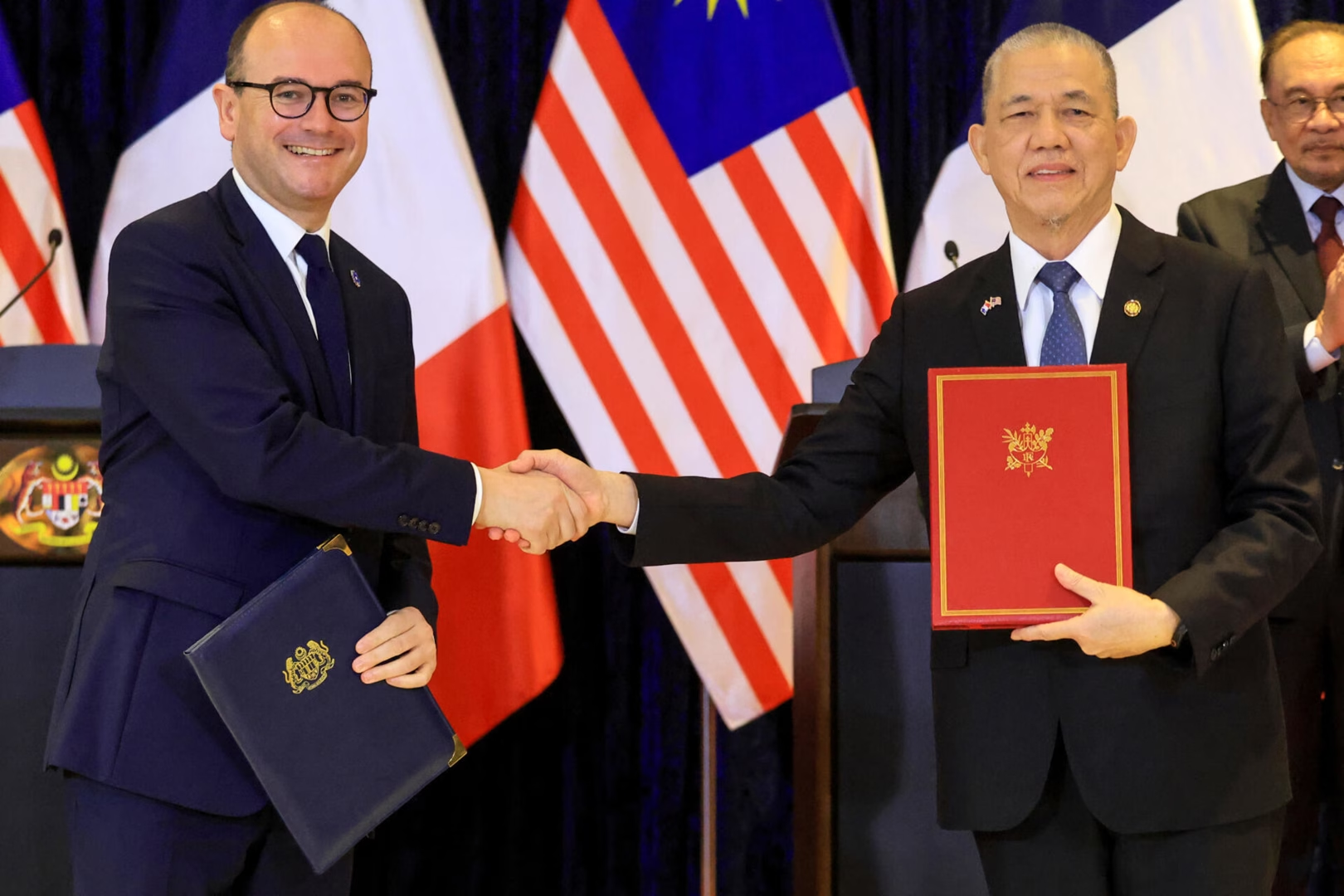
The photograph shows French Industry Minister Sébastien Martin and Malaysian Minister of Energy Transition Fadillah Yusof after the agreement was signed in Kuala Lumpur. Rare earth elements were a major focus of the economic side of the visit. A separation plant to be established in Perak state by France's Carester and Malaysia's Malaco Mining is expected to begin operations in early 2027. The plant is planned to process approximately 13,000 tons annually, with an option to refine some of the products in France. China controls approximately 60 percent of global rare earth production and about 90 percent of refining.
Macron also emphasized dependence in the energy sector. Saying that the war between the United States and Israel and Iran had exposed the risks of dependence on fossil fuels, Macron proposed a partnership with Malaysia on civilian nuclear energy and announced that France would present a project for eight new reactors in the coming weeks.
The two countries elevated their relations to the level of a “strategic partnership.” Trade between France and Malaysia exceeded 4.9 billion euros in 2025, and more than 300 French companies operate in Malaysia. Macron also said he supported a free trade agreement between the European Union and Malaysia. The two countries will mark the 70th anniversary of their diplomatic relations in 2027.
Video: social media. Photos: Nikkei Asia (Norman Goh), AFP.
Stay Updated with The Turkiye Times
Subscribe to be informed about special news, developments and announcements. We will keep you informed.
By signing up, you agree to our Privacy Policy