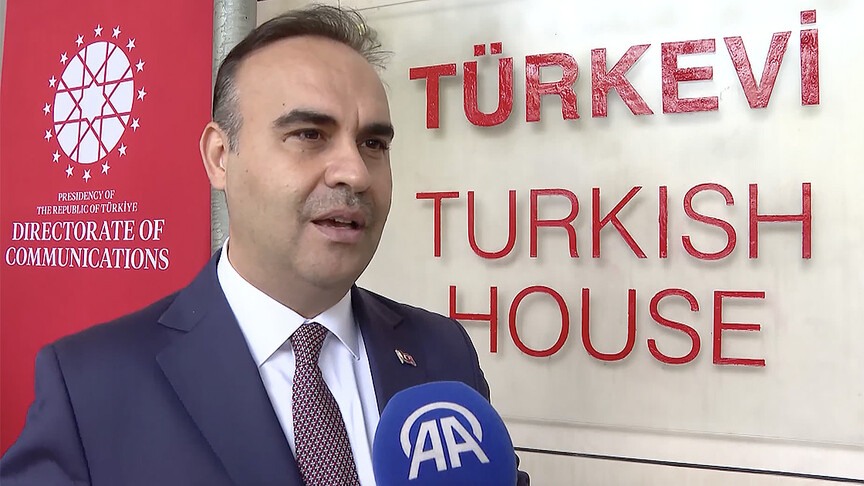
Minister of Industry and Technology Kacır assessed Türkiye’s priorities in international investment while accompanying President Recep Tayyip Erdoğan, who was in New York for the 81st United Nations General Assembly.
Kacır said that over three days they met with representatives of global companies and participants from different countries, shared Türkiye’s goals and vision, and took steps to direct investments to Türkiye. He said they had met with numerous American and global companies at the Industry and High Technology Roundtable Meeting.
Advanced technology support under HIT-30
Kacır said geostrategic developments had made the security and sustainability of investments more important and that Türkiye had become a stable destination for investors. He said new programs in infrastructure, public incentives and support were being implemented to accelerate this process.
Kacır said preferential support was being provided under HIT-30, Türkiye’s largest-scale investment incentive program, for investments in semiconductors, mobility, solar energy, wind turbines, data centers and artificial intelligence.
$10 billion target for artificial intelligence investment
Kacır said Türkiye’s roadmap in artificial intelligence had been set out through the Artificial Intelligence Action Plan announced by President Erdoğan and the 2030 targets, adding that 2% of the public investment budget would be allocated to artificial intelligence projects.
Kacır said 2,000 public datasets would be made available to artificial intelligence developers, domestic artificial intelligence solutions would be supported, and data center infrastructure would be expanded to gigawatt scale by increasing its current capacity fourfold. He said artificial intelligence growth zones would be established and data center investments would be accelerated through measures to facilitate energy supply.
Kacır said the aim was to bring at least $10 billion in private-sector investment to fruition in this field, adding that global companies wanted to take part in this roadmap through their projects and investments. He said technology companies were inclined to expand their operations and investments in Türkiye and that Türkiye was responding to expectations of predictability.
Advanced technology focus in Türkiye-US trade
Commenting on the target of $100 billion in bilateral trade between Türkiye and the United States, Kacır said trade had doubled over the past 10 years but that the existing potential was higher.
Kacır said the target covered not only trade in goods and services but also new partnerships, mutual investments, technology development cooperation and joint work on scientific infrastructure. He said the United States was one of Türkiye’s important trading partners and economic stakeholders, adding that they aimed to strengthen the momentum of recent years in advanced technology.
Kacır said Türkiye had gained new opportunities in connectivity through the Middle Corridor, the Zangezur Corridor and the Development Road, adding that digital connectivity and fiber infrastructure were as important as road and rail links. He said the Northern Marmara railway connection would give Türkiye a more important position in Europe’s value and supply chains.
Artificial intelligence will boost productivity in the economy
Kacır said the United States was among the countries investing the most in artificial intelligence and that American companies accounted for approximately 70% of total data center investments worldwide. He said Türkiye was in close dialogue with leading companies in this field.
Kacır said Türkiye’s pace of digitalization, its market of 86 million people, its technology development capabilities and its production competencies were important to companies. He said artificial intelligence-powered digitalization in education and healthcare, as well as in the manufacturing and services sectors, would increase productivity, adding that artificial intelligence-focused projects would play a leading role in the development of the Turkish economy.
Türkiye aims to secure a larger share of space investment
Kacır recalled that Türkiye had carried out its first crewed space mission under the National Space Program and had produced and launched its own communications satellite. He said Türkiye was capable of producing communications and imaging satellites.
Kacır said a spaceport was being built in Somalia to provide independent access to space, a space technopark had been established in Ankara, and an expanding space ecosystem had emerged in the country. He said the Moon program had marked a step toward deep-space projects, adding that more than $600 billion was spent on space worldwide each year and that Türkiye wanted to secure a larger share of this sector.
Kacır said the Moon project, planned for implementation next year, would be the first step toward becoming a country that develops technology for deep-space operations. He said the lunar spacecraft in the project, which would use Türkiye’s hybrid rocket technology, would be produced with a localization rate of more than 80%.
Kacır said the project would enable Türkiye to join the nine countries capable of reaching the Moon and would position the country as a technology development partner in international lunar programs. He added that signing the Artemis Accords would also contribute to Türkiye taking on a greater role in deep-space and lunar projects.
















