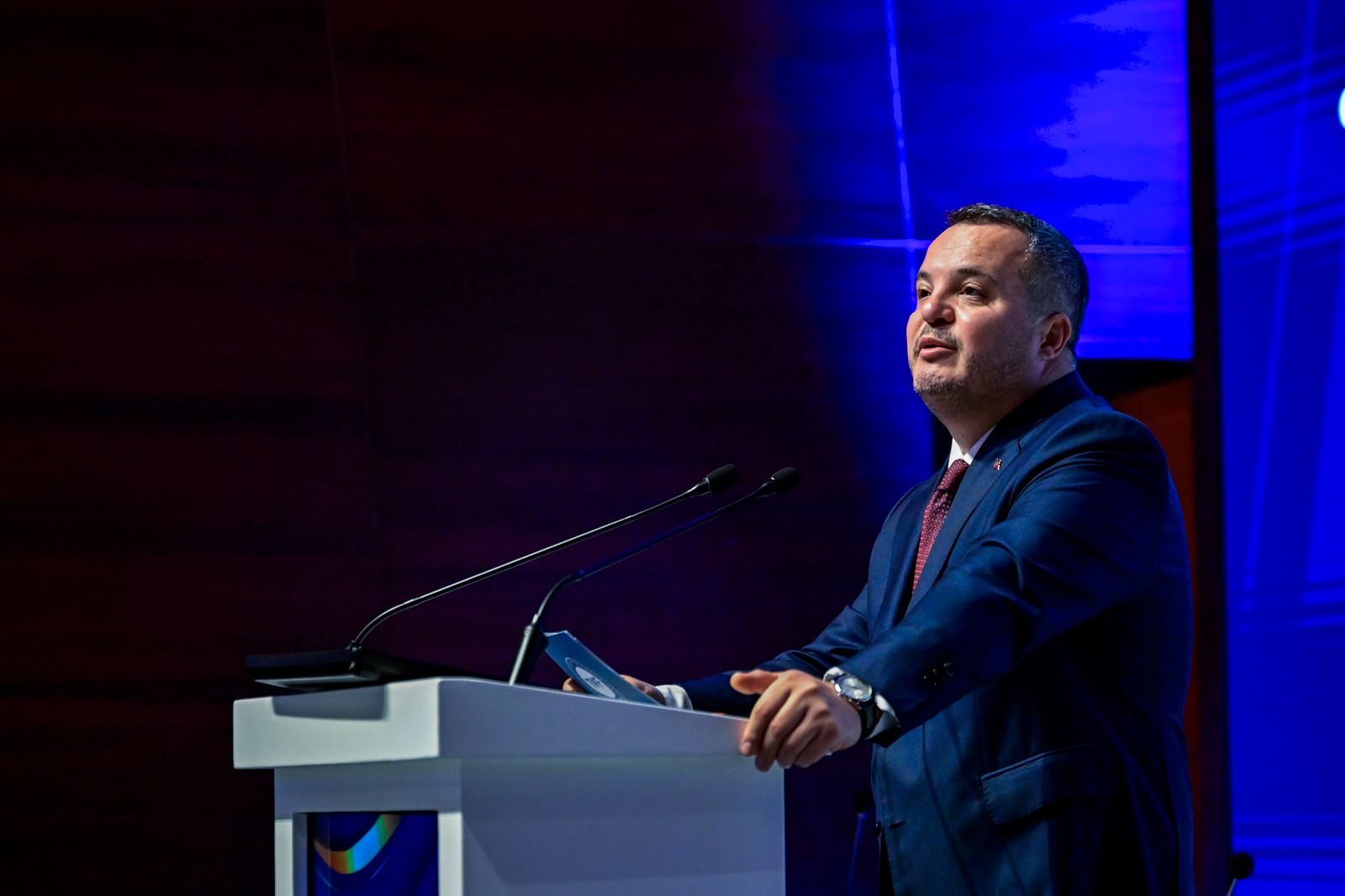
The “New Focus of Investment: Creating Value for the Future Summit,” organized by Bacacı Investment Holding at the Ziraat Towers Auditorium in the Istanbul Financial Center, began with the participation of Minister of Industry and Technology Mehmet Fatih Kacır and Fatih Karahan, Governor of the Central Bank of the Republic of Türkiye.
Speaking at the opening of the summit, Kacır said geopolitical and strategic disruptions were intensifying the global economy’s search for direction. He said the free-trade approach was gradually giving way to an economic model in which protectionism was becoming more prominent.
Kacır said countries viewed their production and technology-development capacity as an integral part of national sovereignty, adding that the center of gravity of the global economy was shifting from west to east. He said Türkiye was preparing for this period through policies focused on political and economic stability, research and development, high value-added production and a qualified workforce.
Kacır said the national income had risen from $238 billion to $1.6 trillion over the past 23 years under a development model focused on investment, employment, production and exports. He said annual goods exports had increased from $36 billion to $283 billion over the same period, adding that Türkiye was among the leading exporting countries in terms of product and market diversity across the broad belt stretching from China to Central Europe.
Kacır said they were supporting investments that would accelerate the National Technology Initiative, the twin transformation of production infrastructure and regional development through the new incentive system. He also announced the launch of a new implementation under the investment-commitment advance loan program.
Kacır said the implementation for incentive-certified manufacturing-industry investments would provide direct funding for strategic projects. For other projects with investment values above 100 million liras, he said the level of investment progress, activity in organized industrial and industrial zones, and investors’ research and development activities would be taken into account. He announced that the loans would have five-year maturities, including a one-year principal repayment-free period, with a financing cost set at 70% of the Central Bank’s policy rate.
$30 billion target for high-tech investments
Kacır said they were implementing the HIT-30 High Technology Investment Program to make Türkiye a stronger hub for new technology investments. He said the program offered suitable financing conditions and investment locations for projects that would contribute to the country’s capacity to develop and produce technology.
Kacır said calls targeting battery, electric vehicle, solar cell, wind turbine, chip, defense technology, data center, artificial intelligence and industrial robotics production, as well as large-scale research and development centers, aimed to increase Türkiye’s advanced-technology production capacity. He said the plan was to bring investments to life with $30 billion in government support by 2030.
Kacır said they aimed to establish a sustainable production structure that was environmentally responsible and used resources efficiently, alongside high value-added production. He said models combining the work of Turkish industry and international financial institutions under the net-zero emissions target were important for the green transformation of industry.
Kacır said more than $1 billion in financing had been provided to industrialists, small and medium-sized enterprises, and green-technology startups under the Türkiye Green Industry Project, the Türkiye Organized Industrial Zones Project and the Türkiye Socially Inclusive Green Transition Project, carried out in cooperation with the World Bank. He said they had taken steps to secure 5 billion euros in international financing by 2030 through the Türkiye Industrial Decarbonization Investment Platform.
Kacır said four priority areas had been identified for each city under the Local Development Initiative Program. He said local potential would be mobilized through investments in manufacturing, mining, agriculture, tourism and healthcare.
The entrepreneurship ecosystem and Terminal Istanbul
Kacır said technology startups were at the forefront of change because of their ability to rapidly implement innovation and turn technology into economic value. He said they aimed to build an entrepreneurship ecosystem that would enable technology startups capable of competing globally to emerge and grow from Türkiye.
Kacır said high-potential startups received support in investor access, internationalization, mentoring and strategic partnerships under the Turcorn 100 Program. He announced that Terminal Istanbul would open in 2027 with all its functions. Kacır said numerous international stakeholders from 14 countries were part of the Terminal Istanbul ecosystem.
Kacır said the “Digital Company” application would enable technology startups to complete their establishment procedures through a digital platform. He said virtual office services would reduce the financial burden on entrepreneurs in the incubation stage. Kacır said Türkiye would become a stronger hub for investments, startups and talent.
Karahan: Price stability creates a foundation for investment
Fatih Karahan, Governor of the Central Bank of the Republic of Türkiye, said global developments had led to increases in energy and commodity prices, higher transportation costs and disruptions in supply chains. He said global inflation had risen during a period of weaker global growth, adding that measures supporting a tight monetary policy had been taken to limit the impact of increased uncertainty on inflation.
Karahan said the slowdown in domestic demand had become more pronounced under tight monetary policy and that inflation had risen more slowly in items directly affected by monetary policy. He said underlying inflation had increased between March and June but began to decline again from July onward. He added that the disinflation process would accelerate as the effects of shocks eased.
Karahan said annual inflation had risen to 75.5% in May 2024 before falling to 29.7% in September, while underlying inflation stood at 23.7% in the same month. He said underlying inflation remaining below annual inflation indicated that disinflation could continue at a faster pace if supply-side pressures eased.
Karahan said annual inflation had declined in September from the previous year in all major groups except energy. He said annual inflation in the services group had fallen by 7 percentage points to 37.7%, while inflation in the food and non-alcoholic beverages group had declined from 36.1% last year to 27.6%.
Karahan emphasized that price stability created a more favorable environment for investment and production by reducing uncertainty. He said average annual investment growth had risen to 7.8% during the 2004-2019 period, when inflation declined. Karahan said investment growth had strengthened again in 2025, when disinflation continued under tight monetary policy.
Karahan also said productivity indicators declined during periods of high inflation, noting that output per worker in non-agricultural sectors fell by an annual average of 0.4% between 2022 and 2024. He said productivity growth in non-agricultural sectors, particularly industry, recovered in 2025 as inflation declined. Karahan said higher productivity supported the real sector’s capacity for sustainable growth and companies’ resilience to shocks.