The solar eclipse was widely observed across many European countries. While a total solar eclipse was visible in parts of northern Spain, more than 90% of the Sun was obscured by the Moon across much of the United Kingdom.
Observers across Europe used specially filtered glasses and telescopes to view the Sun safely. Open spaces, parks, squares and elevated locations were preferred, particularly when the Sun was descending toward the west.
The eclipse was observed in London
In London, the capital of the United Kingdom, the eclipse began at 18:17 local time and reached its peak at 19:13. The time of maximum eclipse varied between 19:02 and 19:16 in different parts of the country.
Greenwich Park, Telegraph Hill, Primrose Hill, Parliament Hill and Crystal Palace were among the prominent observation points in London. Many people also followed the eclipse from Parliament Square and Trafalgar Square.
Mike, who observed the eclipse along the River Thames, said he had watched three solar eclipses over the past nine years and expected an eclipse of approximately 90% this time. Rajed described the event as one of the rare moments of the century and said he hoped to photograph the eclipse.
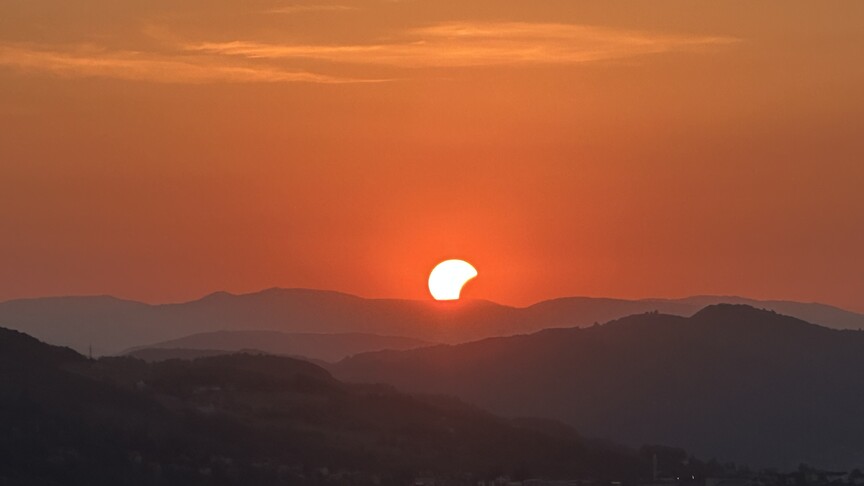
A total eclipse was visible in parts of Spain
The total eclipse moved eastward from northwestern Spain and was observed in parts of the country’s north and in the Balearic Islands. The partial phase began at approximately 19:30 local time, while totality occurred between 20:27 and 20:33, depending on the area.
In some areas, totality lasted approximately two minutes. A total eclipse was visible in northern cities such as Gijón, Santander and Bilbao, while approximately 99% of the Sun was obscured by the Moon in Madrid. The eclipse reached its peak in the capital at around 20:32.
Many people in Spain watched the eclipse using specially filtered glasses. The last total solar eclipse observed on the Iberian Peninsula was in 1912, while another total eclipse is expected in Spain on August 2, 2027.
Obscuration reached 99.6% in France
The eclipse was particularly pronounced in southwestern France. While 92% of the Sun was obscured by the Moon in Paris, the figure reached 99.6% in Saint-Jean-de-Luz.
In Paris, the eclipse began at 19:22 local time and ended at around 21:10. The Citroën Park, the Luxembourg Gardens and the roof of the Paris Philharmonic were among the locations used for observation.
Many people in Paris watched the eclipse in front of the Sacré-Cœur Basilica and around the Arc de Triomphe on the Champs-Élysées. Queues formed at some outlets during the final 24 hours because stocks of protective glasses had sold out days earlier.
Queues formed for glasses in Belgium
The solar eclipse began at 19:18 local time in Belgium. People seeking to watch the eclipse went to sales outlets to buy specially filtered glasses, while long queues formed outside some shops.
Some Belgians travelled to Spain and Iceland to see the total eclipse, while others observed it in squares across the country. The historic Cinquantenaire Arch complex in Brussels was opened to observers, and tickets offered there sold out within minutes.
The MIRA Observatory, the Zavelenberg nature area, Scheutbos Park and the area around the Koekelberg Basilica were also among the observation points in Brussels. At an event held on the roof of the MAS Museum in Antwerp, participants followed the eclipse using solar telescopes.
Switzerland saw its largest partial eclipse since 1999
Switzerland experienced its largest partial solar eclipse since 1999 during the evening. The eclipse began across the country at approximately 19:25, reached its most striking phase about an hour later, and the Moon obscured between 91% and 93% of the Sun.
At the maximum eclipse in Geneva, approximately 93% of the Sun was obscured by the Moon. The eclipse began at 19:26, reached its peak at around 20:20 and ended shortly before sunset.
Abhishek, one of the observers on the shores of Lake Geneva, said he watched the eclipse using a pinhole projector. Tom Stanley said he had previously watched an eclipse from Geneva but that this event was more extensive. Hundreds of people waited outside shops in Bern to buy special glasses.
The eclipse peaked one minute before sunset in Austria
In Austria, the Moon obscured 89% of the Sun. The eclipse began at 19:22 local time in Vienna and reached its peak at 20:13.
Because the Sun set at 20:14, the eclipse reached its highest point just one minute before sunset. The Steinhofgründe, Kahlenberg and Cobenzl areas, as well as the 150-meter-high observation terrace of the Danube Tower, were preferred for viewing.
The Vienna Adult Education Centers’ Planetarium also organized public viewing events in the city for the eclipse.
The eclipse lasted approximately 10 minutes in Sweden
The solar eclipse, which began at around 19:56 local time in Sweden and lasted approximately 10 minutes, was visible from much of the country. Dozens of people watched the eclipse using special glasses in the Drottninggatan area of Stockholm.
Peter Linde, president of the Swedish Astronomical Society, said the eclipse was a magnificent experience. Linde said 30% of the Sun had been obscured in the country last year, while the figure reached 85% this time.
Sweden last experienced a total solar eclipse in 1954, while the next total eclipse is expected in 2126.
Observations in Germany and Iceland
People in many German cities watched the eclipse at historic sites, in open spaces and in parks. The Moon obscured 85% of the Sun in Berlin and 90% in Freiburg, in the country’s southwest.
The eclipse began at 19:12 local time in Germany and reached its peak at 20:05. Tempelhofer Feld and the area around the Brandenburg Gate were used as observation points in Berlin. Stocks of protective glasses sold out days in advance across the country.
Iceland experienced the first total solar eclipse visible in the country since 1954. Totality was observed in the western Westfjords and on the Snæfellsnes Peninsula, as well as in areas including Reykjavík.
In Reykjavík, the eclipse began at 16:47 local time, totality occurred at 17:48 and lasted approximately one minute. In some parts of western Iceland, totality was visible for more than two minutes. Many visitors travelled to the country for the event, while specially filtered glasses sold out quickly.