Israeli Prime Minister Benjamin Netanyahu released a video message Saturday evening, calling for a national unity government as the process of forming a government remained deadlocked following the October 27 election. Netanyahu said in the message, “Citizens of Israel, now is the time for unity,” and called for a government encompassing “all the parties in the national camp and all Zionist parties that want to protect our country.”
According to Netanyahu, such a government would “permanently eliminate Iran’s nuclear threat, preserve Israel as a Jewish state and ensure unity among us.” Saying, “There is only one option: national unity, not national suicide,” Netanyahu added, “This is the will of the people and what the moment requires.”
In the approximately two-and-a-half-minute video, posted on Netanyahu’s X account with the note “National unity,” the prime minister speaks from a podium in front of a blue backdrop. Netanyahu claimed in the message that some circles intended “as early as next week” to “hastily swear in a government with supporters of terrorism,” saying, “A government relying on Hamas supporters will not fight Hamas,” and called on everyone “to show responsibility at this decisive moment.”
“The flames in Paris and Brussels will pale in comparison”
In the harshest part of the message, Netanyahu argued that a government relying on “Islamists” would bring Israel down from within “as in European countries, or even worse.” Saying, “The fire and flames we saw in the streets of Paris and Brussels will pale beside the fire and flames we will see in the streets of Jerusalem, Tel Aviv, Haifa and other Israeli cities,” Netanyahu continued: “This is not a fantasy. These are not scare tactics. This is the reality we will face; that is why we must stop it, because our lives depend on it. Israel cannot survive with such a government.”
Netanyahu did not specify which events in Paris and Brussels he was referring to. In France, protests that began in response to conditions in schools and the cost of living turned violent in mid-October, and Prime Minister Sébastien Lecornu said on October 17 that approximately 1,200 people had been detained and more than 150 police officers injured. The Times of Israel reported in the same article that some young people protesting rising education costs in Brussels had also clashed with police.
Netanyahu had drawn the same framework in his November 4 message. Defining “radical Islam” as “the challenge tearing countries apart in Europe today,” Netanyahu argued that the threat was targeting Israel “from outside through Iran and its proxies, and from within through Islamist parties that support terrorism.” On November 2, he wrote, “The people of Israel do not want a government relying on Ra’am and the Joint List.” Arab parties won a record 19 seats in the October 27 election.
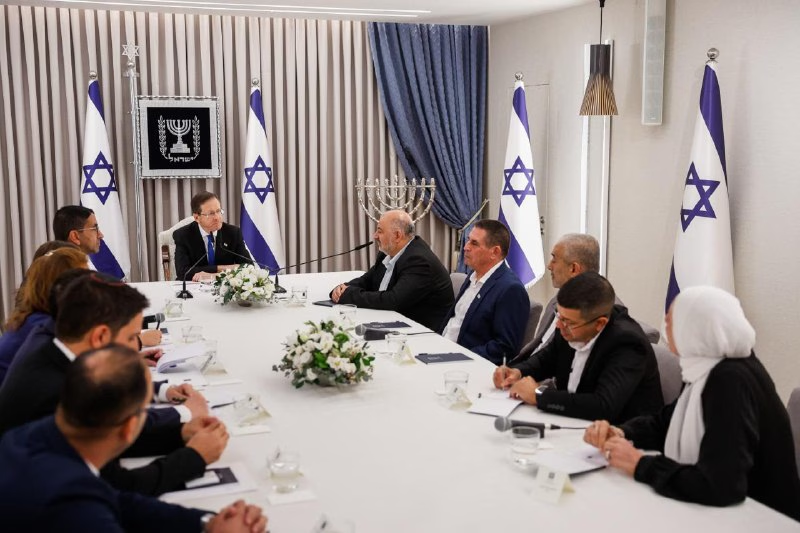
Ra’am leader Mansour Abbas and a party delegation met with Herzog at the President’s Residence in Jerusalem on November 5 and recommended Eisenkot to form the government. The Joint List was also among those who recommended Eisenkot that day.
Eisenkot camp: “A pathetic spin”
Eisenkot’s Yashar! party referred to Netanyahu as the “outgoing prime minister” in a statement on X shortly after the speech and described it as “hysterical.” The statement said, “The person who divided, fragmented and turned Israeli society against itself is using the word ‘unity’ only after realizing that his days in office are numbered.”
The party said that only parties accepting four principles, including recognizing Hamas as a terrorist organization and eliminating its military and governing capabilities, would be allowed to join the “national emergency government” Eisenkot would form. The party emphasized that Likud would be “more than welcome” if it broke its alliance with the “extremists,” accepted these principles and announced its readiness to join a government led by “Prime Minister Eisenkot,” adding, “Until then, this is nothing more than a pathetic spin.” According to Ynet, Gilad Kariv of the Democrats party also said, “If Netanyahu says this is the time for unity, he must also understand that they lost the election.”
Eisenkot will receive the mandate on Sunday
According to a statement from the President’s Office, Herzog informed Eisenkot on Saturday evening of his intention to task him with forming a government. The mandate will be formally given at a ceremony at the President’s Residence at 5 p.m. Sunday. In consultations, groups representing a total of 67 lawmakers recommended Eisenkot, while groups representing 46 lawmakers recommended Netanyahu; United Torah Judaism, which holds seven seats, recommended no one. Eisenkot will have 28 days to form a government, and Herzog may extend the period by 14 days.
According to Ynet, Eisenkot said, “I intend to fulfill the mandate given to me by the people and the mandate the president is expected to give me.” Netanyahu did not say who would lead the unity government he proposed in his Saturday evening speech. In a November 2 post, he wrote, “A clear majority of the Jewish public chose Likud as the largest party and chose me as the prime minister who will lead the next government.”
Video: Benjamin Netanyahu / X. Photos: Israeli Presidency / GPO
















