- BIST10012,239+0.73%
- USD49.34+0.24%
- EUR55.21-0.01%
- GOLD4,209.10+0.44%
- INTEREST37.00%-1.00
- BITCOIN83,280+1.87%
- October 13, 202618°
- BIST10012,239+0.73%
- USD49.34+0.24%
- EUR55.21-0.01%
- GOLD4,209.10+0.44%
- INTEREST37.00%-1.00
- BITCOIN83,280+1.87%
- October 13, 202618°
Sunlight-cast human shadows at Divriği Great Mosque mesmerize visitors
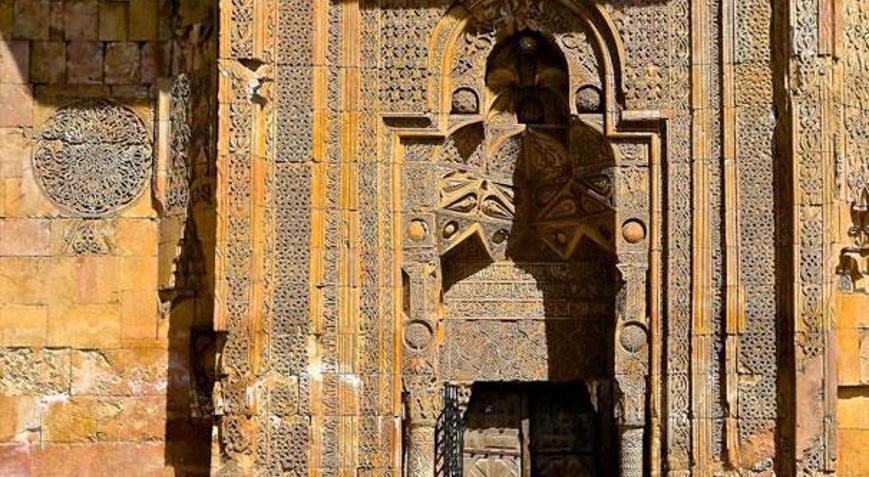
At the 800-year-old Divriği Great Mosque and Hospital in Sivas, the interplay of sunlight with stone carvings at certain times of the year creates silhouettes of people praying or reading the Quran. Listed as a UNESCO World Heritage site and known as the 'Alhambra of Anatolia,' the complex holds a different story at each of its doors.


Located in the Divriği district of Sivas and built in 1228, the Divriği Great Mosque and Hospital captivates visitors not only with its unique Seljuk architecture but also with the human silhouettes that appear on its stone doors at certain times of the year.
This historic complex, which is on the UNESCO World Heritage List and dubbed the 'Alhambra of Anatolia' by European researchers, comes alive as sunlight meets the meticulously carved stone reliefs.
Shadows appearing on the doors
At the entrance known as the North Gate because it faces north, the Qibla Gate because it is oriented towards the qibla, and also the Gate of Paradise, a silhouette of a woman praying appears at 7:00 a.m. in July and August. The details on the door are so finely carved that even the woman's eyelashes and headscarf are discernible.
At the Crown Gate in the west, a shadow of a man first reading the Quran and then standing in prayer appears in the afternoon. While it is thought that the facial features of the mosque's patron Ahmed Shah come to life at the Shah Gate, a silhouette of a man deep in thought greets visitors at the hospital gate.
The door where stones speak
Mustafa Yıldırım, a volunteer guide at the mosque, told an Anadolu Agency reporter that they describe this unique structure with the phrase 'Don't die without seeing it,' adding, 'Words are insufficient to describe this masterpiece.'
Yıldırım emphasized that the Gate of Paradise in particular is 'the door where stones speak,' explaining that it is adorned from top to bottom with motifs of roses, lilies, ivy, and gardens of paradise mentioned in the Quran. Noting that describing the decorations of this door alone could take two hours, Yıldırım said each motif carries a meaning, and that the rose and nightingale figures in particular symbolize divine love in Sufi literature.
Discovery by a Japanese tourist
The human shadows on the doors were first noticed by a Japanese tourist in 2005. After the tourist discovered a silhouette of a man reading the Quran at the Crown Gate, the shadows on the other doors also came to light. Following this, visitors began flocking to the site, especially in summer and in the afternoon, to witness this collaboration of nature and art.
The door that makes the ruler bow
The Shah Gate, on the other hand, draws attention with its low design and the inscription 'Sovereignty belongs to Allah.' According to Yıldırım, the fact that the ruler is forced to bow when passing through the gate conveys the message that arrogance belongs only to God and that a person should bow only before their creator.
The Alhambra of Anatolia
Tongues are incapable of describing it, pens incapable of writing its beauty.
With a mosque area of 1,280 square meters and a hospital area of 768 square meters, the complex was built in the 13th century during the Mengücek Beylik period by Ahmed Shah and his wife Melike Turan Melek. The structure, which is the only complex in Anatolian Seljuk period built side by side by a woman and a man, is considered one of the rarest examples of Islamic art with its thousands of three-dimensional stone carvings, each different and never repeating. This work, attributed to the master known as Hürrem Shah of Ahlat, is his only surviving work. These words of the Ottoman traveler Evliya Çelebi about the monument summarize the centuries-old magic of the structure.
Yıldırım stated that visitors are enchanted by what they see, and that even a neurosurgeon was so overcome with emotion that he prostrated himself, adding, 'Those who see this place want to come again, and we say, 'May God grant you long life so you can come again without ever getting enough.''
Stay Updated with The Turkiye Times
Subscribe to be informed about special news, developments and announcements. We will keep you informed.
By signing up, you agree to our Privacy Policy