- BIST10011,483+1.32%
- USD50.07+0.05%
- EUR55.96-0.52%
- GOLD4,074.90-0.94%
- INTEREST36.00%-1.00
- BITCOIN75,768+0.02%
- November 8, 20267°
- BIST10011,483+1.32%
- USD50.07+0.05%
- EUR55.96-0.52%
- GOLD4,074.90-0.94%
- INTEREST36.00%-1.00
- BITCOIN75,768+0.02%
- November 8, 20267°
Poland declares national mourning after Krakow attack kills six
An attacker drove into Krakow’s Main Market Square, crowded with tourists, and opened fire at random, killing six people, including four women, and injuring 15, including two police officers. Police said the bodies of the 24-year-old Polish suspect’s mother, father and sister were found with gunshot wounds at his home in Ostrowiec Świętokrzyski.
The Turkiye Times Editorial DeskUpdated:


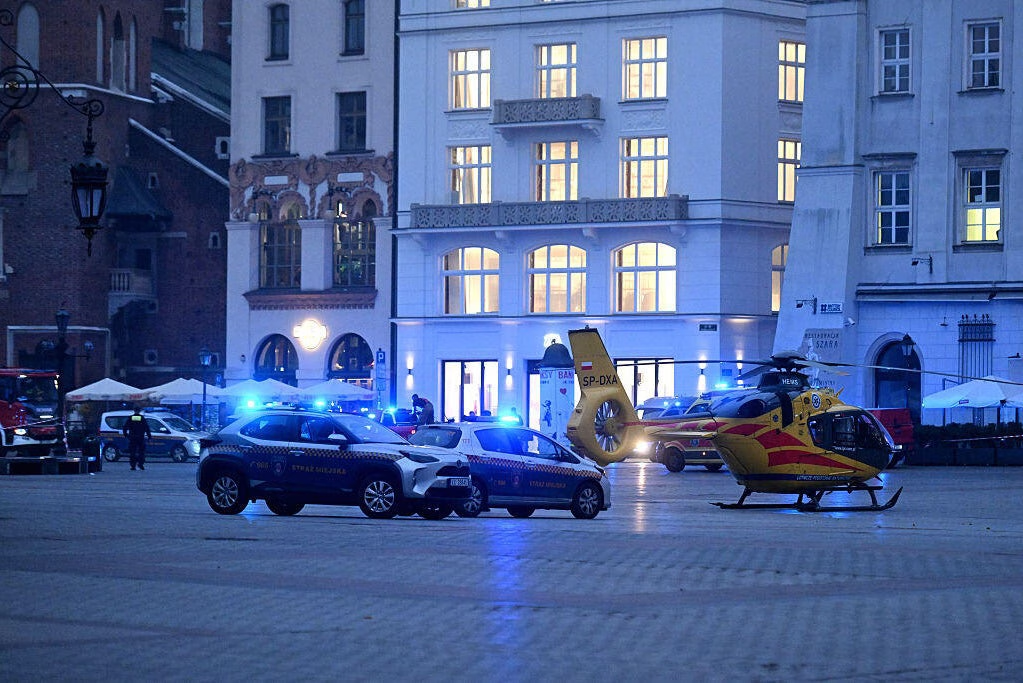
At around 3 p.m. local time on Saturday, an attacker drove into Krakow’s historic Main Market Square (Rynek Główny), which was crowded with tourists, and opened fire at people nearby. Police and Interior Minister Marcin Kierwiński said six people—four women and two men—were killed and 15 people were injured, including two police officers who stopped the attacker. The number taken to hospitals, including the attacker, who was shot and incapacitated by police, was 16. Andrzej Fijołek, a spokesperson for the National Police Headquarters, said on Sunday morning that the death toll had not changed and that the condition of the injured had not worsened.
Katarzyna Cisło, a spokesperson for Małopolska police, said the attacker entered the square from Sławkowska Street in a black Subaru, wearing military-style camouflage, a helmet and a bulletproof vest, and using a military-style long-barreled weapon. Cisło said the attacker made “a frantic circuit” around the square, leaving people injured at different locations. Police said the attacker fired at random people from the vehicle.
This short video, shared on social media as showing the attacker’s vehicle, was filmed from an upper floor of a building in the historic center. It shows a dark-colored car speeding along a narrow street while pedestrians move out of its way. No official statement has been issued about the footage.
Escape and capture
After opening fire near Sukiennice (the Cloth Hall) and at the exit of Sienna Street, the attacker fled toward Wawel Castle via Grodzka and Stradomska streets. Krakow’s public transport company said shots were also fired at a tram from the moving vehicle, shattering the driver’s cabin window. Police stopped the vehicle at the intersection of Dietla and Stradomska streets. Kierwiński said officers fired their first shots at the attacker just three minutes after receiving the alert, adding that the swift response “prevented a much larger massacre.”
The attacker’s identity
Police said the attacker was a 24-year-old Polish citizen born in 2002 who lived in Ostrowiec Świętokrzyski, about 150 kilometers northeast of Krakow. Authorities did not officially release his name, while Polish media identified him as “Michał O.”, using only the initial of his surname in line with practice in the country. Police said the attacker had no previous criminal record but held a firearms license. Fijołek told TVN24 that the attacker used a civilian version of an AR-15 rifle; on Sunday morning, he said the vehicle probably contained five weapons.
Prime Minister Donald Tusk announced at a meeting in Krakow on Saturday night that the bodies of two women and one man had been found at the attacker’s home in Ostrowiec Świętokrzyski. Fijołek said on Sunday morning that the bodies belonged to the attacker’s 53-year-old father, 52-year-old mother and 20-year-old sister. Fijołek said all three had gunshot wounds and had most likely died from those injuries. The circumstances of the deaths at the home are under investigation; the three people are not included among the six people killed in Krakow.
Małopolska Governor Krzysztof Klęczar said the attacker, who was shot and captured by police, remained in critical condition as of Sunday morning. Kierwiński said one of the hypotheses being examined was that the weapon had been taken from the family home, adding that the attacker’s father also held a firearms license. The minister said, “The initial analysis points to extreme nationalist views, but this will be verified.” Defense Minister Władysław Kosiniak-Kamysz said, contrary to claims on social media, that the attacker “had never been a soldier in the Polish army and had no ties to the army.”
National Police Chief Marek Boroń said three of the four identified victims were Polish women and one was a British male citizen. According to Poland’s Interior Ministry, the injured also included citizens of Austria, Germany, Portugal, Russia and the United Kingdom.
Investigation and official responses
Justice Minister and Prosecutor General Waldemar Żurek said seven prosecutors were working at the scene and that investigators were also examining the address where the attacker lived. Prosecutor’s Office spokesperson Tomasz Waszczuk said the charges against the attacker had not yet been determined and that investigators were examining whether anyone had helped him. Witness statements are expected to be taken in the coming days.
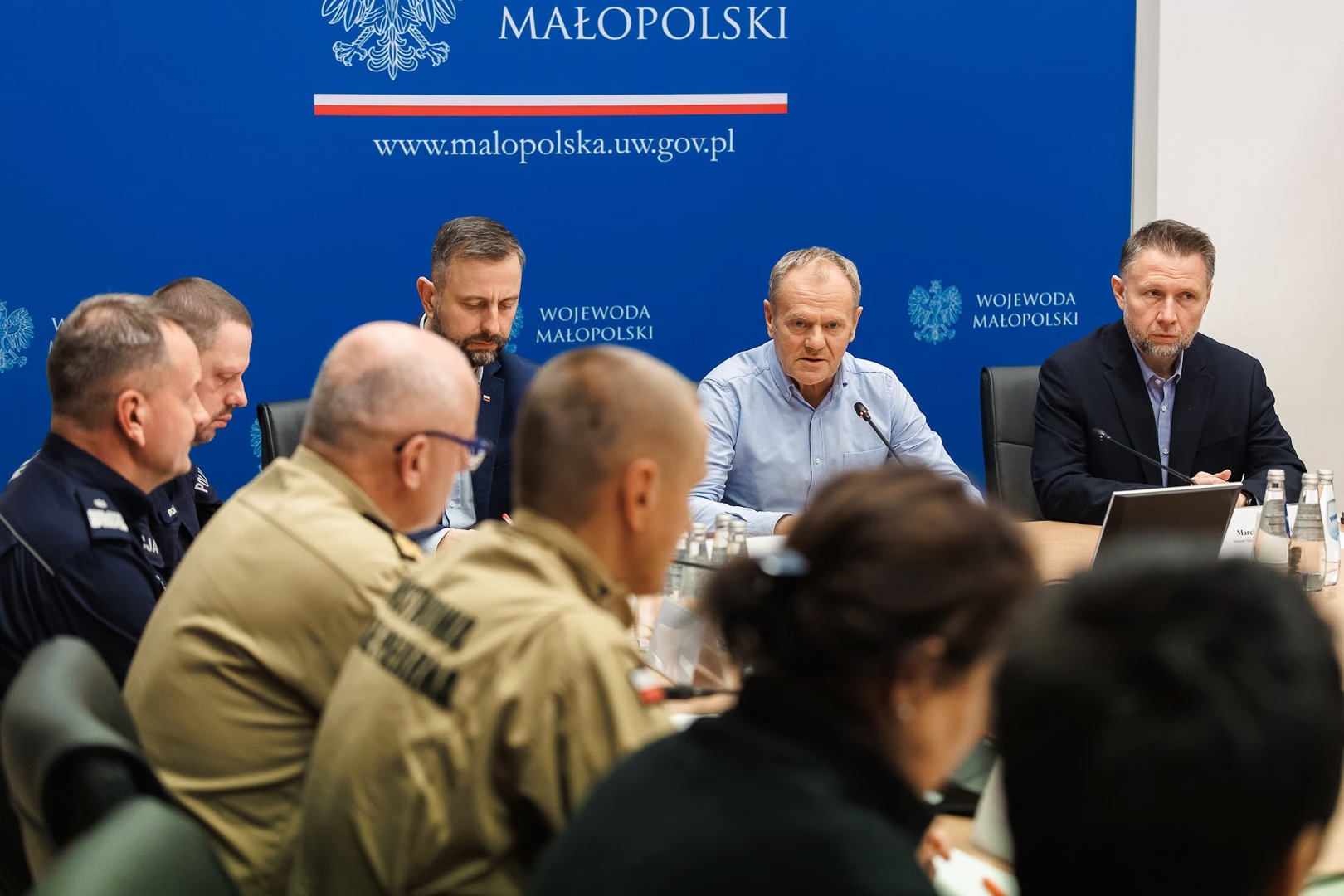
Prime Minister Donald Tusk described the attack using the word “zamach,” meaning “assassination,” and called on politicians from all political views: “Do not play politics with this tragedy.” After an emergency meeting in Krakow on Saturday night with ministers, regional authorities and security commanders, Tusk said, “Poland has never experienced terrorist incidents this serious. This brutal attack must be called what it is.” Defense Minister Kosiniak-Kamysz also described the incident as “a terrorist act against the people living in Krakow and tourists.”
Tusk called senior police officers Jakub Kulik and Artur Morański, who stopped the attacker, “real heroes” and said the two officers had probably saved many lives. The Polish Police and Justice Minister Żurek called for blood donations for Kulik, who was fighting for his life in hospital; Chief of the General Staff General Wiesław Kukuła also urged soldiers to donate blood. Governor Klęczar said the two officers remained in serious condition but were doing better than the previous evening.
National mourning
A decree signed by President Karol Nawrocki declared national mourning in Poland on November 8 and 9. Krakow Mayor Łukasz Gibała also declared mourning in the city through November 11; municipal events were canceled, and flags were lowered to half-staff at public buildings and on public transport.
In this video message posted on the evening of the attack, Gibała addressed Krakow residents and offered condolences to the victims’ families. He urged people to stay away from the area around the square, rely only on official sources, and avoid spreading false reports or footage from the scene. Gibała thanked the municipal officers who first reached the scene, the police who stopped the attacker “heroically and at the cost of their lives,” and residents who opened their doors to people fleeing. He said, “Violence will not change the fact that we are a proud, hospitable and open city. The square will belong to all of us again.”
Part of the square reopened on Sunday morning, while the first candles were placed at the attack sites. Police spokesperson Katarzyna Cisło said the crime-scene examination was continuing but that authorities “cannot paralyze the city.” Around 15 million tourists visit Krakow each year, and most pass through the Main Market Square. Mass shootings are rare in Poland.
Türkiye also condemned the attack. In a written statement, the Foreign Ministry said it condemned the terrorist attack carried out in Krakow on November 7, offering condolences to the victims’ families and the people of Poland and wishing the injured a speedy recovery.
Cover: Beata Zawrzel/AP. Photos: Getty Images, Donald Tusk/X. Videos: social media / ConflictTR, Łukasz Gibała/X
Have a story, event or announcement of your own?Send us your news on WhatsApp
Spotted an error in this story?Report it on WhatsApp
Share on all social platforms
Sponsored Ads
Featured Listings
Loading featured properties...
Stay Updated with The Turkiye Times
Subscribe to be informed about special news, developments and announcements. We will keep you informed.
By signing up, you agree to our Privacy Policy