Minister of Transport and Infrastructure Abdulkadir Uraloğlu answered journalists' questions on the agenda after the signing ceremony of the concession agreement for vehicle inspection services to be carried out across Türkiye in the 2027-2047 period.
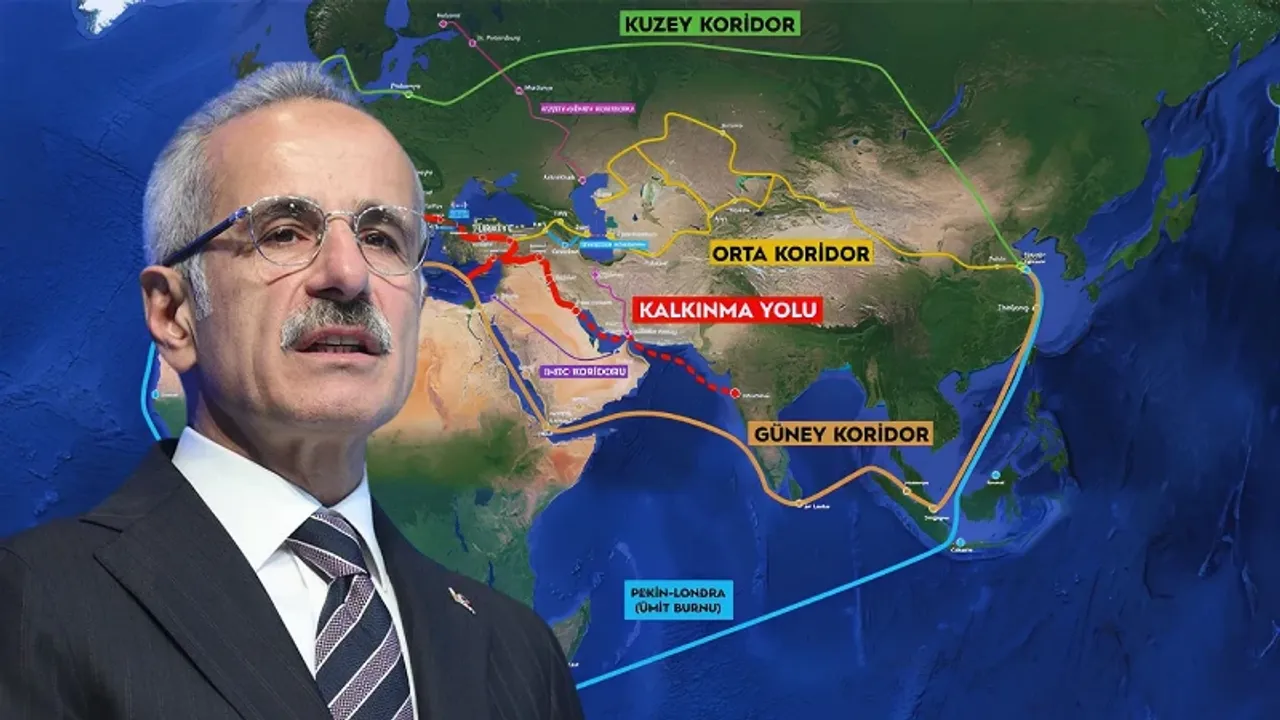
Pointing out that the Development Road is a major project covering 1,200 kilometers of railway, highway, energy transmission and communication lines, Uraloğlu said that transportation will be provided from Fav Port to Türkiye and from there to Europe. Uraloğlu noted that a project worth approximately 15 billion dollars is being discussed on the railway side alone, and said, 'There had been an election in Iraq, as you know.
The formation of the government took some time. The government was formed and the Iraqi Prime Minister's visit to our country on the 28th was confirmed. Before this visit, we made a business trip to Iraq on the 21st to discuss more clearly what we would do. We made the necessary assessments with the Ministers of Transport and Communications there. Afterwards, we visited the Prime Minister.
Here, we had agreed on where the Iraq-Türkiye border gate would be and how the financing of this project would be provided. The content of the agreements was the construction of the Fişhabur-Ovaköy border gate and the construction of the Development Road by Turkish contractors in exchange for oil.'
Uraloğlu said that they discussed all the details in the meeting, and made the following assessment regarding the signing ceremony held within the scope of the visit of Iraqi Prime Minister Ali al-Zeydi: 'On the eve of the signing ceremony, just minutes before, there was a need to correct a technical detail that was identified. Our counterpart, the Minister of Transport, already made a statement himself after returning to Iraq.
A technical point needed to be corrected. They suggested, 'Let's sign after we correct this.' We considered it reasonable. I would particularly like to underline that there was absolutely no difference of opinion there. There were some question marks for the public and you journalists like 'What is happening there, was the signing abandoned, will it not be signed?' but we were clear. It was the correction of a small deficiency that was identified instantly.
In fact, right after the press statement, we, as the two ministers, signed both signatures in the presence of our President and the Prime Minister and shared it with the public. There was a very clear will on both the Iraqi and Turkish sides, no doubt arose, and just as no doubt arose, the signatures were put. It was just a technical detail, and we resolved it. May it be auspicious for our country, Iraq, and the Middle East.
When we complete this project, the Strait of Hormuz or critical waterways will be talked about less. If we had completed the Development Road today, the Strait of Hormuz would not have been on the world's agenda this much. Our roadmap from now on is to quickly prepare the technical groundwork and break ground as soon as possible, to start the process with a groundbreaking ceremony.
'Our goal is to break ground this year,' Minister Uraloğlu said, noting that 50 of the world's 250 largest contracting firms are Turkish, and continued: 'We really do things very, very fast. We are talking about a project that can be completed in 4-5 years. But after it starts, we will of course also discuss 'Can we finish it in 3 years?'
It would not be correct to evaluate this only as a railway and the transportation of millions of tons of cargo through Türkiye. Along with this, we foresee the establishment of logistics centers in Türkiye, especially petrochemical facilities based on oil, and the establishment of facilities for the production of many related products in Türkiye. During the AK Party governments, we invested 355 billion dollars in transportation infrastructure.
Its contribution to our country over a 10-year period has been 2 trillion dollars and it has led to the employment of 1 million of our people annually. Therefore, we consider this not just a transportation project, but, as the name suggests, a development project. Our goal is to break ground this year, we are striving for it. The priority will be the railway. Frankly, there is a road where the wheels are turning, although not at the standard we want.
So that is an advantage we have, but unfortunately there is no possibility on the railway side, we will build the railway from scratch. Considering that the target countries are Europe, I would like to state that the primary mode of transport with which we can reduce carbon emissions is the railway.
'TRAIN LINE ON YAVUZ SULTAN SELIM' Providing information about the railway project that will pass over the Yavuz Sultan Selim Bridge, Uraloğlu noted: 'We are talking about hundreds of trains passing daily. We are talking about an annual capacity of around 30 million tons. Of course, there are things we need to do in our country as well. One of the most important of these is to cross the strait with a line that has no standard and capacity restrictions.
Currently, we can only pass 4 trains a day through Marmaray. Why? Because there, 300 trams and 300 metros travel through Marmaray daily, but we can only pass 4 trains at night. With the connections we will make on the Yavuz Sultan Selim Bridge, a 122-kilometer line that will go to Gebze, Sabiha Gökçen, Yavuz Sultan Selim Bridge, Istanbul Airport and Çatalca...
When we do this, it will be a double track and we will eliminate a capacity problem. Under the leadership of the World Bank, we made a 6.7 billion dollar loan agreement with 6 international financing institutions on very, very favorable terms, and we will hold its tender on October 14. We probably cannot start there this year, but we will start there in 2027.'