- BIST10010,962+1.88%
- USD49.86+0.15%
- EUR55.82+0.52%
- GOLD3,979.40+2.06%
- INTEREST36.00%-1.00
- BITCOIN77,436-1.02%
- November 2, 202619°
- BIST10010,962+1.88%
- USD49.86+0.15%
- EUR55.82+0.52%
- GOLD3,979.40+2.06%
- INTEREST36.00%-1.00
- BITCOIN77,436-1.02%
- November 2, 202619°
Sánchez says Spain is governed from Spain, not Washington
Spanish Prime Minister Pedro Sánchez said at the World in Progress forum in Barcelona that his country is governed neither from Tel Aviv, Moscow nor Buenos Aires. Sánchez stressed that the EU is not in decline and that countries want to join Europe rather than leave it.

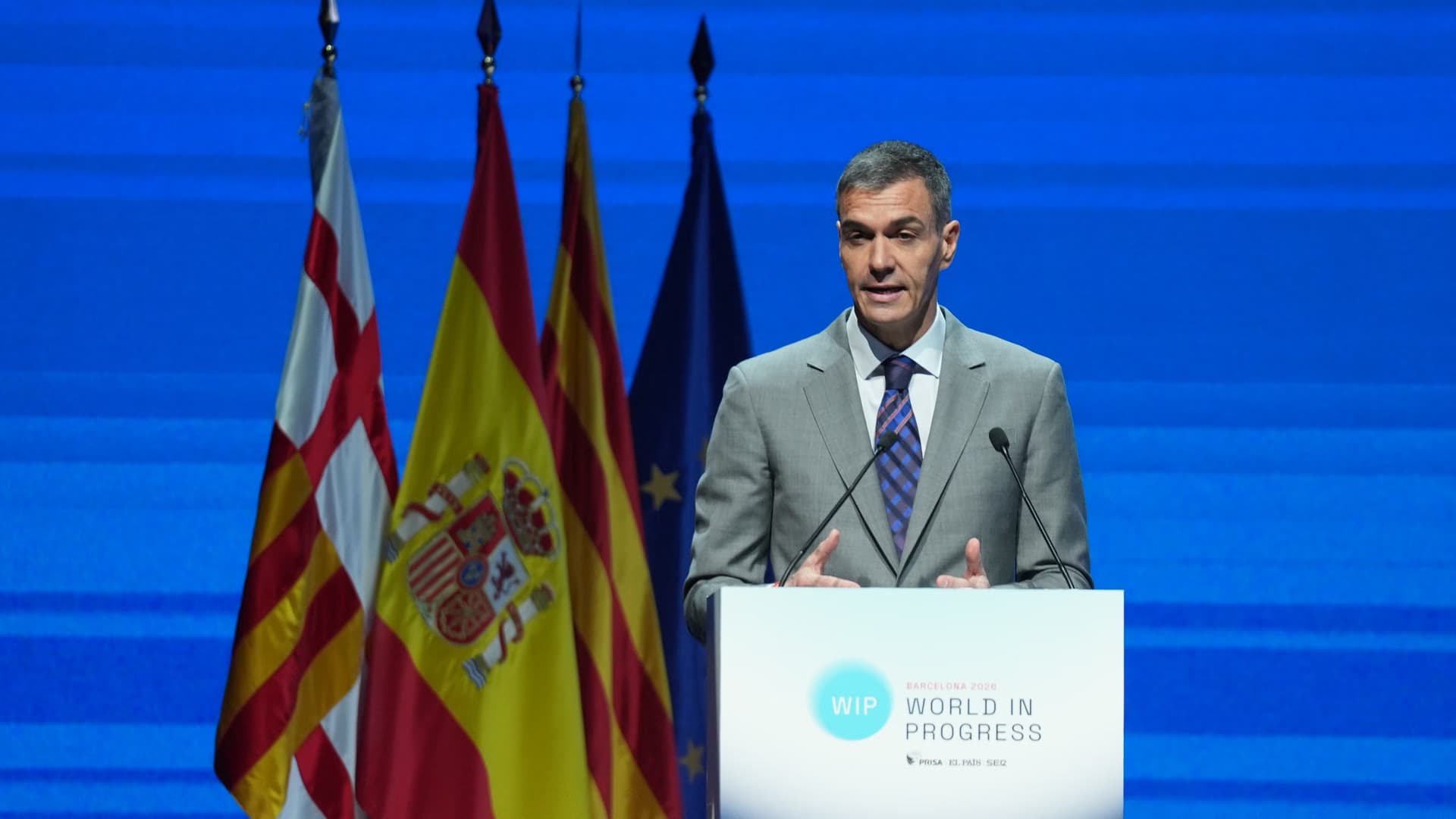
Spanish Prime Minister Pedro Sánchez stressed that his country is not governed from outside centers in a speech titled "Rethinking Europe" at the World in Progress (WIP) forum in Barcelona. Sánchez said, "Spain is governed from Spain, not Washington. Certainly not from Tel Aviv either, nor from Moscow or Buenos Aires. This is the path Europe needs."
Speaking on the opening day of the forum organized by the PRISA group, owner of El País newspaper and Cadena SER radio, at the Palau de Congressos de Catalunya, Sánchez made the remarks while criticizing center-right parties that form alliances with the far right. Citing German Chancellor Friedrich Merz and Polish Prime Minister Donald Tusk as leaders who have closed the door to the far right, Sánchez said there were "lines that cannot be crossed." In his view, crossing that line means joining forces with powers dependent on foreign leaders and oligarchs who finance and shape the direction of far-right movements around the world.
"There are countries that want to join Europe, not leave it"
Sánchez also rejected arguments that the European project is collapsing. Drawing attention to how the Union is viewed from outside, the prime minister said there are countries that want to join Europe rather than leave it. He said the country that made the "mistake" of holding a referendum on leaving the EU in 2016 is now reconsidering its relationship with the Union, and that it is not known whether it will return in the future. According to Sánchez, the EU is a "moral beacon" for humanity and a lifeline for human rights, democracy, social and territorial cohesion, and progress.
The emphasis is also notable for Türkiye, which continues to regard EU membership as a strategic goal. Türkiye was granted candidate-country status in 1999, and accession negotiations began in 2005; however, the process has effectively been frozen for many years. Sánchez did not list the candidate countries individually in his speech, but described the Union as an ongoing center of attraction through the countries seeking to join it.
The example of joint gas purchases
Sánchez said Europe is currently facing three major threats: war returning to the continent through Russia's attacks on Ukraine, intense competition between the United States and China, and the struggle over resources, especially energy. Saying that these threats could only be addressed together, Sánchez cited joint gas purchases made during the most difficult periods of the war in Ukraine as an example.
Following Russia's 2022 invasion, the EU launched a joint gas-purchasing platform in 2023 that consolidated demand from member states to secure energy supplies. Sánchez presented the experience as proof of the argument that "Europe wins when it is united."
Warning about an "international far-right"
Sánchez devoted a significant part of his speech to the far right, arguing that for this movement conflict is not a means of coming to power but an end in itself. Saying that its strategies cross borders, Sánchez said the structure he called an "international far right" was forming alliances to weaken Europe from within.
The remarks came as Spain prepared for its general election on November 29. Sánchez returned to his regular program with the forum after days of mourning declared following a train crash in Urda, Toledo, that killed 69 people. Foreign Minister José Manuel Albares, who also spoke at the forum, warned against "foreign interference" seeking to influence elections in Europe.
The cost of the war in the Middle East
Sánchez drew attention to the cost imposed on Europe, the world and especially the Global South by the "illegal war" in the Middle East and tensions in the Strait of Hormuz. According to the prime minister, the war has imposed an additional cost of 100 billion euros on Europeans this year because of rising fuel prices.
Sánchez said his government's investment in renewable energy eight years ago had been the right decision, noting that more than half of the electricity produced in Spain now comes from renewable sources. He concluded his speech by saying, "Our response to those who want less Europe should be much more Europe. More unity against those who want to divide us."
Video: El País / Clash Report · Cover photo: Europa Press
Stay Updated with The Turkiye Times
Subscribe to be informed about special news, developments and announcements. We will keep you informed.
By signing up, you agree to our Privacy Policy