- BIST10012,151-0.94%
- USD49.220.00%
- EUR55.21+0.28%
- GOLD4,195.90+0.13%
- INTEREST37.00%-1.00
- BITCOIN82,500-1.40%
- October 13, 202618°
- BIST10012,151-0.94%
- USD49.220.00%
- EUR55.21+0.28%
- GOLD4,195.90+0.13%
- INTEREST37.00%-1.00
- BITCOIN82,500-1.40%
- October 13, 202618°
Spain's Sanchez calls for UN Security Council veto power to be scrapped
Spanish Prime Minister Pedro Sanchez called on Wednesday for the United Nations Security Council to be reformed to ensure fair representation for all regions. Recalling his country's sanctions against Russia and its arms embargo on the Israeli government, Sanchez described what is happening in Gaza as genocide.


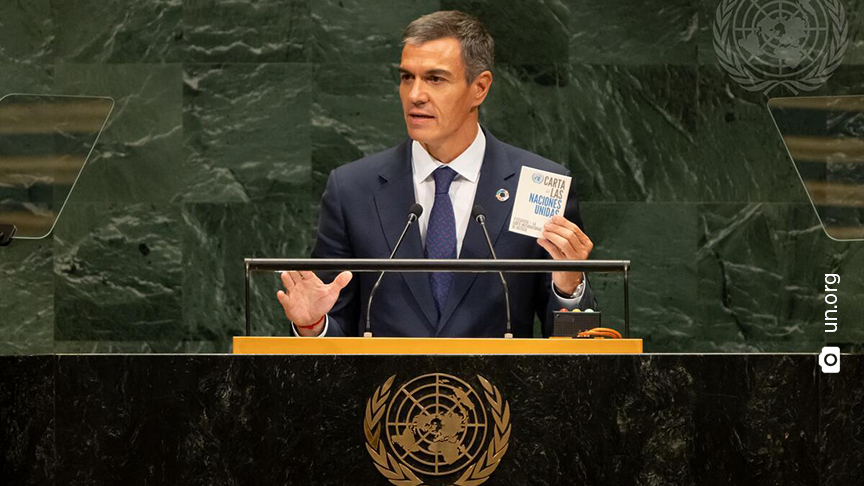
Speaking at the United Nations General Assembly, Spanish Prime Minister Pedro Sanchez called for the UN Security Council to be reformed and for the veto power of its permanent members to be abolished.
Sanchez said all regions of the world should be fairly represented on the Council. He said the UN Charter provides that no country, regardless of how powerful it is, can act as a judge in its own case.
Warning of pressure on the multilateral system
Sanchez said the fundamental principles of the international system were being increasingly questioned, and that peace, sustainability and equal opportunities were being targeted by political actors and governments seeking to return the world to a dark past.
Sanchez argued that forces opposing multilateralism were carrying out a planned and coordinated effort to weaken international institutions. He said these actors first questioned international rules, then violated them, cut their contributions to multilateral organizations and, after obstructing the institutions' work, sought to portray them as ineffective.
The Spanish prime minister said his country was doing everything possible to oppose actions it considered contrary to the UN Charter. In this context, he cited sanctions against Russia and the arms embargo imposed on the Israeli government.
Sanchez also described as genocide and unequivocally condemned what he said were the actions being carried out by Israeli Prime Minister Benjamin Netanyahu in Gaza. Saying that multilateralism was the best way to manage global interdependence, Sanchez called for trust in the UN to be renewed and the organization to be strengthened.
Proposal for a woman from Latin America as the next secretary-general
Acknowledging that strengthening the UN would not be easy, Sanchez said the next secretary-general should be a woman from Latin America. Noting that all nine people who have served as UN secretary-general so far have been men, Sanchez described addressing this situation as a historic debt.
Irregular migrants in Ceuta
Sanchez also addressed the irregular migration crisis in Ceuta, Spain's territory in North Africa. He said Spain would not take the easy route of treating migrants as enemies or violating the law, and would act with respect for human rights.
According to official estimates by the Spanish government, around 72,000 people crossed irregularly from Morocco into Ceuta on July 30-31. The government's latest estimates show that more than 3,000 migrants, including several hundred children, are still living on the city's streets.
Officials say temporary accommodation centers are being established and that up to 200 people return voluntarily to Morocco each day.
Stay Updated with The Turkiye Times
Subscribe to be informed about special news, developments and announcements. We will keep you informed.
By signing up, you agree to our Privacy Policy