- BIST10012,251+0.82%
- USD49.37+0.07%
- EUR55.21+0.01%
- GOLD4,182.70+0.13%
- INTEREST37.00%-1.00
- BITCOIN83,494+0.48%
- October 14, 202617°
- BIST10012,251+0.82%
- USD49.37+0.07%
- EUR55.21+0.01%
- GOLD4,182.70+0.13%
- INTEREST37.00%-1.00
- BITCOIN83,494+0.48%
- October 14, 202617°
Turkish Scientists Complete Arctic Climate Change and Space Tech Research Expedition
The 6th National Arctic Science Expedition, organized under the auspices of the Presidency, has been completed.


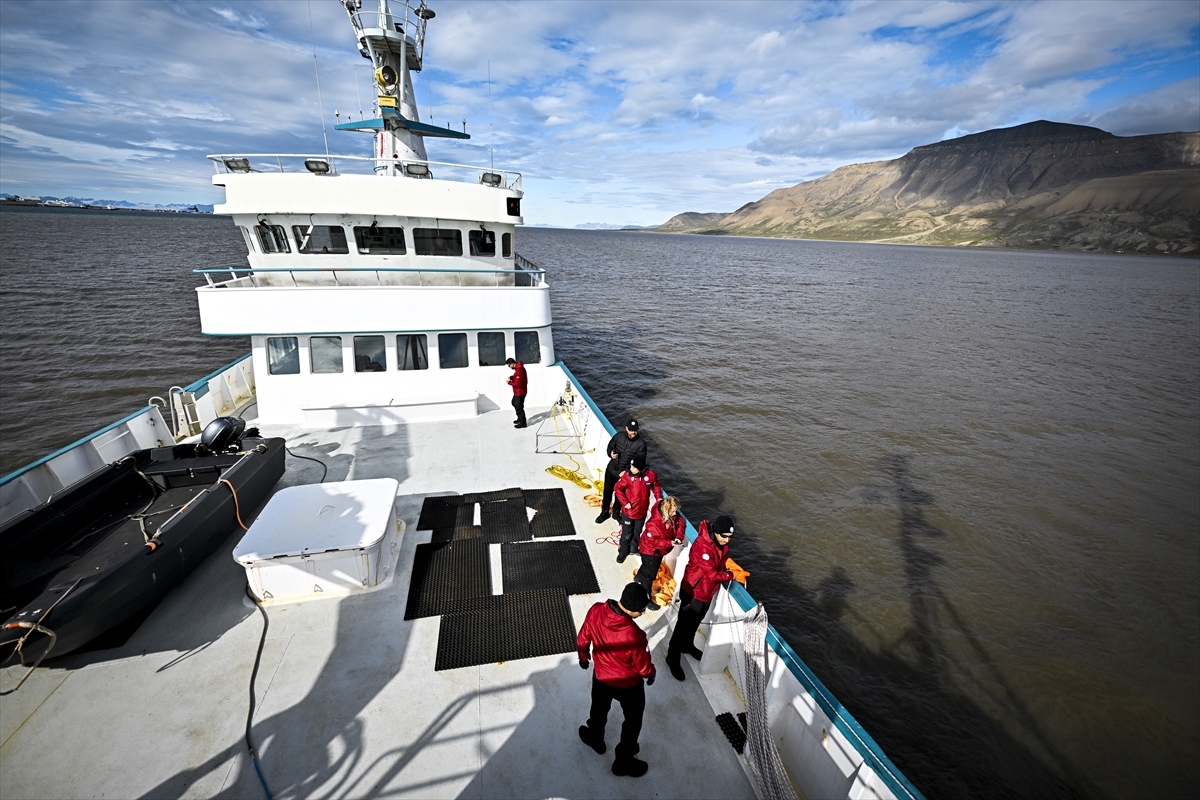
The 6th National Arctic Science Expedition (TASE-VI), organized under the auspices of the Presidency, coordinated by the Ministry of Industry and Technology, and led by the TÜBİTAK Polar Research Institute (KARE), has been completed. During the expedition, 12 scientists carried out 12 scientific projects in fields such as oceanography, biology, chemistry, atmospheric dynamics, meteorology, geodesy, and satellite systems.
The team, which also invited three foreign scientists from Argentina, Bulgaria and Uruguay, reached 82 degrees North latitude by ship. The work was carried out within the framework of the National Polar Research Strategy, which focuses on priority issues such as global climate change, threatened ecosystems, and the impacts of human activities.
Climate Change's Impact on Marine Organisms Examined
Prof. Dr. Denizhan Vardar from Istanbul University’s Institute of Marine Sciences and Management said the team investigated the impact of climate change on living organisms on the seafloor. Vardar stated, "We applied to TÜBİTAK 1001 polar research projects and our project was accepted. That is how we came here. Our work has two important aspects. First, we are taking images from 28 seafloor points and examining the coverage of the surface by living organisms. We are also using underwater robots and drones to determine the boundaries of the areas where these organisms appear and disappear." The scientist added that they also filmed critical areas such as glacier-front regions with underwater drones.
Nanomaterials Tested Under Near-Space Conditions
Prof. Dr. Filiz Altay from Istanbul Technical University’s Department of Food Engineering explained that her research is primarily related to nanotechnology applications, which later sparked an interest in space research. Altay stated that the project approved by TÜBİTAK KARE consists of two parts, and said, "In the first part of the project, we aim to determine the stability of nanomaterials produced in the laboratory under space conditions. In the second part, we are trying to obtain exosomes, the vesicles that enable intercellular communication, from fish living in this region."
Medical Team on Standby Throughout Expedition
The deputy head of the expedition and health specialist Assoc. Prof. Dr. Bengüsu Mirasloğlu said her task was to intervene in participants' possible emergencies, illnesses and sudden health problems. Mirasloğlu noted that the health preparations for the expedition began long before departure, and all participants underwent detailed health checks and tests. "The aim of these checks is to prevent possible health risks, take precautions against diseases, and provide treatment when necessary," she said. Mirasloğlu added that participants received special training and were informed about basic medical aid before the expedition, and that they did not encounter any serious health issues during the expedition.
Svalbard Island Is Crucial for Understanding Climate Change
Researcher Özkan Özel from Dokuz Eylül University’s Institute of Marine Sciences and Technology stated that he joined the expedition after his project was approved under the TÜBİTAK KARE KUTUP-1001 program. Özel said, "Our research is of great importance. The selection of Svalbard Island is particularly important for understanding the consequences of global climate change because it is one of the unique places where atmospheric processes interact with sea and ocean waters." He emphasized that the region is a natural laboratory where freshwater and saltwater meet, and noted that conducting research in the same area and at the same points for about three years would enable them to obtain important data on the melting process of glaciers, the rate of disappearance, and the effects of climate change, and they believe that this research will contribute to developing future predictions.
Precision Positioning Technologies Tested
Research assistant Emre Bozdoğan from Gebze Technical University’s Department of Geodesy Engineering reported that the team collected data from the expedition’s starting point in Tromsø using three GNSS receivers and antennas for different purposes. Bozdoğan said, "The aim of our project is to test the effectiveness of different GNSS positioning technologies under Arctic conditions. We are also investigating whether data loss caused by signal interruptions and GNSS corrections can be compensated with the kinematic VRS technology-based positioning software we developed." He added that the project aims to provide continuous positioning capability in the GNSS field for both Turkish and global scientific literature.
A Student’s Passion for the Poles
Murat Cürebal, a senior student at Istanbul Technical University’s Department of Geodesy Engineering, said he analyzed and compared high-precision positioning methods in GNSS systems. Cürebal stated, "My project was accepted within the TÜBİTAK competition. I have been interested in polar regions since my early years as a student. I am happy to be here. I hope to participate in many future expeditions. I am very excited and happy."
Stay Updated with The Turkiye Times
Subscribe to be informed about special news, developments and announcements. We will keep you informed.
By signing up, you agree to our Privacy Policy