- BIST10012,151-0.94%
- USD49.220.00%
- EUR55.21+0.28%
- GOLD4,195.70-0.49%
- INTEREST37.00%-1.00
- BITCOIN82,434-1.48%
- October 12, 202619°
- BIST10012,151-0.94%
- USD49.220.00%
- EUR55.21+0.28%
- GOLD4,195.70-0.49%
- INTEREST37.00%-1.00
- BITCOIN82,434-1.48%
- October 12, 202619°




Foreign Minister Hakan Fidan at AA's Editor's Desk: The Mecca Alliance, Hormuz, Gaza, Ukraine and Cyprus
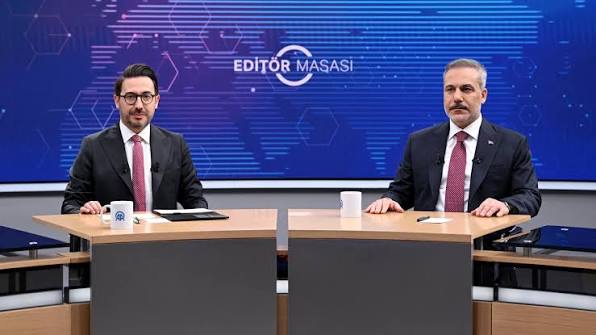
Foreign Minister Hakan Fidan was the guest of Anadolu Agency's Editor's Desk on 8 August 2026, the day after Türkiye, Saudi Arabia and Pakistan signed the Mecca Defence Agreement. Fidan spoke about the agreement's similarity to NATO's Article 5, its institutional structure, the possibility of its enlargement, the Strait of Hormuz crisis, the Gaza Peace Plan, the attacks in the Black Sea, the Terror-Free Türkiye framework law, Cyprus and the ASEAN Dialogue Partnership.
The guest of Anadolu Agency's Editor's Desk is Foreign Minister Mr Hakan Fidan. Minister, welcome.
Thank you.
We are holding an 'Editor's Desk' at an hour we are not used to.
Yes.
What does the Mecca Agreement aim for?
Because we truly have a very special agenda. You have come straight from your trip. Türkiye, Saudi Arabia and Pakistan have signed an agreement. The Mecca Defence Agreement, the Mecca Agreement. We would like to start with this first of all. What are Türkiye's goals in this agreement? Did Türkiye need such an agreement? I would like us to talk about that as well. Could you tell us a little about this agreement?
Of course, with pleasure. Yesterday, as you said, was truly a historic day. There are certain cornerstones that we have been aiming for over many years in the foreign policy we conduct under the leadership of our President. We witnessed an event related to the realisation of one of them. Now, as you know, there has been instability in our region for many years. Wars, occupations, exiles, displaced people… These are events that have long been going on in our own near east, in our own near south-east, in the geography generally known in the world by the name of the Middle East. Of course, this absence of a system was an issue that we, the AK Party governments that have been in power for many years, followed very closely, analysed, and constantly racked our brains over, asking, “What kind of lasting arrangement can we bring to these problems?” Frankly, over the last few years, by further maturing our views on this issue — “what kind of steps can we take in practice” — first our assessments, then sharing them with the relevant parties, and so on, we have finally, thank God, arrived at the stage of making them concrete.
Our aim, as we always say, is that increasing our regional ownership is important. Because hegemons coming from outside do not solve the problems in the region; they make them even more acute, and the cost is very high. The countries of the region need to move towards more institutional arrangements that will, in fact, guarantee their own security, their own economic stability, their own development and their own prosperity by themselves. We have very good relations with almost all the countries of the region. But these were relations that truly depended on the conjuncture, depended on political perceptions and understandings, and were of a kind that could change at any moment. But Türkiye's foreign policy has for a long time, under the leadership of our President, been the same… We have always thought that making this more lasting would be more beneficial. The matters we call a relationship of brotherhood, or simply a relationship, between us need to be at a more structural, more professional, more self-sustaining level for the stability of the whole region. In that respect — and this was something I was always asked from time to time in particular — “What is your regional vision as Türkiye?” We always said this: in fact, there is a need for a defence alliance in this region. Countries cannot build economic structures on top without being sure of each other's security; this is something history has also shown. We saw this in the European Union too. We saw the European Economic Community come into being within the atmosphere provided by the American security umbrella, and then evolve. Here too, there is a great will to eliminate the instabilities in the region, or at least to halt them, and to advance the prosperity of the people of the region by achieving greater economic and social integration. This is not an easy job. We are at the very beginning. We are aware of this. All the mental and conceptual preparations and plans for this exist. We have work on how we will put these into practice institutionally. And we know what kind of problems we will encounter while doing this. For exactly 2 years and 8 months I have been talking about these without interruption with our partners — the partners with whom we signed and the other countries of the region. Our President, of course, always raises it in the talks he holds at leader level. This is something we have worked on a great deal…
So this agreement had been in preparation for 2 years?
Of course. Its passage from the level of an idea to a concept, and from a concept to the point of an agreement…
Comparison with NATO's Article 5 and how it will work
Now, Minister, I would like to go gradually into the details of the Agreement together with my editor colleagues. First of all, the principle said to resemble NATO's Article 5, “Any attack on one of the three countries shall be deemed an attack on the entire pact” — is this the same as NATO's Article 5? What is our approach here?
Technically, it is the same. That is precisely why you set up a security pact; that is why the other countries take the ultimate decision to join an alliance — to benefit from each other's protective support. There is no problem here.
So it brings an obligation for the signatory countries.
Of course, of course.
Well, is it something that will be activated immediately? Could you elaborate on this a little?
Of course. Let me elaborate on it like this, without going into too much detail and boring our viewers. Essentially, agreements of this kind... Look, we have been in NATO since 1952, for very many years. We go to NATO meetings, we take part. We hosted the latest NATO Summit, after all. We prepared the concept papers. We contribute to strategies, plans and programmes. In its entire history NATO has taken a joint intervention decision and launched an operation once or twice — twice, I believe, when I last checked. One, it supported a matter in Afghanistan; and the other, it supported in Kosovo.
Apart from that, NATO's preparations… NATO's greatest deterrence is developing a deterrence capability in a defensive posture, that is: “If you attack me, I have made my preparations; I am a military power with such a large community behind me — do not test my strength.” Therefore I am not attacked, and the geography I am in develops by resolving whatever political and economic problems there are, and proceeds along a more normal path. Now, this is important. Because what blocks all progress is violence, war and tears. You increase your deterrent power.
A second point is this: the way of entering alliances of this kind — rather than sending a message to the outside — is that the countries signing this alliance demonstrate, and commit, that they will not be a threat to each other's security and that, on the contrary, they will in fact be a guarantee of each other's security. That is the starting point. When you enter a security alliance, it is not against an outside actor; it is a matter of “internally, from now on, we are in solidarity with one another; no harm will come from one of us to another.” This is an important starting point.
After that, one needs to work according to the existing threats. Now, in NATO, as I was saying, there is preparatory work, there is interoperability. Here too — perhaps if you ask further on how it will function — there are a few points.
Well, the most frequently asked question is: in the event of an attack, does an obligation arise immediately, and how will that obligation be made operational?
Now, when you look at the text of the agreement, there are of course general commitments there. In what practice and in what way these general commitments will be implemented always depends, as I said, on a discussion and on the relevant institutions taking decisions. First of all, a country needs to make a call on the matter. That is, “I am in difficulty on such-and-such an issue, help me with this” — that is the first thing. The country also defines the nature of the assistance. It says, “I need intelligence, I need logistics, I need ammunition; failing that, at a more advanced stage, I need military units.” These are multi-stage matters that vary according to the scale of the threat. In the work done so far, the perspective we have put forward is this: now, structurally, there will be a Ministerial Committee. Just as in NATO, there is a Political and Military Committee made up of the Foreign Ministers, the Defence Ministers and the Chiefs of General Staff. The Political and Military Committee is the committee that takes decisions within this Alliance on the vision set out by the leaders and carries out the work. There will be a Secretariat, an Organisation, that will implement the vision it sets out. This, too, is an important structural step. That is, there is no “We signed here and went our separate ways.” This Secretariat will then closely follow the matters relating to this defence alliance among the three countries — the implementation of the decisions taken. We have not started work here yet; the signatures have only just been put down. After the first Committee meeting, the matters that we as Ministers will probably submit for the approval of the leaders will be the establishment of the Secretariat, its structure, its functioning and the first tasks to be assigned to it. There are, of course, a great many matters here. Military matters — that is, what we call the ability to work together, a very important matter conceptualised in NATO as interoperability: countries with different army structures being able to operate and work together, side by side; mutual training and support, logistics, threat analyses, intelligence sharing and, most importantly, cooperation in the defence industry. The most discussed topic among the leaders yesterday was cooperation in the defence industry and countries benefiting from each other's technologies in this field. As I said, this is serious institutional work that requires continuity. It will have work of its own that, from now on, runs on automatic. When countries find themselves under pressure, they will not be in the position of saying, “What were we going to do together?” As you may have noticed, the point we always emphasise is that in foreign policy, or in any matter, success should not be left to chance; it needs to be institutionalised, it needs to be made permanent. Rather than “You are good today, bad tomorrow,” countries need to be members of an alliance built around certain interests. Another matter is that these three countries are the core countries.
Deterrence and the definition of the threat
Minister, you said that technically it is in fact the same as Article 5. It was also announced that the Agreement does not target any country. However, there is of course an ongoing Iran War at the moment, the Houthi threat, and Israel's aggression in the region. What is this agreement's aim in terms of deterrence? What does it define as its main threats?
It is like this: at the moment, as I said, there is no such thing as a common threat that has been put down in writing and signed at the top and bottom by us. We are making a commitment that “From now on we will concern ourselves closely with each other's security” — this is a starting point. But let me tell you the spirit of the matter. However the spirit developed, however the discussions were held, you will see in events that in practice too — both in putting things into writing, in their legality, and in the formation of units and actions — action is taken in line with that spirit. Our discussions began before the current war situation. That is, there was no Iran–America war or Iran–Israel war at that time. But in the region — that America would redefine its security concerns; that there were a number of other developments and that those would happen too; that Türkiye has its own fight against terrorism — we always knew these would come onto the agenda. Now, frankly, as the countries enter this alliance, this also needs to be underlined: when you look at their foreign policy stances, Saudi Arabia, Pakistan and Türkiye are not countries with expansionist policies; they are countries occupied within their own borders with their own troubles and their own development, and wishing, if possible, to make a positive contribution to their surroundings through good relations and good neighbourliness. They have different styles, they have different capacities, but, well, that is the point. Now, when we come together with these countries, we naturally become a defence-oriented organisation. That is, it is not an offensive approach of the “Let's go over there and all together do this and that” kind. Therefore, as long as it is not attacked, whether from within the region or from outside it, this alliance cannot have any quarrel with any country in the region. But of course this composition of forces we have put forward will make a constructive contribution to regional stability; that also needs to be said. That is in fact why we are establishing it. That is also why we are taking it forward. But I underline this: Iran is not this organisation's…
It is not its target.
No, no.
Israel, Iran… because these two countries stand out as elements of conflict in the region.
We approach these two in the same way as well; no country that does not attack us is our target.
When we say “we”, do we mean the three countries? Türkiye, Saudi Arabia and Pakistan.
Of course.
Compatibility with NATO membership
Well, Minister, Türkiye is also a NATO country. Was this issue discussed with your Allies in NATO? Will there be any overlap between the obligations there — Türkiye's obligations — and Türkiye's obligations under this new Defence Pact?
Well, technically this was a matter we had thought about well in advance. It is an issue we put under the microscope both legally and strategically. The short answer is no. That is, there is no conflict here, there is no problem here. And we are not the first to do this anyway. You can see, for example, that America has similar agreements with many non-NATO countries: it has one with Israel, there is the system we call the “Quad”, there are the agreements it has made in the Asia-Pacific with Australia, New Zealand and Japan. It made this agreement with Saudi Arabia; it recently made this agreement with Qatar. As you know, right afterwards, within the past year, they made this agreement as well. Here, these countries'… France has advanced military arrangements with the Greek Cypriot Administration, which is not a NATO member. In fact, when Macron was recently in the Greek Cypriot Administration, he said something along the lines of “If anything happens to you, we are here.” This is actually not a new phenomenon within NATO; alliances of this kind exist. Türkiye, of course, is a country conscious of its responsibilities, and we are in no way in a position to keep these different geographies and different priorities in conflict with one another. Is it an area that needs to be managed? It is an area that needs to be managed, but in the broad interpretations we have made… In fact, we raised it today as well while I was speaking with my colleague, the German Foreign Minister; actually, I also said it back then when I was explaining: now, what we are trying to do here — a regional security architecture based on regional ownership, and as you know we carry weight in three or four strategic locations — we also need to do in Europe. As you know, we also have very serious talks and discussions with Europe on “what we can do in the security architecture”.
Because of its geography, Türkiye has a strategic orientation through the Caucasus, the Middle East, the Black Sea, the Mediterranean and the Balkans towards the wider European geography. Here you need to develop a perspective for each strategic basin and, with this perspective, harmonise them, even if areas of tension arise. We saw this in NATO. We became part of the European Security Architecture, and all the problems we experienced were those coming from the Middle East. Because apart from us, no NATO country had a border with the Middle East. We drew the lesson from this, we analysed it. Then, likewise, the Caucasus issue… There was no other country among the NATO countries in Türkiye's unique position. Theirs is, after all, the transatlantic relationship — military solidarity in the geography between Europe and the Atlantic, that is, America. Now, since we likewise do not have just one strategic basin of our own — and each strategic basin involves positions and conditions that differ from one another — we need to develop a security architecture for them, we need to develop an economic architecture, and since we do not proceed with a hegemonic mindset, we need to do this together with the countries of the region. After the agreement in the Caucasus, God willing… There is currently a ceasefire, a ceasefire that is working well; Armenia and Azerbaijan are moving towards a lasting peace agreement, and we support this. While supporting it, we have in mind a perspective of a security and economic architecture. The same goes for the Middle East, and the same goes for Europe.
Could a similar micro defence pact also be built in the Caucasus region and in the Central Asian region?
These can be built when needed. At times there may be a greater need for the economy. But since, as you know, the Middle East's biggest problem at the moment is mutual wars, insecurity and conflict, one needs to start with the security architecture. In Europe too there is a search for a security architecture. It is also possible for the European and Middle Eastern security architectures to be harmonised through Türkiye in the long term, even in the medium term. The mental and intellectual groundwork for this is in fact in place. That is, when we worked through the scenarios on this… Because in Europe too there is not a very expansionist mindset; among them too there is a concept of the state in which the majority think, “Let no one attack us where we are, let our economy and our development be good, let us be competitive.”
Frankly, we think these strategic positionings can be harmonised. But as I said, the issues we have been discussing for a very long time with both sides, with our partners both in the Middle East and in Europe, are slowly beginning to take shape. These are matters that are generally accepted, but putting them into practice takes time. The transformation in Europe will be a longer-term transformation.
The Red Sea and the multinational force
Sir, now there is an important issue that could perhaps fall within the scope of this agreement. As you well know, there is a serious debate concerning Saudi Arabia and the security of navigation in the Red Sea. There are Houthi attacks, particularly on Saudi Arabian ships. Saudi Arabia is seeking to set up a “multinational force” here. In recent days, around 40 countries met at the level of Chiefs of General Staff. Would Türkiye join this international force, if we also take this agreement into account? If it does, I wonder what the framework of its contribution would be.
Now, when you look at the way Saudi Arabia has presented the situation in the Red Sea, you actually need to pay attention to that. It raised the issue from the standpoint of world trade security and the safety of Bab el-Mandeb. That is, when calling on other geographies, it did not turn its own bilateral problem with the Houthis into a “come and help me” situation. In fact, here one needs to go a little more into trade data and technical details. We had said this before: in the war and struggle now taking place in the Persian Gulf, the closure of the Strait of Hormuz does not have a direct or very significant effect on us in terms of energy supply. Because we have, in one way or another, secured this through pipelines over many years. There are countries that are affected very differently — that is, countries that cannot obtain energy even if they have the money. It affects us economically, but the closure of the Red Sea trade basin is of course a matter directly related to our interests. The other one is too, but this one is even more directly related.
Therefore, it is perfectly normal for us to take a military interest in this — that is, at a time when the international community has gathered there and paused to ask, “What kind of measure are we going to take here?” Our President has also given the necessary approvals on this matter; our General Staff is going and taking part in the meetings. Türkiye also needs to have a broad perspective. The point where the Red Sea opens out just above, to the north, via the Suez Canal, is the Mediterranean. Who is the most important country of the Mediterranean? We are. The place with the big ports, with the commercial traffic, the port where all the cargo ships in the Mediterranean invariably stop while carrying freight from one place to another, is again us. Therefore, we of course need to be present in order to have a say over any formation there. There is nothing more normal than that.
Saudi–Iranian tension and mediation
Minister, one of the most critical questions here, in my view, is this: Türkiye has always played a calming, sometimes mediating, role in these regional crises. It has shown leadership in this regard. However, it is obvious that in the Saudi Arabia–Iran tension, hot conflict has also occurred from time to time. It is being said that this pact, this Defence Agreement that has been formed, could affect Türkiye's role in this respect. How does Türkiye plan to manage this?
Think of it this way: Russia has an allergy to NATO, and it is also at war with Ukraine; Türkiye is also a NATO member country. Many NATO countries support Ukraine, but there is nothing preventing it from mediating. This has a bit to do with where you stand as a country and how you conduct business. Here, your political leadership — and at this point everyone's trust in our President is absolutely complete… Frankly, I do not see a problem here. That is, when the parties at this point need a mediator, when they believe the suitable mediator is Türkiye, there is no reason for Türkiye not to handle this task. I see no problem here. From time to time they ask this: “How will you be affected by the Saudi Arabia–Iran tension?” It is asked directly, as if this were a somewhat black-and-white area with no grey, but now, when we also talk with Saudi Arabia — that is, their own biggest declaration too — they have no strategy or intention towards Iran along the lines of “Let us fight Iran, let us destroy Iran, let us do this in Iran, let us do that in Iran.” They have different thoughts on this. In particular, that the violence continuing in the Strait of Hormuz should stop as soon as possible… Its biggest advice to the Americans — which Mr Mohammed bin Salman described a few days ago when we were in Mecca, and in his meeting with Mr Trump as well… They have a stance that this war should stop as soon as possible, that military intervention against Iran is in no way a solution, and that this issue should be resolved through dialogue, through agreement.
Saudi Arabia also sees this: any war in the region, no matter how many alliances you have, does not keep you from being harmed. Of course you need to be deterrent enough not to come under attack, but problems need to be managed in a different way. Now, as for the Saudi Arabia issue — in fact, relations did not break down because Saudi Arabia and Iran had problems. A problem arose at some point because their relations with America and Israel were problematic. A second issue, of course, is the question of who is most affected by the Strait of Hormuz. Here, of course, Saudi Arabia, owing to the measures it has currently taken and its geographical location, is not affected by the closure of the Strait of Hormuz as much as Iraq, Qatar or Kuwait. Those are among the countries affected one hundred per cent. As for the United Arab Emirates and Saudi Arabia, their exposure ranges between forty-five and sixty per cent, depending on products and cargo. But this is a grey area.
Did you discuss these with your Iranian counterparts? Were they informed about this Defence Agreement?
With the Iranians — as I said, we have been talking about this in the region for more than two years. There were times when we discussed these matters with the Iranians too. When Iran resolves its own problems in the region — when it becomes necessary to contribute to the constructive policies of the region, to enter that collective space — their role will be needed as well. We always say that; that is, the Iranians are no strangers to this matter.
Institutional structure: the Committee and the Secretariat
Minister, does the Joint Defence Agreement envisage an institutional structure? Within the framework of the Agreement, is the establishment of structural bodies such as a permanent Joint Military Command Centre, a Coordination Council or a Secretariat expected? Are we going to model it on NATO, or, to put it another way?
We will of course learn from our experience in NATO. The examples of what we call best practice there — and apart from NATO there is currently hardly any permanent large defence organisation, and this represents an enormous body of experience. The examples there will of course be drawn upon. Now, as I said, there is a Ministerial Committee for taking strategic decisions at the political and military level. In NATO too there is a Committee of Foreign Ministers and a Committee of Defence Ministers. Here we merged these committees; a single strategic, political and military committee has been established. It comprises the countries' Foreign Ministers, Ministers of National Defence and Chiefs of General Staff. The decisions this committee takes will of course be within the framework of the leaders' vision. They need to meet a certain number of times a year. There is a Secretariat; again an institutional arrangement. A Secretariat, a General Secretariat, will be established. We will discuss the details of its establishment, structure and functioning with our counterparts at our first meeting.
Such as where its headquarters will be?
The Secretariat's headquarters will be in Saudi Arabia. We decided it that way. We will decide among ourselves how the other units to be set up later — military and civilian units — will be organised.
Will there also be joint military exercises, Minister?
There will be exercises, there will be training. These are things inherent in the nature of joint military alliances. Without doing them, you cannot demonstrate interoperability, the ability to act jointly. Because after a while you will see this: when you find yourself in a joint — God forbid — combat scenario, how will your weapon systems and your communication systems talk to each other, how will they be made compatible? These are important issues. But as I said, these are tasks it will carry out after this Secretariat has been established. The Civilian and Military Committee there needs to do these things. It needs to develop standards for this; analyses, assessments — that is a separate matter. But they have a great deal of work to do. In NATO, as you know, there is a large NATO Secretariat General, in Brussels. There is also a large military headquarters in Mons, and that military headquarters has subordinate headquarters. This is of course a very large structure. NATO is currently a gigantic military alliance with 32 member countries. Here we have now started with three countries. We need to take very modest but concrete steps.
Enlargement, Egypt and the Regional Quartet
Minister, is expanding this mechanism to include other countries on the agenda? Are there other countries wishing to join? What kind of mechanism will we see in the future?
Now, I do not want to name them, but there are other countries that want to join this. In fact, while we were drawing up and signing this agreement, it was a matter on which we had some difficulty deciding. The predominant preference of our other partners, as also expressed in the relevant article of this agreement, was this: let the three countries be the founding core countries; let them play an active role in determining the principles, the standards and the survival of this structure, but let other countries join it with the approval of these core countries. Our President's vision in any case includes our not remaining limited to three countries, our growing further and, if possible, all the countries of the region one day gathering under this roof. This is the most important step that will bring lasting stability to the region. Look, for the last hundred years, ever since the Ottomans withdrew from the region, this region has been associated with instability, in one way or another. But now the countries of the region themselves are taking an important step by coming together and assuming their own responsibilities. Until now, attempts were made to achieve things through bilateral steps, but now a bigger step is being taken. I would like to underline one more thing: when you look at Pakistan's geographical location too, we are in fact going beyond a classical definition of the Middle East as well. That is, we look at this matter from the perspective of a wider region, and this too is an important point for us.
Sir, now, there is a mechanism called the “Regional Quartet”, the “Regional 4” — it has also been given a name. What kind of conversation with it, what kind of conversation this alliance will have with it… In fact, an important part of the alliance is also within that Regional Quartet. There is the agreement, but has this alliance also been given a name, does it have a name?
As for the question of what its name will be: what is generally being said at the moment is that it is being referred to as the Mecca Alliance. But there are also those who call it the Mecca Defence Alliance. That will perhaps settle over time. It is also partly a matter for the partners to decide. But when we shorten it a little, we say the Mecca Alliance. Mecca is a very important place for all of us. Egypt and the Regional Quartet… The Regional Quartet is a very important political platform; an informal political platform, and it provides very great flexibility. It will continue to exist; it has to exist anyway. Here, Egypt is in any case our natural partner on all issues. I believe that at the next stage Egypt will also be among us as an ally. We already behave towards each other as if it were a member of the alliance. Relations with all the countries are like that. There are a few technical matters there; once these are put into effect, there is no reason for Egypt not to be in it as well. But the Regional Quartet retains its importance. Egypt is an important country. Neither Pakistan nor Saudi Arabia has any issue with this, there is no difference of opinion; we will all continue with it together.
The US–Iran crisis and the Strait of Hormuz
Thank you. If we have finished our questions about the agreement, let us return to the US–Iran War. Of course, this defence pact may perhaps also have been an outcome of this war. Because there were certain thoughts and ideas, but it accelerated thanks to the war — that is how we understand it. At what stage do you assess the crisis between the US and Iran to be now? It is said that we are close to an agreement on the Strait of Hormuz. But of course it changes every day. Different approaches are put forward every week. In your view, what is the situation in the US–Iran crisis right now?
At the moment, the most important priority, which everyone is working on, is reaching an understanding that will ensure the opening of the Strait, even if only temporarily — it is being described as 60 days. The proposals on this have matured, the drafting has reached a certain point, and something will now emerge once Oman and Iran — one of which lies to the north of the Strait and the other to the south — reach full agreement between themselves on a regime, a procedure. Frankly, I think we are close to that. We also see that within Iran decision-making processes can at times drag on, for understandable reasons. The situation the leadership is in, the security threat, and so on… Reachability also matters. But at the moment the countries of the region, America, the West, Europe, Asia — frankly, everyone is demanding that this Strait be opened as soon as possible. There is great pressure on this.
Is there a role that we, as Türkiye, have taken on in this diplomatic process?
As Türkiye, we are currently talking with the parties. If there is a point where we think things are blocked, we try to unblock it. Here, in fact, the parties currently have a certain preference on certain matters. They have no problem with communication. They are also talking directly themselves. They have no problem in that regard. They have now reached that speed. The mediation we have all put forward has in fact reached such a point that the parties can be in direct contact with each other… At the moment, as I said, there is a procedural situation. That is, the question of how passage will be regulated in the current form. They are discussing this among themselves. Here, perhaps one or two countries that border the Strait — one or two additional contributions could come from them.
The Gaza Peace Plan
Another major issue, of course, is the Peace Plan in Gaza. Here too, Minister, the second phase has been reached. On this matter, we see that Hamas in particular has fulfilled the requirements of this phase and has demonstrated its will to fulfil them. However, Israel is currently backtracking on these matters. What kind of sanctions could be applied militarily, with regard to Israel's stance on this situation — in the sense of its not taking part — what kind of pressure mechanisms could be brought into play? I would like to hear this from you.
As you said, there was the issue of “Hamas laying down its weapons in return for certain conditions”, which was seen as the biggest item for moving on to the second phase in the peace talks. An understanding was reached on this, and the second phase was supposed to begin immediately afterwards. That is, a committee made up of Palestinians was supposed to go in to take over the administration of Palestine, and the stabilisation force was supposed to be deployed. Now, Israel hesitated to start this. We know Israel's strategies very well. Israel never thought that certain issues were within the capability of Hamas and the Palestinians to resolve diplomatically. Therefore it took such a stance on these issues. Whenever they were resolved, it always postponed things to the next point. As you know, some 4-5 hours after Hamas accepted the proposal, Israel carried out an attack that resulted in the martyrdom of 18 people. This is something Israel always does, but now no one has even a single sentence to offer in support of Israel on this. Even the Zionist circles that support Israel the most cannot support it when something like this is at issue.
Here, Hamas's approach of putting the Palestinian people first, of placing their existence ahead of its own, is a commendable approach. The Palestinian people will certainly reward this and appreciate it. The work at this point needs to continue as it is. But as long as Israel's fundamental goal is to empty Gaza of Palestinians, it will continue to resort to games of this kind. So how will this be prevented? Here, the international political mobilisation needs to be sustained without any interruption, without a break; the issue needs to be kept constantly on the agenda with creative ideas, and action taken. What Israel fears most is international isolation. Until today, with the very extensive means at its disposal — which are means located in other countries — by using them it created an illusion in the world. On this illusion it has built a political practice that constantly works in Israel's favour, whatever the conditions. That is, it commits genocide, and even then nothing may happen.
But the whole world now sees the diabolical gap between its own conscience and the illusion that has been created. That this is not an ordinary delusion or the correction of a mistake, and that it is in fact a matter that must gradually turn into a struggle for independence; that people's minds around the world have been shaped at many points by such a movement of knowledge, information and illusion, like the arms of an octopus; that this is a multi-layered, highly systematic movement — the world, we, actually know this. That is, this is not news to people living in this geography who are politically conscious and highly aware. We have always been aware of this. It has always been there, since childhood. It is just that as we grew up we saw — “as we interact with events in the world, this really happens in such-and-such a way” — we saw its mechanics. But to the rest of the world, especially to the West, this is very big news — to many masses, to broad masses. And Israel took advantage of this precisely because it was something these masses had been unaware of for years. Now, as awareness grows, it sees that its isolation will also increase. Here a new story may be produced, a new provocation may be produced, a new narrative may be produced; one must be prepared against these as well, but their job is no longer as easy as it used to be. I had always said this back then too… I had said it with an aching heart, but because we have seen other events as well… It is always like this; there is something like this in the workings of the law of God (sunnatullah). That is, when the blood of so many innocent Palestinian martyrs is shed there, in Gaza, it may not immediately turn into a victory there, but it opens the door to good in many other places, and much of the time we may not know what this good is, unless we look very closely. A mental organisation, a rise in awareness, people awakening to a different world, a new spirit, a new consciousness about the oppressor and the oppressed, the exploiter and the exploited. That is, how a world was secretly built in which Israel abused the means even of its own partners without their even realising it. This is a liberation, a very great liberation.
The Russia–Ukraine war and the Black Sea
So you are saying that, from one perspective, everything is moving against Israel. Indeed, in world history to date there has never been a victory won by killing children and committing genocide.
Sir, another crisis point that concerns Türkiye very closely is Ukraine–Russia. There is an extraordinary deadlock there. That is, the war is deepening. Russian territory has also now become part of the war, with Ukraine's attacks. But most importantly, Turkish ships in the Black Sea are being specifically targeted. There are two problems here. One, in the Black Sea context: Ankara is of course warning both Kyiv and Moscow, but could a mechanism come into play here to stop these attacks, the attacks on Turkish ships, especially in the Black Sea? Is there a plan here? Secondly, you also went to Moscow last month. That was a very critical visit. Then you went to Kyiv. There was a lot of talk that they would make peace, but suddenly things went in a completely different direction. What is the most important obstacle to an agreement between Russia and Ukraine right now? What do you think about this?
If we start with the first part of your question, our warnings are unfortunately coming true. The entire Black Sea has become one of the areas to which the war has spread. At first they were striking the military side, the ports. They were striking military vessels. Now they are striking all commercial vessels, without distinction. Unfortunately, Turkish ships — that is, Turkish-owned or Turkish-flagged ships — are getting their share here too. That is, a ship may be foreign-flagged but Turkish-owned. Sometimes they may be foreign-flagged, foreign-owned ships but with Turkish crews working on board. There are three categories of ships. We are following all of them closely. At the moment, compared with the other ships targeted, the number of Turkish ships is somewhat lower, proportionally. But it is still a matter that causes us great concern. We have a few measures on this that we have also submitted to our President, and we are implementing them. But what I can tell the public is this: we have conveyed our call to both sides for the establishment of a mechanism for declaring a moratorium on this. The Ukrainians already had a request to this effect. We have also conveyed this to our Russian counterparts. We are waiting for their, er, response on this. But now, when you look at the course of the war, we see that both sides are targeting each other's logistics facilities that are important to them. This is a very dangerous…
The war has spilled over to the civilian side.
It has spilled over; we could see this coming. Unfortunately, in its fifth year, this war has come to this. Now, why are the mediators not taking action quickly? The first reason is, in fact, that when the mediating parties step in — the Americans first and foremost — they see this: frankly, as long as the warring parties still have military means they think they can use against each other, no one readily takes steps involving any concessions. And this does not make the mediator's job easier. What always makes the mediator's job easier is both sides making concessions and meeting in the middle. But where no one makes concessions, the war continues with increasing violence until it creates its own space for concessions by itself.
Now, unfortunately, this is what we are witnessing. This is in fact what I told our American colleagues last year. When I saw a loss of morale in them, I said: they are going to drop the matter now and leave. Now this is what will happen: they expect that when both sides have completely worn each other down, a mindset of “let us now come around a table and make peace” will form. Now, this was there before too. When was it there? If you remember, at a point when the negotiations were at their peak, there was this situation: the war had turned into what we call a war of attrition. It was a war of attrition at the front. That is, what was happening? The soldiers at the front were holding their positions facing each other, in their trenches, as in the First World War and the Second World War. Because they cannot advance. They kill with drones and artillery. No one can budge from their position, and thousands of soldiers die there every month. And the countries pour money and people into it. At that time we had defined this as a war of attrition. When we stepped in as mediators at exactly the, in fact, optimum point of this war of attrition, a basis for something had emerged.
A compromise.
A basis for compromise had emerged. There, because a piece of land in the Donetsk region that the Russians had been unable to take — on a scale they put at 24-25% last year and at 15% this year — could not be taken, the parties just could not reach an agreement. The war had also stalled at this point. When this too produced no result, this time the war of attrition turned into a war of annihilation that also takes in civilian targets.
How far can this go, Minister?
That is exactly where the problem lies. When this annihilation — attrition at the front — turns into attrition behind the front, the issue is no longer a matter of losing a war or not, nor of losing a battle on one front or not; it becomes a matter of whether or not you exist as a nation. Then, this time, you use whatever the last means at your disposal is.
We know what the last means at Russia's disposal is. Is this heading towards that, as an analysis?
Of course, of course. Annihilation… If it moves towards that dimension, unfortunately — I mean, so far our analyses have unfortunately always proved right. When we met our counterparts during my visit to Russia, that topic almost came up. Because “the public is now demanding such a thing”. We told the Westerners this too. The Westerners know it as well. Frankly, this is a dangerous situation. Here, whatever it takes, we as the international community need to step in and stop this war, because everything that was said could not happen is happening here. The spread of the war… It is spreading geographically, it is spreading in terms of targets, it is spreading in terms of methods, and it could escalate to a higher level. We need to avoid this. This much should be enough. This much attrition and annihilation should be enough. The Europeans' perceptions in terms of European security and strategy, the Russians' perceptions, the Americans' differences, and where Ukraine stands as a major party to the war differ somewhat. When you get into very deep conversations — we went to both sides and met their leaderships within one month, we talked at length. Then we talked with the Europeans, then we talked with the Americans. In fact, in the strategic assessments at the moment — “let us send very advanced and heavy efforts…”, that is, the understanding that “ending the war is above every other consideration” — has not yet taken shape. Because on certain sides it is thought like this, without my going into detail: “If I leave the war as it is, my loss will be greater than the loss I would suffer from the war continuing. So let me not leave this war like this.” The problem, mathematically, is this: both sides think their losses would be the same. This is one of those rare situations.
Well, do you think both sides would suffer losses at the same rate?
No, no. But there is subjectivity there, emotions are involved, and of course — I do not want to go into detail — there are certain matters here.
Terror-Free Türkiye and the framework law
It concerns domestic politics too, but of course it also has dimensions that affect foreign policy. We will hear from our Minister. Minister, as is well known, a very important step has been taken in the Terror-Free Türkiye process. The framework bill has been submitted to Parliament. What is your assessment of this process?
When we look at the draft framework law, there really are important points in it. One of the important stages for this ongoing process to be brought to a successful conclusion, God willing, is the adoption of this framework law. Here I also listen, from time to time, to certain concerns that arise among the public; they may, of course, be justified in their own way in being concerned, perhaps owing to incomplete information. But this needs to be said: this framework law is very well written and has safeguarding provisions. In that respect it has sound wording, and it has a mechanism. And what is that? Without laying down its own weapons, without giving up its means and capabilities, the organisation will not be able to benefit from what this law provides. As defined there: the organisation abandoning its means and capabilities — its armed ones — and evolving into normal democratic and civilian life; the end of terrorism, which is the strategic goal for us; and the people continuing to live normally in national unity and togetherness. Normally, this should in fact have been put into effect from the day the last democratic reforms were made. As you know, major reforms were made in 2013: education in the language, schools, elective language courses, television channels broadcasting in Kurdish. From the period when all the problems related to identity were removed, the organisation should in fact have evolved onto this peaceful path. But at that time — and of course we talked about this from time to time — they thought that certain regional and international changes and balances would work in their favour. Some also said different things. In the end, they did not take advantage of it. At this stage, reached 13 years later, they now see that neither the regional conjuncture nor the global conjuncture is very much in their favour. They need to be a part of this democratic environment in Türkiye, this environment that works in everyone's favour. That is, what was being done were not things that benefited the Kurds. It is a mode of action that contributes to more economic loss, more instability and more anxiety. God willing, this time they will take this hand, the hand that has been extended. But as I said, the mandatory provisions of the law have truly established good mechanisms; there are verification mechanisms, there are boards. That is, they can rest assured on that score. Thank you.
Cyprus
Minister, of course, the most recent Secretary-General of the United Nations has launched an initiative to resolve the Cyprus issue on his way out. Türkiye is following it closely. I want to ask a very clear question: what does a solution in Cyprus mean for Türkiye?
For us, a solution at this point is essentially the recognition of the two-state solution. This is the ideal solution. The ideal solution is the implementation of the two-state solution: a structure in which both the Greek Cypriots and the Turks have states of their own, and these two states live side by side on the island in peace and tranquillity, contributing both to the island's prosperity and to regional peace and stability. That is where we stand. When we look at practice, how close is practice to this ideal of ours? When we proceed from there, the picture is somewhat different. We need to fill that gap between the ideal we have put forward and the reality in practice. That is in fact the reason why we support the Cyprus negotiations and the search for a solution in Cyprus, and why our President has always supported those efforts.
Now, the Secretary-General of the United Nations, Mr Guterres, is truly a very valuable personality. Throughout his term as Secretary-General, his approach to management always gave priority to human dignity. Both on the Palestinian issue and on other matters, he always tried to stand on the side of what is right. Here too, our President trusts his character. In the initiatives put forward, we believe fairness is essential. Now, the Cyprus that emerged from the 1960 Agreement is not the Cyprus that the European Union admitted as a member in 2004. We recognised the Cyprus of 1960; we were a Guarantor state. There was a Cyprus based on the equal governance of the two communities. Later the Greek Cypriots said, “We do not want the Turks to be in the government.” First they began by throwing the Turks out of the government. Finally, when it came to 1974, Cyprus, the military junta in Greece… As you know, in the summer of '74 it staged a junta coup in Cyprus as well, and the question of annexing the island to Greece arose. Never mind the Cyprus of '60 ceasing to exist — Cyprus was ceasing to exist altogether. For this reason, while the international community was asleep, Türkiye took action both to protect the rights of the Turks in Cyprus and to ensure that Cyprus remained Cyprus — look, this too is an important point. Now, at the point we have reached, the Greek Cypriot Administration is recognised as a state representing the whole of Cyprus. But the Turks living in the north are overlooked and neglected at this point. Who provides their guarantee, both economically and in terms of security? The State of the Republic of Türkiye. They are our brothers. We have no problem whatsoever. We have accepted the Turkish Republic of Northern Cyprus as a sovereign and independent state. All right, we are the only one that recognises it. But that is not something that would change where we stand either. Nevertheless, from 2004 onwards, both in the Annan Plan and later in the Crans-Montana processes, Türkiye — our President at the time — gave its approval to the talks held to see whether a structure could emerge in which the two communities could be equal. The 1960 State was a bi-communal state. Now, both the Annan Plan and the other plans that followed are both bi-communal and bi-zonal, bi-regional. The places where the Turkish Cypriots and the Greek Cypriots live are now clear, separate places. Now, can they reach a solution among themselves? Here, Türkiye's interests, the region's interests and the sovereign, equal and independent standing of the Turkish Cypriots — these are important.
We have always seen this: the Greek Cypriot Administration will never agree to equal sharing of power, of authority, of prosperity or of the state with the Turks. This is a matter as certain as “two plus two makes four”. The man now has a state in his hands; it has become a member of the European Union, it is represented at the UN. It enjoys all the benefits. Now it is supposed to go and share this with someone else. They themselves know this is a lie. We could ask the international community, then; they know it too. Continuing such a lie is not rational. Meanwhile, the rights of the Turks living in the north need to be safeguarded by the international community. Thank God, we are a strong country. That is, our means and capabilities are sufficient for that; there is no problem there. They, too, are a very hard-working country in their own right. They have a dynamic democracy of their own. You can see: opposition, government, many parties — a process running at full steam. They have an economy. But they are not left to themselves. The Greek Cypriot Administration uses the rights stemming from its being a state to block all the benefits that could come to the Turkish Cypriots from the international community. In trade, in transport, it blocks all of these.
Now, it is a very long subject... Just, in two ways, where do we focus? First, when proposals for a solution of this kind come to us, we look at whom they come from. If they come from the United Nations, if something comes from Mr Guterres, we listen to it. That is, our President, the UN as the international community… Because there was a state established in 1960 through UN resolutions, and it is gone. The international community needs to understand that. Second, we support every kind of dialogue environment that includes the Turkish Cypriots, because the position of the Turkish Cypriots needs to be well understood. The political generation of 20 years ago, in Europe or elsewhere, may have understood this, but it needs to be explained constantly. Now there is a new generation, and they need to explain again and again why the Turkish Cypriots established a state, why they had no option other than establishing a state, and how unjust the isolation suffered by the state they established is. We support this dialogue environment.
Secondly, our President has developed a method, which I am proposing to the parties on the ground. We do not need to wait for lasting solutions in order to achieve certain benefits. Both the north and the south of the island need water, energy, electricity; they need tourists. Joint projects and joint work can be carried out for these. We have also conveyed this to the Secretary-General. This can be considered as part of confidence-building measures between the two sides. Because the Greek Cypriot side is content with where it is, and the Turkish side is content with where it is. That is, the parties no longer have any issues with the places where they are geographically located. Because since 1974, for the last 50-odd years, the parties have been in the same places. New generations have now formed there, come into life, and there is a life that goes on. However, the means the Turks possess are more limited than those of the others. This needs to be overcome. That is why — but what do we do in response? We, too, do not recognise the Greek Cypriot Administration as a state. That is, if you do not recognise the rights of the Turk of Cyprus, I will not recognise your existence as a state either. Because you are not the state established in 1960. Everyone knows this. Therefore our non-recognition is also entirely legitimate. And that in turn brings a number of disadvantages for the Greek Cypriot Administration. In fact, it is possible to leave these issues to the long term and for both sides, without changing their legal positions, to take mutually beneficial steps that will build common trust. As I said, we have put this to the other side very boldly, with creative ideas. There can be energy cooperation, water cooperation, commercial cooperation. Everyone can make money, everyone can live well. The presence of Turkish troops there, look, has not changed the status quo at all; the status quo has been the same for 50 years. This means that the stability and peace on the island exist for one single reason: the presence of Turkish soldiers on the island.
Is this indispensable for the island?
Under these conditions. That is, under conditions in which neither side consents to a lasting agreement. Because with the Greek Cypriots, you cannot prevent this. There is this thing where, I mean, they say, “The whole island belongs to me.” Now, if you use the overwhelming means in your hands against the Turks, who will come to the aid of the Turks? It will be us who go, once again.
Therefore, where this has not been tied to a lasting solution, where conditions remain the same, you cannot expect this to change in the equation either; nor will it change. But as I said, had the Annan Plan been implemented, had something been achieved at Crans-Montana, perhaps different steps could have been taken. But the current status quo will never allow certain balances to change.
ASEAN Dialogue Partnership
Minister, last month in Manila, Türkiye obtained ASEAN Dialogue Partner status. What opportunities will this status offer Türkiye? Following on from this, what concrete steps will we see in terms of the defence industry, increasing the trade volume and participation in the regional security mechanism?
As we have seen in ASEAN, and as we have seen in the security pact we discussed at the opening a little while ago, in foreign policy we are constantly trying to carry certain things forward in an institutional and structural way. By dropping anchor on solid ground, we try to ensure that productivity and success are not random. We try to make them lasting. One of the issues we have been working on for the last three years was the ASEAN partnership. Here there were 11-12 of the world's largest countries that have dialogue partnerships with the 11 ASEAN countries: China, America, Russia. This is the only place where all these countries meet. Because the ASEAN countries have a population of 700 million and are countries that are quite politically neutral but focused on the economy, development and the market. There too, there is a big... At the moment there is Thailand, which has a border dispute with Cambodia. That is, they have a problem between themselves. Apart from that, frankly, the region is calm. There is great economic potential here, there is productivity. How can we benefit from this economic productivity in real terms? Frankly, we have serious pursuits and work on this. There had been a search for this. As you know, we have opened Embassies in all of these countries.
Our businesspeople have major activities there, and we have major investments. But we need to be in a constructive dialogue with this region. That is, in a place where Russia, America, China, the United Kingdom, France and Canada are present, it was not acceptable for the Turkish economy not to be a structural partner. Although they had declared a moratorium, Mr Serdar. That is, the ASEAN countries — saying, “We are already few ourselves, and our capacity to handle things with our dialogue partners may be limited” — and there was a great deal of demand from around the world, had declared a moratorium quite some time ago on accepting new dialogue partners. But as a result of our persistent and systematic efforts, thank God, this too has come about. From now on we will continue to work very closely with the ASEAN region. In general, this should be said: in this foreign policy that we conduct under the leadership of our President, our policy of going far beyond our classical areas — that is, of developing commercial, economic, social and political relations — is proceeding very systematically. It is like this with the African countries too; we are like this in Latin America, we are like this in the Asia-Pacific. God willing… We do not get fixated on this — that was the mistake of the past, of past foreign policy making. The fire in your immediate region engulfs you so much that you inevitably pass over the other places history has cast you into. Now, it was necessary to have — mentally as well as structurally and institutionally — the means and capabilities to manage different crises at the same time, and the mindset and institutional structure to see and manage crises and opportunities at the same time. That is what we have done. A crisis we are dealing with in the Middle East should not keep us from securing an interest in the Asia-Pacific. Our mind should not be imprisoned in there. Fine, it is heavy, it is big, we deal with it at the level of leaders, but other institutions, other structures we have established, should be able to take charge there. Thank God, that institutional maturity, that mental awareness, that diplomatic skill is something Türkiye possesses at the moment. And we are using this to the full.
The AK Party's 25 years and foreign policy
Minister, the 25th anniversary of the founding of the AK Party is approaching. One of the areas in which our country has been most effective during this period is undoubtedly foreign policy. We see that Türkiye is conducting a very effective, simultaneous foreign policy and diplomacy across many geographies and on many issues. How do you assess this picture?
I tried to express this throughout the programme as well. In fact, Türkiye, as a respected actor, makes very great and constructive contributions — pre-emptive contributions — in the face of all the vital problems facing both the region and the world. Now, how did this come about? This is in fact, in a sense, also a history of the AK Party's foreign policy. When the AK Party was founded 25 years ago, the world looked like this: a world that had just emerged from the Cold War, searching for a mental framework, trying to prepare for the post-Cold War period. In 2001, 9/11 took place, and right after that the AK Party was founded. There was a need here for a cadre and a mindset that would read and understand well the new world that was emerging and position Türkiye's place in it well — not merely as rhetoric, goals and ideology, but also by reading the existing reality well. There is a formulation that the AK Party put together by drawing lessons from the mistakes of the past, by assessing today's conditions well, and by taking into account this nation's strategic culture, its strategic aspirations and its strategic state of mind. Of course, in the post-Cold War period, as you know, Türkiye–NATO… Türkiye had to come out of the autopilot mode in which it had felt comfortable in its foreign policy during the Cold War. In that period the alliances were clear, the enemy was clear, the friend was clear, your room for manoeuvre was clear. You had handed over from the captain to the autopilot, and you were proceeding with foreign policy on many important, vital issues. But in the post-Cold War period, when friends, enemies, alliances — everything — had changed, you now need to fly not on autopilot but in free mode, in manual mode. And there the captain matters. That is, our nation's greatest advantage here is in fact that our President emerged as a leader. You need the captain to take the seat and fly the foreign policy, which has come off autopilot, manually. Because there is no longer anywhere in the world that you can put on autopilot. That world is no longer the world it was.
Autopilot would probably not have led to the Mecca Alliance.
Impossible. That is, autopilot… That place no longer exists anyway; you are trying to keep it alive in your mind. The Transatlantic Alliance has undergone many transformations. You have been pushed out of the friend category into the enemy category in terms of the clash of civilisations. Especially after 9/11 this became entirely evident. You insist on trying to keep it there in your mind, but it just does not work. That is, you try to join the EU, there are other kinds of problems there, and so on. It is necessary to pursue all our goals — that is, our goals inherited from the past — at the same time, while also taking the new risk environments well into account. Of course, this was not easy. Look, it was very difficult. We saw this a great deal in Syria, in Iraq, in the fight against the PKK and on other issues. When the AK Party came to power, Türkiye was not ready, either mentally or structurally, for the period of uncertainty that emerged after the Cold War. Its institutions were not ready, nor were its means and capabilities. Today we can say this. Had we been state employees at the time, we could not have said it. You cannot say, “We are not ready for this, we are not ready for that.” That runs counter to the etiquette of running a state, but years have passed, and you now assess certain things in hindsight.
Here, in the face of such impossibility, a leadership emerges. At home there is a pile of accumulated problems relating to the economy and development. There is an infrastructure problem. You need to solve those. You have a ton of problems with democracy. First and foremost, there were the issues described at the time as the denial of identity. There were other democratisation problems, relating to freedom of thought. You have a ton of problems in foreign policy. Problems in domestic politics... All of these at the same time, without interrupting the flow of normal life — people will marry, there will be children, there will be grandchildren, there will be jobs, they will earn, they will go bust; that is what I mean by normal life — without interrupting normal life, where are you making possible a world with its hardships and its blessings? In a place where everyone is on fire. Your north is on fire, your south is on fire, your east is on fire, your west is on fire. Everywhere is on fire, and here you carry the job forward in manual mode, with the skill of the pilot, the captain. Now, this is the AK Party. This is the AK Party.
Wherever I go, when speaking at party bodies, when I am assigned, I always tell the delegates and members there the same thing. The success here is your success. Because you have consistently elected the government that serves you, that brings you success and benefit. You brought our President to the office of leadership again and again. This long-term leadership has given us a very great strategic advantage, especially in foreign policy. That is, you cannot bring about certain alliances, certain transformations and changes in 5 years, 6 years, 7 years. Over many years, the same will, the same alliance, the same cadres need to act together and carry issues forward stage by stage. Especially in the region we are in, personal relationships and accumulated experience have an incredible effect on managing events. As I said, you are not on autopilot.
When you expect something from a hegemon, the hegemon comes to you with its own institutional capacity and does something; that is how it has always been in the region. But now a person who has governed and led in the region for many years, our President, comes forward and says: I have been governing in this country, in so much of the region, for so many years, as your brother. I am the leader of this country. I have such-and-such a vision for this region and for Türkiye. And when people listen to this, they say, “This is something in the interest of all of us.” That is, everyone wants to take what is happening in Türkiye as an example. Therefore, this vision put forward by the AK Party needs to continue without interruption. Our President's leadership also needs to continue.
There are many things to talk about on this foreign policy question. That is, there are many things to discuss within the triangle of where the AK Party stands ideologically, the expectations and the steer of the grassroots, and our President's leadership. Perhaps we will do that in another programme. That is a somewhat more social and intellectual topic.
Closing
Minister, thank you very much. Well, we now have to bring to a close this programme, which we began with the Mecca Defence Alliance. Our assessment is that this Alliance generates confidence among friends and concern among enemies. Let us have a final assessment from you and close our broadcast.
What you say is right, confidence among friends… There are many who are very pleased. There are especially countries that are not members of the Alliance yet are as pleased about it as if they had joined it themselves. There are just as many communities of people. Truly, there are many, especially from the Islamic world, who strongly support this. There are also those in the West who support it — among those who know the real nature of the matter. That is, the way for the Middle East to cease being a place that produces trouble and problems for humanity and for the international community and, on the contrary, to become a place that produces added value with everything it has, lies in bringing constructive alliances of this kind to life, and frankly those who take the lead in this are appreciated. Saudi Arabia, Pakistan and Türkiye have played a great role here with their leaderships. The task that falls to us, in the offices we hold… We are also aware that this political will put forward by the leaderships of the three countries has created very great regional and global expectations. We need to give it substance in a very professional manner and move it forward step by step, working on it, and we have begun doing so. God willing, we will continue.
Thank you. Today is 8 August 2026. The guest of Anadolu Agency's Editor's Desk was our Foreign Minister, Mr Hakan Fidan. Our broadcast has come to an end. I wish you a good evening.
Featured Listings
Sponsored
Similar Interviews


Parliament Speaker Numan Kurtulmuş to Ortadoğu Analiz: Terror-Free Türkiye, a terror-free region and the Türkiye model
Ortadoğu Analiz (ORSAM)
- 9/30/2026


Justice Minister Akın Gürlek to Sabah: assets seized in the investment fund probe will go to victims
Abdurrahman Şimşek (Sabah)
- 10/4/2026


Education Minister Yusuf Tekin on NTV: the Turgutlu attack, school security, PISA and private school fees
Ahmet Ergen (NTV)
- 9/30/2026
Featured News


Job Listings
Stay Updated with The Turkiye Times
Subscribe to be informed about special news, developments and announcements. We will keep you informed.
By signing up, you agree to our Privacy Policy











