- BIST10012,151-0.94%
- USD49.220.00%
- EUR55.21+0.28%
- GOLD4,195.70-0.49%
- INTEREST37.00%-1.00
- BITCOIN82,434-1.48%
- October 12, 202619°
- BIST10012,151-0.94%
- USD49.220.00%
- EUR55.21+0.28%
- GOLD4,195.70-0.49%
- INTEREST37.00%-1.00
- BITCOIN82,434-1.48%
- October 12, 202619°




Foreign Minister Hakan Fidan on NTV: the Mecca Alliance, Gaza, the Black Sea and the S-400s
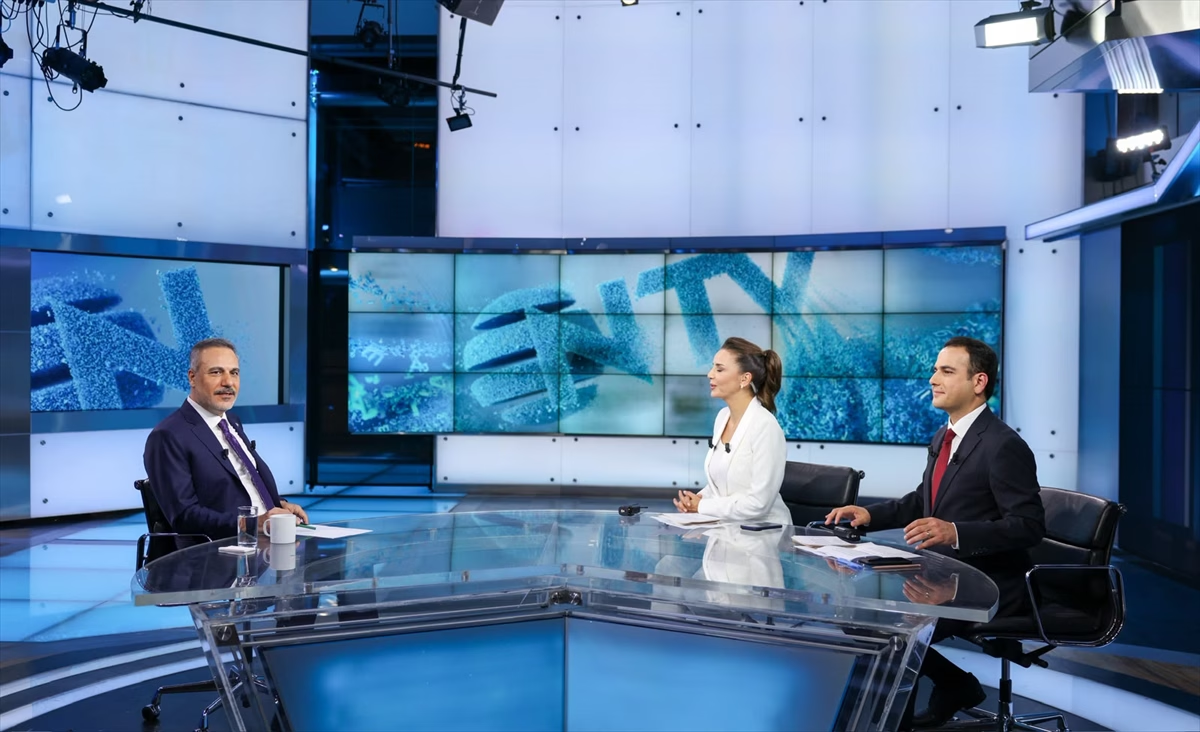
Turkish Foreign Minister Hakan Fidan answered questions from NTV on 19 September 2026. Fidan spoke about his visit to Damascus, the integration of the SDF, the Netanyahu government, the Houthi attacks on Saudi Arabia, the institutionalisation of the Mecca Alliance, Gaza, the Iran–US negotiations, grain shipments in the Black Sea, Greece, the UN General Assembly, CAATSA and the S-400s, the Terror-Free Türkiye process and artificial intelligence.
The visit to Damascus and Syria
You honour our programme.
Of course, you had important visits this week. We have many topics, but we would like to start with your visit to Damascus — the agenda of your visit to Syria… You held talks with al-Sharaa. Which issues did you take up, what was on the table? Looking at my notes, the fact that Turkish will remain in the curriculum as an elective language was announced as a concrete result of the visit. What else was on the table?
In fact, since December 2024, as you know, there have been many files we need to work on at the table with the new Syria. In particular, there are many headings such as Syria's reconstruction, its unity and integrity, cooperation with regional countries, the removal of certain problems that exist in the international system. The fight against DAESH, the fight against terrorism… These of course need to be reviewed at regular intervals. Our Presidents tasked us, as Foreign Ministers, with setting up a "Joint Planning Group". Within this framework, we need to follow closely a great many matters, issues and projects under way between the two states. So we need to meet constantly. Thank God, Syria is getting better every day; this is an important point for us. As you know, we have a 911-kilometre border with Syria. Whatever happens in Syria and in Iraq directly affects Türkiye. So stability, peace, tranquillity and development there are important for us as well. I went over these issues again with Mr al-Sharaa; there were messages from our President, and I conveyed them.
As you know, Mr al-Sharaa came to Ankara on the margins of the NATO Summit and met our President there. There were points it was decided to follow up on, and we had the opportunity to exchange views on them again. We discussed many issues, including regional stability, risks, the integration process in the country and the fight against terrorism.
Integration of the SDF
Minister, you mentioned integration. The "SDF" dissolved itself, talks followed and an important stage has been reached. You must have impressions of this too. What can you tell us about the integration process?
At the moment, of course, the statements being made and the intentions revealed by the parties' attitudes are extremely important. In fact, we see a desire on the parties' side to move the process forward in a controlled manner. Frankly, we welcome and support this; this is an important point.
On the other hand, of course, until all the conditions are met and the process is completed, we need to follow it with great care. We are talking closely with our Syrian brothers in particular — with the security institutions and intelligence institutions there… That is: how is the process going, is it going well, are there risks, how are the risks being managed? These are, of course, matters that both we and our other institutions are following closely. But as I said, the statements being made at the moment are good. Practical steps also need to follow them, and we are following that closely too.
Netanyahu and Israel
Minister, we would also like to talk about Netanyahu's aggression in the region ahead of the elections. He has, of course, sharply stepped up his anti-Türkiye rhetoric. What is Netanyahu's aim here?
As we have said before, Netanyahu is currently pursuing certain avenues to strengthen his domestic political position, to declare himself indispensable and to stay in power. Hostility towards Türkiye, the perspective of presenting a "Türkiye threat", is frankly a product of this — we see this very clearly. But at the same time, we are not taking it lightly; the words and attitudes put forward here are matters we follow closely. We are closely following in particular his military cooperation with countries in the region. One would hope, of course, that Israel adopts a foreign policy based on peace, on respect and on cooperation, which would be in its own interest and in the interest of the region. Otherwise, it will not only become increasingly isolated, it will itself pay the price together with the region; this is the kind of process we are in. We see this very clearly, we are aware of all the details. We also see its effort, after Lebanon and Palestine, to turn Syria into a field of indispensability for itself. We clearly see its intention to create a problem there, to make that problem acute and permanent, and to give its own society a message along the lines of "there is a serious problem here, and without me this problem cannot be solved".
So, as our President has said several times, Türkiye is a state that acts with wisdom; it is not a state that will fall for this kind of provocation, for cheap incitement. We know our own strategic posture well, we make our calculations well, and we never act on our own. We have partners in the region, there are other countries. Because with Netanyahu's policies Israel is not only a threat to the region — Israel is a threat to the world, it is a problem for the world. The whole world is coming together in search of solutions to cope with Netanyahu's policies. As long as this is the case, I think the necessary response will be given one way or another. We see that these views, this stance, this strategy are increasingly finding a base even among Israel's traditional friends, among countries that feel indebted to Israel; this is a very important development too. In the longer term, God willing, we believe the process will turn in favour of the oppressed Palestinians.
The Islamic world is going through a difficult period these days, in crisis on several fronts at once. But thank God, as long as our President is at our helm, the leadership and magnanimity he shows the region and the solidarity we have built with the countries of the region will enable us to overcome many problems. God willing, better days await us; I believe that.
Saudi Arabia, the Houthis and Bab el-Mandeb
Minister, we started with Syria and moved a little further south. If we go further down, unfortunately there is a problem there too: the clashes between Saudi Arabia and Yemen, the Houthis. We are even seeing a process that has evolved to the point where the Bab el-Mandeb Strait is almost closed. Can an interim formula be found, are there initiatives to reduce this tension?
There are many initiatives, but these initiatives of course need to produce outcomes that are acceptable to the parties concerned. Today again I held many talks, in particular with the colleagues acting as mediators and with the other parties.
As you know, there has been a deadlock in the America–Iran talks for the last few months, and as a manifestation of this deadlock we see not only attacks on each other, but also that the Bab el-Mandeb leg has now been opened by Yemen. We see that the parties are engaged in a gradual spreading operation towards Saudi Arabia. It is now becoming increasingly complicated. Of course, we are putting all our weight behind the negotiations between America and Iran reaching a result, but there is great mistrust between the parties here. They had reached an understanding in Pakistan, but then problems emerged in implementation, and now both sides have frankly started to interpret the process under way differently, in their own favour; there are different interpretations here. There are now new proposals put to the parties; I hope they accept them. Otherwise… The ongoing crisis was tolerated up to a certain point by the countries affected by it, but for some countries its economic repercussions have now begun to go far beyond what can be tolerated. We see this closely in Europe, in the Asia-Pacific, in Africa. As you know, in the Russia–Ukraine war there is now also the targeting of energy infrastructure, and here too there is a serious bottleneck affecting energy routes. When the two come together, countries like ours, which run their industry and economy on imported energy, face a large area of economic crisis management.
The Mecca Alliance
Minister, after the Houthi attacks on Saudi Arabia, the Mecca Alliance has of course come back onto the agenda — not that it had left it. Let us ask this first: what stage is the Mecca Alliance at, is it moving towards institutionalisation, will new members join? We are curious about where it stands.
The Mecca Alliance really is at a good stage. There is a very strong will that has been put forward, and we are working with all our strength to put that will into practice. At the moment there are steps being taken towards institutionalisation. In particular, the detailed work on setting up the Secretariat named in the Agreement and on establishing a military headquarters linked to it is almost complete. We have reached a common understanding. What remains now is the stage of sending personnel and getting the headquarters running. I am pleased with the process on that front. When we look at other institutions, international institutions complete their institutionalisation very late, whereas we are taking quick steps here, because certain dynamics in the region frankly require it.
As I have said before, our Alliance is open to the countries of the region. After the institutionalisation steps are taken, I expect the necessary talks on admitting new allies to be held together with the other two founding countries; we have a decision in principle on this. Because our President said from the very beginning: "If this does not grow, it will not be an alliance space anyway; we will have created a camp." Our regional vision is for the countries of the region — as many countries as possible — to come together and establish a common defence area. This defence area is in fact not directed outwards; it is about solving the problem areas within the region better, with a sense of regional ownership, and preventing new crises from arising by creating an environment of trust that they have not been able to build so far.
The starting point of all this is essentially the search to bring regional solutions to regional problems. As I have said time and again, when an international hegemon or hegemons come to our region to try to solve a problem — whether with good intentions or other intentions — it may of course appear to produce a result, but more often than not it has produced more problems than results. We have seen this time and again. Now it is time to learn from it. I see the Mecca Alliance as very important in this respect; God willing, we will soon see its positive results.
Minister, after the Houthi attacks on Saudi Arabia: first, has there been a request for support from Saudi Arabia to the Alliance, and is there a possibility of the Mecca Alliance entering into a military engagement alongside Saudi Arabia?
As you know, the problem with the Houthis is one that has existed for the last ten years. Frankly, it is a problem that began in 2015. In 2022 a ceasefire agreement had actually been reached, but after the events in Gaza things flared up again. At the point we have reached now, we of course see very serious attacks on Saudi Arabia's territorial integrity, its sovereignty and its infrastructure. When we look at our Agreement, the countries here have an allied responsibility towards one another. As you know, our President is truly a leader who keeps his word. There is something we have signed as a state. We are in solidarity on this, and in particular we are evaluating the situation assessments. As you know, as the Ministry of Foreign Affairs we condemn the attacks carried out, especially those targeting Mecca and the oil infrastructure. Saudi Arabia has not attacked anyone, and we frankly condemn this kind of provocative attack. Nor do we accept that it be made part of the ongoing dispute and conflict between Iran and America. Saudi Arabia should be kept out of this equation, because they themselves are not seeking to take part in it. At this point, as members of the Mecca Alliance, we are following the situation closely. We have certain conversations, certain talks that have not been made public. At this point they may have military needs — particularly on certain technical matters — and we would have no difficulty in meeting them.
Minister, I would like to ask one more thing: since the day the Alliance was founded, there have been some countries that are particularly uncomfortable with it. After these latest developments, we saw comments from Israel, Iran, India, even Greece, claiming that the Mecca Alliance has remained on paper. What would you say to these comments?
Well, when we look at the countries you mention — Israel, India, Greece and so on — we actually understand how resonant and important a move the Mecca Alliance is. Because this kind of discrediting operation — through the press, through disinformation methods — is in fact a reflection of that. Of course, we just laugh this off. It is completely unfounded. We have been a member of NATO since 1952. As I have said before, NATO has invoked Article 5 perhaps twice in its history, and apart from that it has not had a mission area. But nobody has ever called NATO a paper tiger or something on paper. So describing an agreement that was signed only three months ago in this way, even though it is taking such rapid steps, is an attempt to finish something before it has started. In fact, what you describe is an approach that indirectly reflects the threat they perceive here. We see these things, we look at them, but they are not to be taken seriously. You will see: the Mecca Alliance will, God willing, be a real game-changing platform.
Gaza and the West Bank
Minister, there are of course many international crises, but Türkiye's position on Palestine has always been clear. Could we open this up a little: what is the latest situation in Gaza and the West Bank?
In Gaza, the transition from the first phase to the second cannot be made; I want to state this frankly about the Peace Plan. Here, of course, Israel's role as a spoiler is the biggest factor. The Palestinian side, in the person of Hamas, did many of the things that fell to it in the first phase of the Peace Plan, above all releasing the hostages. It did so with difficulty and reluctantly, because its internal decision-making mechanisms are difficult. But at a certain point, through the work and influence of the mediators and our own intensive efforts, Hamas did its part in this agreement accepted by the international community. Israel brings new demands as the Palestinian side delivers, it does not consider itself bound by this agreement; this is now our biggest problem. This month it will be one year since the attempt to implement this agreement. As you know, in September last year a delegation of Islamic countries chaired by our President met with Trump in New York, and the Gaza Peace Plan emerged from the talks held there. These leaders said to President Trump: "This problem now has to stop, because it is now in a position to affect many things; if we do this, we will do it together."
Now, after a year, the deadlock here has to be overcome, but as I said, Israel's obstructive role on this point continues. The international community and the countries that have taken on a role in this need to work to overcome this deadlock.
Now, on humanitarian aid, we do not see steps being taken in the quantity and at the speed we want. It is not as bad as before, but it is not as widespread as we would like. Shelter issues need to be addressed, because by publishing lists of restricted materials such as iron and so on, Israel is not allowing certain shelter materials and prefabricated structures to enter, and not allowing construction materials in. This is, at present, extremely bad from a humanitarian point of view.
On the other hand, it is not carrying out mass killings as it did in wartime, but it continues to hit selected targets. As you know, the other day it struck an apartment block, and again children were killed. Here too the killings continue — there are violations. In the West Bank, the settlers becoming ever more unbridled and accelerating their land grabs is, as you know, drawing very serious attention from the international community too. The European Union tried to take a decision but could not achieve unanimity because of a few countries. The United Kingdom, as you know, imposed sanctions on its own — deviating for the first time from a policy of many years, it imposed sanctions on illegal settlers. Nobody defends the illegal settlers, but is there anyone stopping them, anyone able to stop them? This is precisely the test of the international community, and the test of the Islamic community. We are working as hard as we can to make this possible. Of course, the Palestinians also have a duty; one has to look at that as well. They need to achieve their own unity. This is something that happens in the historical journey of political movements: sometimes there is a conflict between the interests of your movement and the general interest of the cause you serve. Which will you choose?
Türkiye made a great deal of effort for that unity. Could such a possibility arise?
It did. We worked very hard for unification between the West Bank and Gaza, but this has not happened, for reasons I would not like to go into in detail now. It was not only us; many countries were involved in this issue.
There is also something in the Islamic world: because of Hamas's character, many Arab countries have reservations about it and do not engage with it. Türkiye is one of the rare countries that can engage with both Ramallah and Gaza. We maintain this equal relationship, our support, between Ramallah and Gaza… Because for us it does not matter which Palestinian party it is. They always try to push us to Hamas's side, but for us what matters is that it is Palestinian, that it serves the Palestinian cause and that it is a legitimate movement supported by a legitimate base in Palestine — as in the example of Fatah, as in the example of Hamas… These are parties chosen by the Palestinians, parties that send deputies to the Palestinian Council. Cooperation between them is extremely important. We hope, God willing, that they will take the necessary steps on this point. They need to make certain sacrifices. We will continue our mediation efforts on this issue.
Iran–US mediation
Minister, I would also like to ask about the talks between Iran and the United States. Speaking of mediation, there is Qatar, there is Pakistan, there is Oman working on this. Are their mediation efforts continuing?
Their mediation continues "on and off". Like this: a process was carried out in Pakistan, it was put into practice, it came up to a certain point, and then it went off the rails. Later… The country most affected by the events in the region is undoubtedly Qatar. Qatar cannot sell anything. They are also very close to Iran, they are in a position to talk to Iran. Using this — they have good relations with both Iran and America, and they are among the countries most affected — they are trying to do something. Today I also spoke with our Qatari mediator colleagues. But reconciling the positions the parties have set out, especially as America heads into elections, is somewhat difficult — but not impossible. God willing, I expect good results.
The Russia–Ukraine war and the Black Sea
Minister, we are in a difficult geography. We would also like to ask about developments to our north. There is a war now approaching its fifth year. We see tension rising in the Black Sea again. In the early period of the war, the Grain Corridor Agreement, brokered by Türkiye, perhaps averted a global food crisis. Where do the initiatives and efforts to end the war stand? If the war is not ending, is it possible to find another interim formula like that, one that would bring a little more calm to the Black Sea?
There are some initiatives to end the war, but frankly, as of now it looks somewhat difficult for them to produce a lasting result. Nevertheless, the work must continue; one must not lose hope.
There is a point here, dear friends, that needs to be said: will all the parties sufficiently recognise the destructiveness of the war and say "are we going to head towards a war that burns itself out", or will they say "it is already clear that we will end up there, we are in a war of annihilation — let us meet somewhere reasonable in between and prevent ourselves from destroying each other any further"? We are trying to explain to the parties that this psychology exists.
Up to 2023, the war was a classic war. After that, until 2025, it turned into a war of attrition. We saw mostly soldiers at the front destroying each other. After 2025 it turned from attrition into a war of annihilation, and increasingly we see all civilian targets being struck indiscriminately — infrastructure being hit, apart from residential areas — and energy in particular, transport and commercial areas being targeted. This is of course making civilian life ever more difficult. This annihilation must be prevented. Now the parties are demonstrating their own resilience and it is turning into a kind of contest of who will blink first, who will give up first. But there is no need to come to this point. We are working, by talking to the states concerned, on what kinds of interim formulas can be produced — but in the meantime this is a situation linked to the war as a whole.
The Black Sea issue is important. The Black Sea is important in several respects. First of all, it is Türkiye's adjacent area. As you know, trade in the Black Sea is an important matter for us too. Our ships are affected by this, our businesspeople are affected. But more importantly, right now it is exactly the season: if the grain harvested from the fields does not reach world markets, we see that there will again be difficulties in many countries in terms of food security. For the last few years — we actually made an agreement, that agreement later broke down, but despite its collapse — there was also a de facto system in operation; they were not touching it. But now they are hitting each other hard. In particular they are striking ports, striking all maritime traffic.
Now, we have sent a proposal on this to both sides. We are working on it, we are waiting for their responses, and responses have come from the parties as well. Frankly, we are trying to take this somewhere. But here too, drawing on the lessons they learned from the implementation of the previous agreement, the parties have some demands and positions that are difficult to reconcile — let me say that as well. It would of course not be right for me to say here which side wants what. But most recently the Deputy Prime Minister of Russia came; we were together last Friday. He too conveyed to us Russia's perspective on overcoming this problem. We are assessing all this data. We have also submitted the matter to our President. God willing, the first priority is getting this grain out of the Black Sea. It has to reach world markets. Many places need this grain — African countries, Egypt included — and grain, unlike energy, is a product both countries sell. Energy is mainly sold by Russia, of course, but… There are some difficulties here too that need to be overcome; we will overcome them as well, God willing.
The difficulties of mediation
Speaking of mediation, we know that you have in fact been involved in mediation on many fronts on behalf of Türkiye, and that you have had a great deal of influence. Looking at the ongoing international crises, Minister, where does the greatest difficulty in mediation begin?
It actually depends on the issue you are dealing with. But you see the benefit of this: the identity of the mediator matters, their attitude matters. If it is a party that both sides respect and trust, this really is very serious support and things are resolved quickly.
As you know — let me give an example — there was a problem between Ethiopia and Somalia that almost turned into a conflict. Ethiopia is a "landlocked" country, a very large country with a large population on an African scale. But it has no access to the sea. Yet the countries right next to it have thousands of kilometres of coastline. If you do not solve this in an appropriate way, it will head towards… Our President hosted the leaders of both countries, Ethiopia and Somalia. As a result of talks that lasted hours without anyone leaving the table, and because of both sides' respect for him and their trust in his fairness, the draft we put forward was largely accepted, and we see that the possibility of conflict there did not exist at that moment and does not exist today.
But there are some wars — wars involving more than two parties… Say the Russia–Ukraine war: there is Russia and Ukraine, America on one side — it was there at the beginning — there are European countries, everybody is there. The Iran–America war: Israel is on one side, the Gulf is there, other countries are there, there are many things. Here, after a certain point, some of those following the issue closely… What we do most — because we follow mediation issues very closely, not only the issues in which we ourselves mediate but also the ongoing crises in our region — is give the mediators very good input: sometimes we boost their morale, sometimes we say "look at it from this angle, this part may have been missed".
There are points where you offer advice, of course.
Of course, of course — that is important too. Because everyone needs perspective. Complex problems… These are not issues anyone can solve alone with their own mind, not things anyone can handle with their own psychology. Reason must be put to work on such issues as far as possible.
And what I have seen is that in mediation, countries and mediators who genuinely focus on results rather than seeking credit are more effective, they become more acceptable. That is, if you advertise what you do, frankly people do not want to see you on the next issue — there is that aspect as well. So one should see this somewhat like charitable work and carry it out quietly…
Türkiye is the best at this then, isn't it?
Of course.
So there are issues we don't know about, Minister.
There are, there are — that is how it should be. Because… I have seen this: sometimes, say, one country does something, and once it has done something, other countries say, "What am I doing here, what are you doing?" That can happen… So a certain moral standard needs to be observed there too.
Greece and the Aegean
Minister, let us not pass without touching on Greece. There have been some statements from the Greek side in the context of Aegean issues. How do you assess these statements?
In Greece, as we have said before, there is a Türkiye factor in domestic politics. If someone in domestic politics wants to take a "shortcut", if they need to score extra points quickly or draw public attention to themselves, if they need a tailwind of public opinion, the card they will play is the Türkiye card. Politics in Türkiye does not work this way. Talk about Greece as much as you like, or don't — there is no such issue. We have bigger, more global problems, but Greek politics has one topic.
Türkiye.
On their behalf, in fact, we say from time to time that a country like Greece should not conduct politics from such a narrow perspective, but they squeeze each other on this. Now, we reached a common understanding with the current government from May 2023 onwards. We said: until the next elections, as long as these governments are in power, they will do their best to resolve the problem in good faith, there will be no tension in the Aegean as there was before, and they will not spring surprises on each other. We really tried to advance this as much as we could. Whenever the government in Greece tries to take this somewhere, the only place the opposition hits, immediately… It plays a single card. What it means to say is: "Why aren't you fighting Türkiye, why are you talking nicely, talking well with them?" If they fought, they would criticise them for fighting. Unfortunately, there are aspects of this politics that are irrational. Democracy is a good system, but sometimes it has, how shall we put it, hormone-pumped sides as well. It inevitably touches on…
But this does not mean, dear friends, that we do not take the existing threats seriously. Our position is clear. First of all, until the problems in the Aegean — the continental shelf issue — are resolved, where we stand is clear. We are not in favour of creating tension. We never accept the arming of islands that have demilitarised status. We have very subtle, very persistent initiatives on this. Most of the time we carry them out without making them public, because making certain things public can be more problematic in Greece than for us. But this region needs peace, not armament. We have said this time and again. War is in nobody's favour; what matters is peace. But Greece insistently, its politicians… We now also see a move towards an election atmosphere there. This language will now be used a bit more. But we look at what happens in practice, at what is really official. Our Armed Forces are extremely vigilant on this, our Coast Guard Command is vigilant. We hope nobody makes a crazy move there, and that they do whatever peace and tranquillity require. We are now in 2026; so many centuries have passed — if civilised states cannot come together, talk and solve things, then there is something else going on. Our President has conveyed his will to every Greek government that has come along. Since 2003 he has shown that he wants to resolve these issues by talking with all of them. At first they say fine, they say good, they try to get somewhere, but Greek politics immediately drags it down.
What is their reason for doing this, Minister?
Well… Because there, someone who solves these problems will be…
And in this process some came from the right and some from the left; in terms of government, it doesn't change.
Of course, of course. No — our President gave all of them the same credit, that he really wants to solve it…
Look, the Aegean issue is a very sensitive matter. It is a sensitive matter in Türkiye too. But it is a matter on which only a leader with very high political credit, like our President, can say "yes" or "no" on certain points and put his will behind it. Before him, many Governments had, so to speak — by the very nature of the matter, of course — to kick the can down the road, just as the Greeks do. On this he said, "Come on, brother, let us solve this, whatever the issue is, both on the Cyprus issue and on the Aegean issue", and he put his will behind it. But Greek Governments, by the nature of Greek politics, cannot take a step forward on this. Perhaps here the Greek people need to encourage their politicians — that is: "We are behind you not in war, not in war rhetoric, but in peace; if you do not bring peace, we will punish you — not otherwise." Instead, they encourage politicians with very small, jingoistic things. Things like, "Hakan Fidan said this today, why don't you say that tomorrow?", "He did that, why don't you say this?", "This ship passed through there, why isn't that the case?" It is a subject on which people are constantly on alert.
With the politicians there — we now have close friends, we talk with them — there is such a context. But I repeat: this does not mean anything else; we are a serious state, and we follow our issues very seriously. God willing, some of what they say will remain at the level of rhetoric; people will say it was "for political reasons", and it will stay there. But if they intend to take this further and move towards adventurous steps at an irrational point, the seriousness and strength of this state are known to everyone.
The UN General Assembly
Well, Minister, next week the United Nations General Assembly convenes in New York — the 81st session. Of course, the President and you will have an intense schedule there, with bilateral meetings. What is on Türkiye's agenda in New York this week? I want to ask that, and also, of course, the President will address the General Assembly — could you give us some hints about his speech?
Now, as you know, our President is by now one of the very few leaders on a world scale who are democratically elected, whose leadership is consolidated by the will of the people every five years, every four years, and who have stayed in power for so long. So being the leader of Türkiye is in itself a source of prestige and weight, but staying for so long is something else. Every year our President's messages at the United Nations are followed and listened to very closely. He is always one of the first three or four speakers anyway. As you know, there are nearly 200 states; one or two of these never change — since the UN was founded, they have been America and Brazil. Then who will be the third or fourth, or towards the fifth… Generally our President speaks in these top places, fourth, fifth, sixth, on the first day in the first hours. This year too, God willing, he will give a comprehensive, visionary speech on the solutions Türkiye, from where it stands, proposes for the world's problems. An emphasis on resolving the world's problems on the basis of common interest and human values…
Artificial intelligence is also on our agenda at the moment. On artificial intelligence, we are now in a situation where, for the first time, humanity may need to foresee future risks this far in advance and take joint steps. Our President will also make a call on this.
The Trump meeting, CAATSA and the S-400s
Yes, we will have a question about artificial intelligence in the coming minutes, but President Recep Tayyip Erdoğan is also expected to meet United States President Trump. US Ambassador Tom Barrack said this meeting would take place in New York. Could you give us a hint about this meeting? And we would also like to ask whether there is any development regarding the S-400s, Minister.
As you know, most recently we hosted Mr Trump with our President in Ankara. He paid a bilateral visit and also attended the NATO summit. Afterwards he spoke with our President by phone many times and wrote letters, saying how impressed he was by the hospitality and the talks, that they want to take relations between the two countries even further and that he will work to remove the existing problem areas… Now, as you know, the CAATSA sanctions are a shackle for us, especially for our Defence Industry Agency, and we are trying to have them lifted. There are also some creative ideas on the way to solving the S-400 issue that triggered them. We are trying to put these into practice with mutual goodwill, certain solution paths… God willing, I hope we will take positive steps on this.
Diyarbakır and Terror-Free Türkiye
Yes, another of our topics is Terror-Free Türkiye, and in that context you actually visited Diyarbakır. There was indeed very strong interest in the visit. We already know from social media and from television that you were pleased as well. You were in contact with the public, of course. How do you assess this visit together with the process?
Really… I used to go to Diyarbakır in my previous posts too. This time I went on assignment from our party, because as ministers we go to certain provinces. I saw that Terror-Free Türkiye finds an incredibly positive echo there; the grassroots are already ready for it. I had the opportunity to meet representatives of many different civil society organisations. We talked for hours, I listened to everyone, they expressed very valuable views. There are those with a political stance, those with a commercial stance, those with a religious or cultural stance. From where each of them stands, we listened to and discussed Diyarbakır and the Terror-Free Türkiye issue, their satisfaction with the steps taken to remove the obstacles facing Kurdish identity — all of it — and we exchanged views. Frankly, it was very good for me too.
But of course I was very glad about this: for a long time — of course, as you know, the AK Party government carried out very major political reforms from the moment it came to power. The biggest political revolution is the ending of the denial of identity. That is, a person is precious, is respected and is under constitutional protection not because they are Kurdish, Alevi, Sunni or Arab, but truly because they are a citizen of the Republic of Türkiye, a respected individual, a member of these lands; we made this possible. Once this was removed… And as you know, since the founding of the Republic there have been sensitive issues concerning three segments. There were areas in which issues sensitive for the religious were violated, concerning freedom of religion: the headscarf, the freedom to worship, putting these into practice for civil servants… For the Kurds, in particular, the problem of speaking the Kurdish language and of identity, the removal of the obstacle before it… Finally, in 2013, with Kurdish entering schools as an elective language, the legal obstacles on this issue were also removed. Are there areas that can be advanced? There are. The way to do this is not violence, it is politics.
As you know, there were areas in which our Alevi citizens had serious grievances, where they felt deprived in terms of state policy. These needed to be remedied. I am a close witness that, as the governing power, our President — both when he was Prime Minister and when he has been President — took important steps with the AK Party cadres to achieve reconciliation between state and society in these three critical areas.
As I said, the political basis of these problems has ended. Especially in Terror-Free Türkiye we… The organisation's leader had said this years ago too. That is, its political reason has ended; in practice, one needs to look for a way to stop these clashes. I have seen that developments in the region in particular — in Syria, in Iraq — have made this possible.
Now, of course, it is nice to hear this too: our brothers in the region now say, what are you doing for the industrialisation of Diyarbakır? We have a certain industrial capacity; how can we industrialise further? Well, we have industrialised, but I have no port — how will you solve the connectivity issues that will carry my products?
The demands were different in the past, weren't they?
Now look, these are economically difficult demands but enjoyable demands — the discussions that ought to be taking place… This is the way to go. That is, here there is this irrigation canal project, as you know — the Silvan Dam and the Ilıca Dam currently under way… When these are finished, and the other dams around them are finished and the irrigation canals are completed, we see that an extra 4 million decares will gain access to more irrigation, and they said yields will increase 2.5 times. So, in fact, in a place where this political problem, the identity problem, has been removed, the goal — as in all civilised places — is the welfare of the people, their greater prosperity, greater peace and living with greater opportunities. It is extremely important that these things are being discussed now.
The common ground I saw was this: nobody… Whether it is a political problem — not everyone has to think the same as us, there are people who think very differently… Whether it is a political problem, an economic problem or another kind of problem, everyone wants it to be solved not through weapons but through talking, through dialogue; this is important and precious. I think the will and attitude put forward by the People's Alliance, by our President and by Mr Bahçeli are very important for advancing the Terror-Free Türkiye process. I also think the response given to this from the other side is valuable. God willing, I think this is important not only for Türkiye's future but also for the future of the region, for the regional peace and tranquillity of our Kurdish brothers beyond our borders. For the Kurds living in Syria, for the Kurds living in Iraq… As you know, the stability Türkiye produces does not only nourish itself, it also nourishes the countries in the region. On this point I said there as well: not only our Kurdish brothers in Türkiye, but also the Kurds beyond the border will get their share of the stability and prosperity Türkiye produces.
Now, Minister, in a process of roughly two years known to the public, a very important stage has been reached. A law was passed by parliament, boards were set up. Now the organisation needs to lay down its arms. A mechanism is operating, or will operate, in Northern Iraq for this. How is that stage going — do you think there is a delay?
Like this: of course one would wish everything to be faster. For example, the organisation declared in May 2025 that it had dissolved itself and ended its armed struggle. Where we are now — we are in September 2026 — more than a year has passed. That is, concrete steps regarding the laying down of arms have not been taken so far. For this to happen from now on, certain mechanisms need to be put into effect — so I think the time factor is important for this. It could be faster, but as I said, one needs to be careful. At the moment there are certain statements, certain expressions of will, but what matters in practice is that the threat eliminates itself, stops being a threat. This needs to be followed very closely.
I think that the developing conditions in Syria and Iraq in particular, and the policy we are pursuing, frankly feed Terror-Free Türkiye from both sides. The developments in Syria, the developments now taking place in Iraq and those that will take place, those planned to take place — I am speaking of Iraq as a whole — are complementary to Terror-Free Türkiye. Now there is neither the political environment, nor an occupation environment, nor any longer the mindset in either Syria or Iraq that would allow any armed element other than that country's own armed forces to be harboured there. The governments of both countries — both Baghdad and Damascus — are determined that there should be no armed groups, no organisations, in their countries other than their own armed forces. So nobody can grow there any more, nobody has the possibility of hiding. That is, there is no possibility of staying there and firing at Türkiye from there. If a person has a grievance in Türkiye, there is only one thing to do… They will come, do politics openly here, take their cause to the people, win the people's support, struggle, fall, get up — but they will do politics. Our President did it that way, others did it that way. As in, "No, it didn't suit me, I'll go and take up arms." Then you will find the state standing against you.
So neither Syria nor Iraq… Nobody now allows their territory to be occupied by the PKK or another organisation, to be controlled by armed groups, for these groups to roam freely in the country — this is the point that has been reached. So this is a complementary point for Terror-Free Türkiye. God willing, there is a good opportunity here; we hope the organisation makes good use of it, and that with steps taken by both sides we will, God willing, remove this problem from our agenda permanently.
Artificial intelligence and the surveillance society
Minister, the other day, footage of you walking in Ankara, filmed by a vehicle's camera, circulated on social media. In this context, with your permission, I would like to ask two questions.
First, of course, artificial intelligence… You said a moment ago that the President will address this in his speech in New York, but let me ask this in that context: have data collection and intelligence technologies begun to reach a dangerous dimension? I am curious what you think.
My second question: with such a heavy schedule, can you find time to exercise — to walk, that is?
I like walking. I also like talking, thinking and discussing work with colleagues while walking. People at my previous institutions know this too — there are many things we moved forward a lot during walks like that, long walks. But here I cannot find as much opportunity as before. Sometimes, say, on my way back from work I get out somewhere near the residence and walk like that. The other day I went to report to our President at the Presidential Complex, and on the way back I walked from the Ankara Terminal all the way to the Ministry, for example. When the weather is good and circumstances allow, I try to walk in the countries I visit. Here I don't have the opportunity to walk in a very planned, regular way, because the job is not like that.
You can't set time aside for it.
You can't, because you have to focus yourself on one thing, and that is the work. This job is a great trust. While doing this job, if an opportunity to walk comes up, you take it. As I said, in the countries I visit, if I have the opportunity and the time, I sometimes do it. But now, as you say, that day, while I was walking at the weekend, they filmed it from a vehicle's camera, and it ends up on social media just as it was filmed. In fact, we are now building George Orwell's total surveillance society with our own hands.
There is actually an irony here: when you take into account and compare the observation and recording done by the state with the observation and recording people do of each other, citizens actually do more, they record more, they follow more, they produce more data about other people's lives. So George Orwell's book is, in one sense, coming true a bit. That is, at some point the public is watching itself; there is that aspect too, the information society…
Of course, artificial intelligence is like this — it is worth underlining again…
Towards a time when it gets out of control…
It has also been a major topic of debate in the United States in recent days. There are company executives resigning, there are those saying "it will destroy humanity" on the other side.
Yes. But there is this point: of course America has reached a point where it will debate this. It produced the technology, it began to see its effects, it began to see its potential, and then it says, "how will I take the good side, how will I regulate the side that will harm me"… Now what we need to do is exactly that — to own the technology. For this we need to declare a mobilisation; this is extremely important.
One day something like this will happen… One day we were at a meeting in Europe, on the Russia–Ukraine issue — we went representing our President, the Coalition of the Willing. Everyone was saying, "what will we do about the war, how will we…" I saw that nobody was talking about anything to end the war. When it was Türkiye's turn, we said… I am mentioning what I said to convey our current views on artificial intelligence. Now America and China are preparing themselves for a new era. At the moment, 75 percent of artificial intelligence investment, data centres and what we call "computing power" is in America, 20 percent in China and 5 percent is spread around the world. They are preparing themselves for a new era; this will not be like the Industrial Revolution, it will not be like other revolutions. The Industrial Revolution could be "proliferated", spread, a bit more easily — "you built a machine here, take it…" Other countries — just as with nuclear weapons — either you will own that technology or you will not. Now, for example, the dollar is widespread at the moment; when you fall out with America, it can apply something to you via the dollar or via SWIFT, it can impose sanctions. Tomorrow artificial intelligence will enter life so much that when it wants to sanction you, it will cut you off from artificial intelligence, it will say "such-and-such countries do not…" As you know, there was a big debate in the European Union recently too, and they have already started doing this. The Americans said, "we are banning such-and-such versions of Anthropic from use outside the country". And imagine this increasing…
Now, therefore, in other fields we buy technology produced by others — for example, a car is produced and you buy it, something is produced and you buy it — but artificial intelligence is not quite like that. With artificial intelligence, fine, there are areas where it will be turned into money, we use them and will continue to use them, but in this field it is not very easy for us to do it on our own either; there are steps we will take, but we need to take big steps, especially by coming together with certain countries within our own geography, where we will produce big data and set up big data centres. We are actually discussing this with the European Union to a certain extent as well. That is, steps in which Türkiye is also a stakeholder need to be taken. At this point there is work under way in the government, and there is very great awareness among our Ministers. But the competition on a global scale — let me put it this way, where do I come in? This is no longer an ordinary matter of technological competition or commercial competition. This is a matter related to national security and to existence, a matter at a very high level. We need to see it from there and carry it forward from there. That is, "I produced this product, I brought this, this data is there…" — it is not only about this, it is a matter we need to look at from very high up.
Spiritual visits in Damascus
Well, Minister, we started with Syria; let our last question be about Syria again — we asked about policy, this time I want to ask a little more about the other parts of your visit. You have been to Syria many times since the fall of the regime, but this time it was a two-day visit. We saw that, apart from your official contacts, you visited different places as well: you went to the tomb of Saladin, you went to the tomb of Muhyiddin Ibn Arabi, you went to the Umayyad Mosque. How was it to be able to visit those places again after so many years?
Of course it is a lovely thing. There is also a message we need to give. We stayed there one night — as in, "Syria is now normal, we should stay here, we should come". The figures we visited and paid our respects to are also personalities who have a place in our Anatolian culture, faith, strategy and politics. His Holiness Muhyiddin Ibn Arabi, as you know, is perhaps one of the deepest figures in the history of Islamic Sufism and thought in particular. He has a great influence in Anatolia. Sadreddin Konevi was his student; Davud-i Kayseri likewise comes from his school. There is a tradition of thought, from an Islamic point of view, that they put forward and that extends all the way to Molla Fenari. A great Sufi, a great thinker, who raised very big philosophical questions, questions of creation, issues concerning the relationship between God and the universe — being, above all. By visiting him, you are in fact visiting these issues, this thought, this spirit within yourself; that is important for me. His masterpieces, as you know — Futuhat al-Makkiyya and Fusus al-Hikam, two books. Futuhat al-Makkiyya is thicker, bigger. Beautiful books, deep subjects… Even today, what he put forward — later labelled wahdat al-wujud, but in my view that is a rather crude naming — is a field that various thinkers today try to explain with models borrowed from quantum physics; it is that deep. That is why he is important.
There is no need to say anything about Saladin — he is indispensable for us, when you go there you must pay your respects. A military leader who truly left his mark on Islamic history and on the history of the region. The fact that his tomb is in Damascus is also significant.
We also visited His Holiness Mawlana Khalid al-Baghdadi and paid our respects. He too is a figure who deeply influenced Anatolia; that great figure lies at the foundation of a great many Sufi traditions in Anatolia today. Damascus is such a place.
Our aviation martyrs are there; we visited them. There are elders of the Ottoman dynasty who passed away and are buried there; we visited them.
There are many works built in the Ottoman period, and it is actually important to see them. The Süleymaniye Complex is a very important architectural work in this respect, and its function is significant too. There are many works like it. I wish we had more time so we could see them all.
But I just want to say this from here: some of our historical roots are there too, and we need to embrace them. For many years we… Of course, our historical roots have several founding places. There are a great many works in the Balkans, many places to visit, and our citizens have gone there a lot, relating to the Turkish-Islamic world. Damascus is likewise such a place, Baghdad somewhat so. Of course, a great many of our citizens go to Central Asia, to the Fergana Valley, to Samarkand, to Bukhara. Making the search for identity and meaning deeper, richer and more complete by making this historical journey is also a beautiful thing. That is, a better future is prepared through a healthier reading of history and a reading of meaning; I believe in that.
Minister, you set aside time for us amid such a busy schedule; you have honoured us. Thank you very much for your contribution to our programme.
Featured Listings
Sponsored
Similar Interviews


Defence Minister Yaşar Güler to Global Business Press: 2035 goals, KAAN and Türkiye–Azerbaijan defence cooperation
Global Business Press
- 10/4/2026


Justice Minister Akın Gürlek to Sabah: assets seized in the investment fund probe will go to victims
Abdurrahman Şimşek (Sabah)
- 10/4/2026


Education Minister Yusuf Tekin on NTV: the Turgutlu attack, school security, PISA and private school fees
Ahmet Ergen (NTV)
- 9/30/2026
Featured News


Job Listings
Stay Updated with The Turkiye Times
Subscribe to be informed about special news, developments and announcements. We will keep you informed.
By signing up, you agree to our Privacy Policy











