- BIST10011,722-2.89%
- USD49.42+0.06%
- EUR55.41+0.20%
- GOLD4,186.70+0.40%
- INTEREST37.00%-1.00
- BITCOIN81,464-0.05%
- October 17, 202611°
- BIST10011,722-2.89%
- USD49.42+0.06%
- EUR55.41+0.20%
- GOLD4,186.70+0.40%
- INTEREST37.00%-1.00
- BITCOIN81,464-0.05%
- October 17, 202611°


YTB President Abdulhadi Turus in New York: the Turkish community in the US, the Turkish language and Türkiye Scholarships
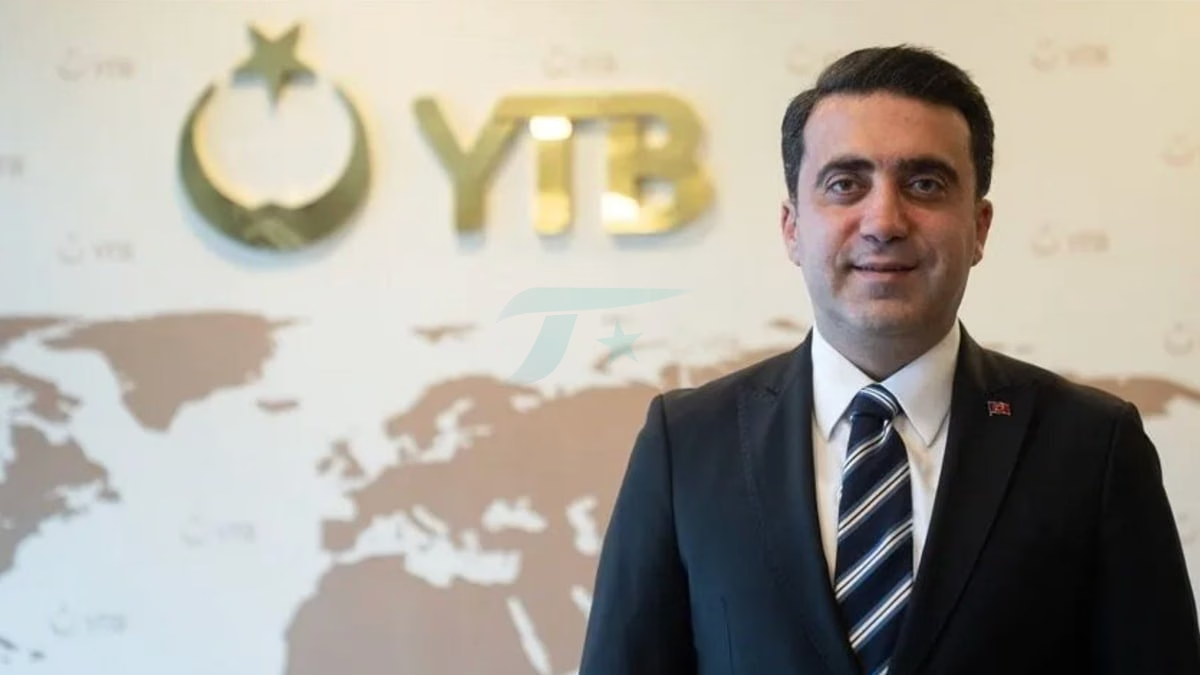
Speaking to Mynet and GZT after meeting Turkish communities in New York and New Jersey during the UN General Assembly week, Abdulhadi Turus, President of Türkiye's Presidency for Turks Abroad and Related Communities (YTB), talked about the Turkish community in the US, the Great Turkish Project, Karachay and Crimean Turks, the Turkish House and Türkiye Scholarships.
Meetings in New York and New Jersey
What did your programme in the US look like during the UN General Assembly week, and whom did you meet?
We carried out a very busy and wide-ranging programme in America. We met our citizens, our young people, civil society organisations, mosque congregations and shopkeepers. We visited various institutions of ours in New York and New Jersey. We also met our Karachay Turkish and Crimean Turkish kin.
We listened to the stories of citizens who have lived in America for many years. We had the chance to see up close the civil society, entrepreneurship and human capital they have built here. For us, every visit was also an opportunity for consultation.
What kind of Turkish community did you find in the US?
There are close to 500,000 Turkish citizens here. Beyond them there are our kin communities: Crimean Tatars, Ahiska Turks, Karachays.
There are mosques, associations, businesses and institutions that the first generations built with great effort. Today, alongside them, we see a new generation growing up in academia, science, business, entrepreneurship and civil society.
What matters from now on is that this large pool of talent becomes more aware of one another, that our young people benefit from this experience and that the ties between our various institutions grow stronger.
Which topics came up most in your meetings?
Our young people, Turkish, education, culture and civil society work were among the main topics of our meetings. In America we have very strong human capital, from academia to science, from business to entrepreneurship and civil society. We want this experience to reach the new generations more. We believe the links between our institutions should grow, and that new opportunities should open up especially for our young people.
Our goal is this: how can we further strengthen their sense of belonging to Türkiye? How can we deepen their affection for Turkish?
Turkish and the new generations
You placed special emphasis on Turkish during your visits. Why?
Turkish is one of our core issues, because our language is one of the strongest carriers of the bond with Türkiye for children and young people born and raised abroad. A young person who can speak and read Turkish and express themselves in Turkish can connect far more strongly with their family's memory, their culture and Türkiye.
With this understanding we run our Great Turkish Project and support Turkish-language work in almost every state in America. In our mosques, our associations and other educational settings, we help our children and young people build a stronger bond with Turkish.
What is being done on the ground for Turkish-language education?
We are running a very big project in America right now. We hold weekend education programmes so that the new generation, our children, do not lose their bond with Turkish. We visited the places where we run those programmes.
In our meetings in America we also listened to the needs on the ground. We discussed how to take the existing work further and how to reach more of our children and young people. We attach great importance to Turkish continuing to exist in the lives of the new generations not only as a language that is learned, but as one that is lived, used and that connects the generations.
Karachay and Crimean Turks
You also met Karachay and Crimean Turks. What did you see in these communities?
We saw up close the efforts of different communities of the Turkic world, such as the Karachay and Crimean Turks, to keep their languages, cultures and identities alive in America. There are different stories stretching from the Caucasus, from Crimea and from Anatolia to America. But what all these stories have in common is the will to preserve their roots and pass this heritage on to new generations.
From the Karachay Turks to the Crimean Turks, the communities of the Turkic world that reached America in different periods and by different routes are very valuable parts of this heritage. While keeping their own culture and memory alive, they also contribute to the common strength of the Turkish community in America. As YTB, we will keep strengthening our ties with every part of the Turkic world and supporting work that will carry this heritage to future generations.
The Turkish House and Türkiye Scholarships
What does the Turkish House across from the UN building represent for you?
What best describes Türkiye is its hospitality and its tolerance. We believe that sharing brings abundance and that the more we share, the more we grow.
With this building, the Turkish House, our President stands up not only for Türkiye but for all the oppressed and all the forsaken in the world.
It was very valuable that he said in his speech at the United Nations, “I represent Palestine, and I will continue to represent it.”
How do you see the global impact of Türkiye Scholarships?
Through Türkiye Scholarships we bring an average of 5,000 young people every year from every country in the world: from Africa, the Balkans, Central Asia, the Caucasus and Latin America.
We have a single condition: they should study in Türkiye and deepen their knowledge of Turkish culture and their affection for Türkiye, but then return to their own countries and use the experience they gained here there.
Perhaps we don't keep them in our country, but we are creating honorary ambassadors with an affection for Türkiye in every corner of the world. We have 160,000 graduates of YTB scholarships alone. Among them are a president, ministers and many leading business people, and all of them have an affection for Türkiye.
I believe that in the years ahead, this network will be a very important factor both for our country and for a fairer world.
A message to the Turkish community in the US
What would you like to say to the Turkish community in the US?
There is a truly strong body of achievement here. Our citizens produce, create jobs and succeed in academia and business. They take on responsibility in civil society and take an active part in the social life of the society they live in. Our wish is for this achievement to grow further with the new generations.
It is extremely valuable to us that our young people, while gaining a strong position in the societies they live in, also preserve their ties with Turkish, with their culture and with Türkiye. As YTB, we will continue to stand by our citizens wherever they live, and to develop work that opens doors for our young people, strengthens our institutions and carries their ties with Türkiye to future generations.
Featured Listings
Sponsored
Similar Interviews


Foreign Minister Hakan Fidan at AA's Editor's Desk: The Mecca Alliance, Hormuz, Gaza, Ukraine and Cyprus
Anadolu Ajansı (AA)
- 9/23/2026


Parliament Speaker Numan Kurtulmuş to reporters en route to Portugal: the fund crisis, Netanyahu, Terror-Free Türkiye and a new constitution
Gazeteciler (Portekiz uçağında)
- 10/4/2026


Foreign Minister Hakan Fidan on NTV: the Mecca Alliance, Gaza, the Black Sea and the S-400s
NTV
- 9/23/2026
Featured News


Job Listings
Stay Updated with The Turkiye Times
Subscribe to be informed about special news, developments and announcements. We will keep you informed.
By signing up, you agree to our Privacy Policy











