- BIST10012,151-0.94%
- USD49.220.00%
- EUR55.21+0.28%
- GOLD4,189.90-0.63%
- INTEREST37.00%-1.00
- BITCOIN82,595-1.29%
- October 12, 202619°
- BIST10012,151-0.94%
- USD49.220.00%
- EUR55.21+0.28%
- GOLD4,189.90-0.63%
- INTEREST37.00%-1.00
- BITCOIN82,595-1.29%
- October 12, 202619°




Parliament Speaker Numan Kurtulmuş to reporters en route to Portugal: the fund crisis, Netanyahu, Terror-Free Türkiye and a new constitution
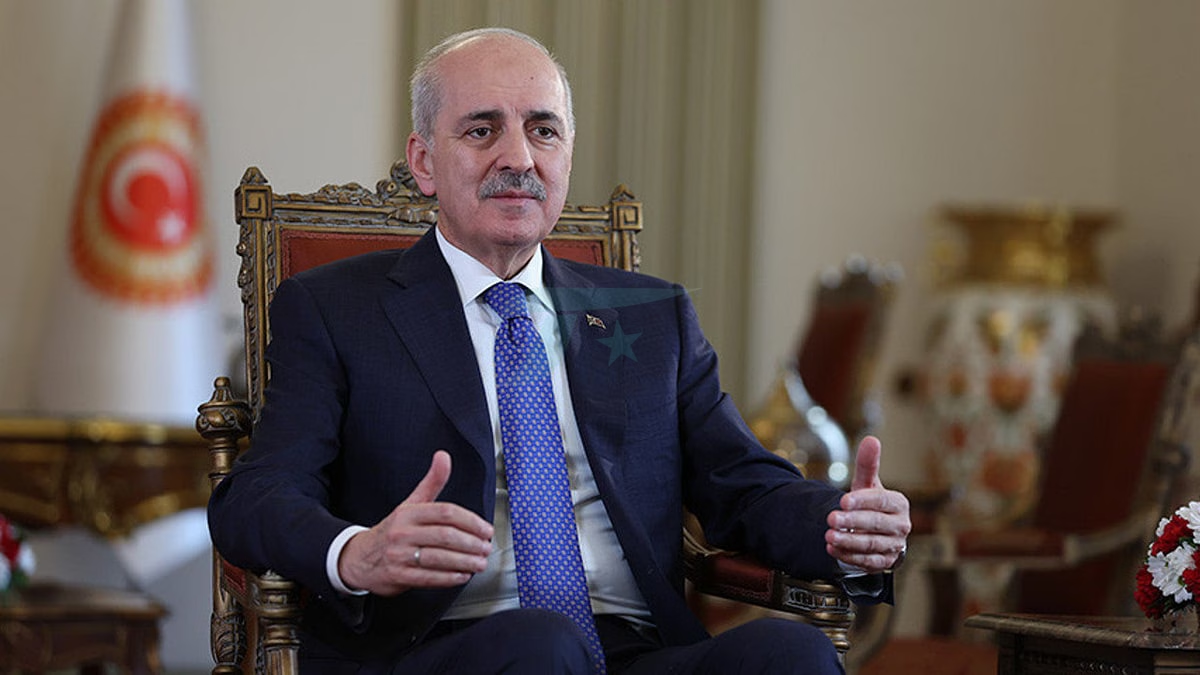
On his way to an official visit to Portugal on September 28, Turkish Parliament Speaker Numan Kurtulmuş answered reporters' questions on the plane, discussing the investment fund crisis, President Erdoğan's UN speech and Netanyahu, the Terror-Free Türkiye monitoring commission, a new constitution, parliament's rules of procedure and the Mecca Joint Defence Agreement.
The fund crisis: “No one who did this will get away with it”
Let us start with the most pressing issue: the fund crisis and the movements on Borsa Istanbul have spilled over into politics and parliament. What is your assessment?
I said this at our annual review meeting on Friday as well. This is an extremely sensitive issue that concerns a very large number of people. All of these people invested in the stock market to earn something from the few pennies of honest money they had saved. Whoever speculated with their money, whoever made unjust gains, must be made to pay dearly; every one of them must be held to account.
It is truly an issue for which there can be no making amends. The future dreams of a great many people accumulate in a fund, and you seize those dreams. This is an unforgivable and extremely serious matter.
Beyond the corruption and speculation, another important side of this matter is economic security. Issues like this must not have effects beyond their own scope. That is why the relevant ministry took its measures on time.
Likewise, in this matter, which has been referred to the prosecutors, the prosecutors must complete their investigations within a short time through extremely meticulous, comprehensive and detailed work, and the cases must be brought to court. I hope that on this issue, which everyone is following closely, the matter will be pursued with such determination that no one who did this will get away with it.
Beyond the funds, there are also losses in the spot market; it is said the number of people affected could reach one million. Could this become a serious problem?
That is right… All of this must now be examined in every detail. Measures must be put in place so that no one is wronged.
Our stock market is not a very broad and deep one anyway; it is a narrow market. Compared with others, it does not have great depth. The smallest thing that happens in this market can cause misguided swings. The willingness of foreign investors, and of domestic investors at home, to invest must not be damaged. I think the economic security side of this matter is as important as its legal side.
The names of some lawmakers have also come up in the investigation. If a request to lift immunity reaches parliament, how will the process work?
How lawmakers' immunity is lifted is clearly defined. The Speaker's Office has no discretion over lifting lawmakers' immunity. When files come from the courts — as you know, there are currently 1,096 immunity files before the Joint Committee in parliament.
By custom, any request that arrives is immediately referred by the Speaker's Office to the Joint Committee, and the Joint Committee may, if it wishes, take up these files and launch a parliamentary inquiry on that basis.
Parliament is still in recess, this matter has not come before parliament, and no summary of proceedings has been prepared. When such files arrive, the procedure to be followed is clear.
The UN General Assembly and Netanyahu
How do you assess President Erdoğan's speech at the UN General Assembly? Netanyahu was protested at the podium and delivered a speech targeting Türkiye and the President. What lies behind this?
First of all, this was our President's 16th speech there. We listened to every one of his speeches carefully and attentively. May God bless him; on behalf of our nation I once again express my gratitude. This speech was far above his previous 15 and extremely ambitious. Ambitious in what sense? He gave a speech that emphasised the resolve of the front of humanity and voiced the global conscience demanding that the genocidal Netanyahu and his gang be held to account.
It is therefore perfectly natural that the Zionist lobby, and the Netanyahu gang tasked by the Zionist lobby, were disturbed by it. This is how I look at it. “The desperation of being backed into a corner…” That is the psychological summary of Netanyahu's speech; when you look at his facial expressions, the sentences he chose, even his body language, he really speaks with the desperation of someone backed into a corner. Perhaps the upcoming elections are also a great pressure on him. On top of that, as you said, he faced the most intense protest ever seen at the UN General Assembly. Almost all countries, apart from a handful, left the hall.
I say it very clearly: the reaction in the hall is the awakening of humanity's conscience against the genocide Israel has committed since the October 7 attacks. It is a sign that the time for accountability is approaching.
That is also why Netanyahu targeted Türkiye and our President there. Because from the very day after October 7 — that is, from the moment Israel's attacks began — it is Türkiye, our President and we who have shown the strongest reaction.
What I have seen at all the international meetings I have attended since October 7 is this: at first we were alone in our reaction. Most countries were too afraid of the power of the Zionist lobby to make a sound; delegations stayed silent. Over time we have seen how quickly this has changed direction.
Whichever international meeting we go to, almost no one is left to speak in Israel's favour, apart from a handful of countries. Everyone has come round to the position we set out. This is in fact a great success of Türkiye's diplomacy.
Terror-Free Türkiye: the monitoring commission
As parliament reopens, people are asking when and how the monitoring commission provided for in the Terror-Free Türkiye law will be set up. What timetable are you planning?
We will follow the same negotiated approach we used in forming the National Solidarity, Brotherhood and Democracy Commission. There, our responsibility was to prepare a report and even the legislative preparations and proposals. Here, parliament's responsibility is to act, so to speak, as a “third eye”, following on behalf of the nation how the process is going and monitoring it.
As you know, the decisions on implementation will be taken by the Board chaired by our Vice President. I hope we will form the commission as soon as possible. It must be a body in which all the parties with a group in parliament are represented.
Will the commission also work in the field?
No. Monitoring what happens in the field is the duty and responsibility of the state's official security bodies.
This law has three important safety valves. One of them is the determination and certification, based on observations in the field, that the organisation has laid down its arms and dissolved itself, followed by a decision of the National Security Council. Until that decision is made, the law adopted in parliament with 467 votes will not enter into force. Very clearly.
Second, the implementation matters you mention — the examination of files one by one — will be carried out by this Board chaired by the Vice President, which includes our ministers and state institutions. The monitoring body to be formed in parliament will have no executive duty or responsibility; it will only monitor the process and, if necessary, work on proposals for legislative amendments.
The Board has set up sub-commissions, but no concrete progress has been made public, and the monitoring commission was not formed over the summer. What do you say to criticism that politics is dragging its feet?
These sub-commissions are already one of the powers legally granted to the Board. The Board can set up whatever sub-commissions it wishes, because very comprehensive work will be carried out.
As for the question “Is politics dragging its feet?”… Let me say it openly: a parliament that adopted a proposal on the process with 467 votes — the centre and the heart of Turkish politics — has also declared that it will never drag its feet on this issue.
Yes, 467 votes were cast, there is great support, public support… But we know very well that some circles do not like this at all and have mobilised to prevent it. One of the instruments they will use to derail the process is to discredit politics.
For God's sake, where in the world has politics taken on such a great responsibility? Politics in Türkiye has fulfilled every responsibility that fell to it, and for this I once again thank all the political parties that took part. Many risks were taken. A report was prepared, a law was drafted and adopted… We did not get here easily.
Frankly, everything is running smoothly within its own process. God willing, the organisation will soon show that it has laid down its arms, this will be established and confirmed, and, even more importantly, they will lay down the weapons in their minds, and we will begin a period in which there are no weapons, only words, and people live together in peace.
After parliament went into recess, statements came from the organisation such as “We will not lay down arms unless Öcalan is released.” How will such statements be overcome?
Such words, such needless statements, happen. But I did not say what I said a moment ago by chance: “Not laying down the weapon in the hand, but laying down the weapon in the mind.” Everyone must stop using separatist language, and some circles must also stop using discriminatory language. The new era undoubtedly requires a new language and a new understanding.
Türkiye has made its decision. The terror issue will be left behind as soon as possible. Whoever tries to put a spoke in the wheel of this process will lose. The determination of all units of the state on Terror-Free Türkiye is absolute; there will be no concession on this.
Looking at examples around the world, did you expect the dissolution process to reach this point in around two years?
We know all the conflict resolution processes in the world; we have studied them in detail. Achieving results in such a short time is probably the most important example in the world — the Turkish example. Many factors are at play here: politics stepping in, a negotiated approach being adopted, full and complete coordination being ensured among state institutions.
Regional developments have also given very serious support to this process. For example, the PYD's rapid and effective integration with the al-Sharaa administration in Syria removed the possibility of a conflict in Syria arising through the PYD/YPG.
I hope that if the armed militias in Iraq are also quickly integrated into the state, what we call not just a Terror-Free Türkiye but a terror-free region will gradually begin to come true.
We know there are some provocative elements, Israel first among them, that are disturbed by this. Everyone should be very careful. Words are easy; everyone can say them, but if what is said has no counterpart in action, it has no importance. What matters is that these things are carried out in the field, put into effect, and that a new era built on peace and brotherhood is established.
Did you expect the proposal to be adopted in parliament with 467 “yes” votes?
We expected it to receive a very large vote, but this figure exceeded expectations. It is truly a very good result. As far as I know, no other legal text in our parliamentary history has been adopted with such a high vote. This shows how strongly the parties supported it.
All political parties go to their grassroots and talk to them. The nation has embraced Terror-Free Türkiye and a terror-free region. Anyone who stays out of this politically knows they will get a negative response from the people. Now we must live up to this support.
A new constitution: “This parliament can make a new constitution”
Will we see the same consensus on a civilian constitution? Does this parliament have the strength to make a new constitution? Is an early election on the agenda?
As you may remember, in the speech I gave when I was first elected Speaker at the opening of the 28th term, I said: “The 28th term of the Grand National Assembly of Türkiye is the most suitable parliament for making a new constitution.”
There are 7 party groups in parliament; the number was 6 and has become 7. Fifteen political parties are represented in parliament, and the representation rate is 99 percent. Almost everyone who voted is represented in parliament. Such a parliamentary configuration has never existed before. This is very valuable, very important.
Türkiye needs a new civilian, modern, inclusive, embracing and democratic constitution; this is essential. It is one of the important steps for Turkish democracy to function flawlessly. I am convinced that this parliament has the strength and the power to do it. I find debates such as the “constituent assembly” that some people talk about completely undemocratic. This parliament can make a new constitution. And the time is exactly right.
We use the phrase “early election”, but legally it is a matter of renewing elections… How that would happen is also clear. If more than 360 lawmakers in the Grand National Assembly want to renew the election, and on whatever date they want, the renewal process begins. Moreover, renewing elections is a matter of political climate. The political agenda currently dominant in Türkiye is not the renewal of elections.
The 28th term is drawing to a close. Will you take the initiative for a new constitution in the time remaining, and could we see it in this legislative year?
Why should a parliament that achieved something harder than a constitution — the report of the National Solidarity, Brotherhood and Democracy Commission — a parliament that secured agreement on a much more difficult issue, not reach consensus on a new constitution? I, too, will fulfil every responsibility that falls to me on this.
This is a matter of climate. When the climate is right, of course… In fact, what I am saying right now is itself a direct step. I am effectively making a call to the parties and to the Turkish public.
There is also something special about this year. Exactly 150 years have passed since the Meclis-i Mebusan, that is, since Türkiye's first constitution. Over 150 years Türkiye has gained a very great constitutional experience; it is a country with a great accumulation of knowledge. Why shouldn't Türkiye make a brand-new constitution in its 150th year?
Consensus always gets stuck on the system of government. Could the Presidential System of Government be debated again?
I believe the Presidential System of Government has largely settled in. I believe it has also been accepted by the people. So the nation has in practice approved this system. But work was done earlier within the Presidency, and the other political parties will certainly have proposals; its shortcomings, missing aspects and aspects that need revision can of course be put on the agenda.
Moreover, if we are talking about making a constitution, and especially about certain fundamental changes to the constitution, the way to do it is to reach consensus on the ideas everyone brings to the table. For that, the parties set out their red lines, and if consensus emerges in the areas outside those red lines, I think a text of agreement will emerge. It is difficult… But as I said, we are talking about a parliament that has achieved something even harder.
Mr. Bahçeli has proposed changing the laws on political parties and elections. What do you think?
I regard this proposal as right and appropriate. Throughout my political life I have believed this: four legal texts set out a country's democratic topography — its constitution, its law on political parties, its election law and its parliamentary rules of procedure…
I believe these four texts need a democratic revision. I therefore find the proposal to change the Election Law and the Political Parties Law extremely positive and appropriate.
When you took office you said, “My first task is the rules of procedure.” Where does that work stand?
We also made the preliminary preparations for that. It could not make it onto the political agenda, but it is our first task… The number of groups in parliament has increased. The General Assembly starts work at 15:00 on Tuesdays and at 14:00 on other days. No debate on any bill can begin before 20:00, even 21:00. This cannot go on.
We did detailed work on the rules of procedure. We even proposed that all debates take place and that one day of the week be a voting day only, for whichever bills are to be passed. All of this was worked out, but we have not been able to make it happen.
I can easily say this: the Grand National Assembly of Türkiye is one of the longest-working, most serious and most uninterrupted parliaments in the world. But if you ask how efficient it is, unfortunately we cannot say the same. Our concern is to make this work more efficient. It is not about cutting short or silencing party A or party B.
The Mecca Joint Defence Agreement
The Mecca Joint Defence Agreement has also drawn attention in the US, and the Houthi attack on Saudi Arabia is being interpreted as a test of the agreement. How do you assess it, and will it come before parliament?
I think the idea that the Mecca Joint Defence Agreement was founded in response to this attack attributed to the Houthis is very wrong.
Saudi Arabia is one of the big countries of the region, Pakistan is likewise one of the big countries, and Türkiye is likewise the most important country in the region… Look at the developments in the region. The greatest source of instability in this region is Israel's attacks. Israel attacked Palestine, attacked Lebanon, attacked Syria, attacked Iraq, attacked Yemen, attacked Qatar, attacked other countries. In other words, there is no mechanism whatsoever to protect the countries of the region from Israel's attacks.
The countries of the region face an open threat. The Mecca Joint Defence Agreement is therefore in fact an agreement that has come about to protect the countries of the region from attacks against which they have so far been unprotected. It is still at the stage of an idea. Yes, the agreement has been signed, a result has emerged, its secretary-general has been appointed; it is a very fresh development.
I hope this agreement will continue to expand and become a common umbrella that includes other countries of the region and even receives contributions from countries across the wider Islamic world. Seen this way, the Mecca Joint Defence Agreement, as has been said from the very beginning, is not an alternative to any defence pact, nor is it an agreement made against any state.
Of course, how an international agreement enters into force in Türkiye is clear. At the moment nothing has come to the Grand National Assembly of Türkiye. It is natural for it to come onto the parliament's agenda.
Featured Listings
Sponsored
Similar Interviews


Foreign Minister Hakan Fidan on NTV: the Mecca Alliance, Gaza, the Black Sea and the S-400s
NTV
- 9/23/2026


Justice Minister Akın Gürlek to Sabah: assets seized in the investment fund probe will go to victims
Abdurrahman Şimşek (Sabah)
- 10/4/2026


Defence Minister Yaşar Güler to Global Business Press: 2035 goals, KAAN and Türkiye–Azerbaijan defence cooperation
Global Business Press
- 10/4/2026
Featured News


Job Listings
Stay Updated with The Turkiye Times
Subscribe to be informed about special news, developments and announcements. We will keep you informed.
By signing up, you agree to our Privacy Policy











