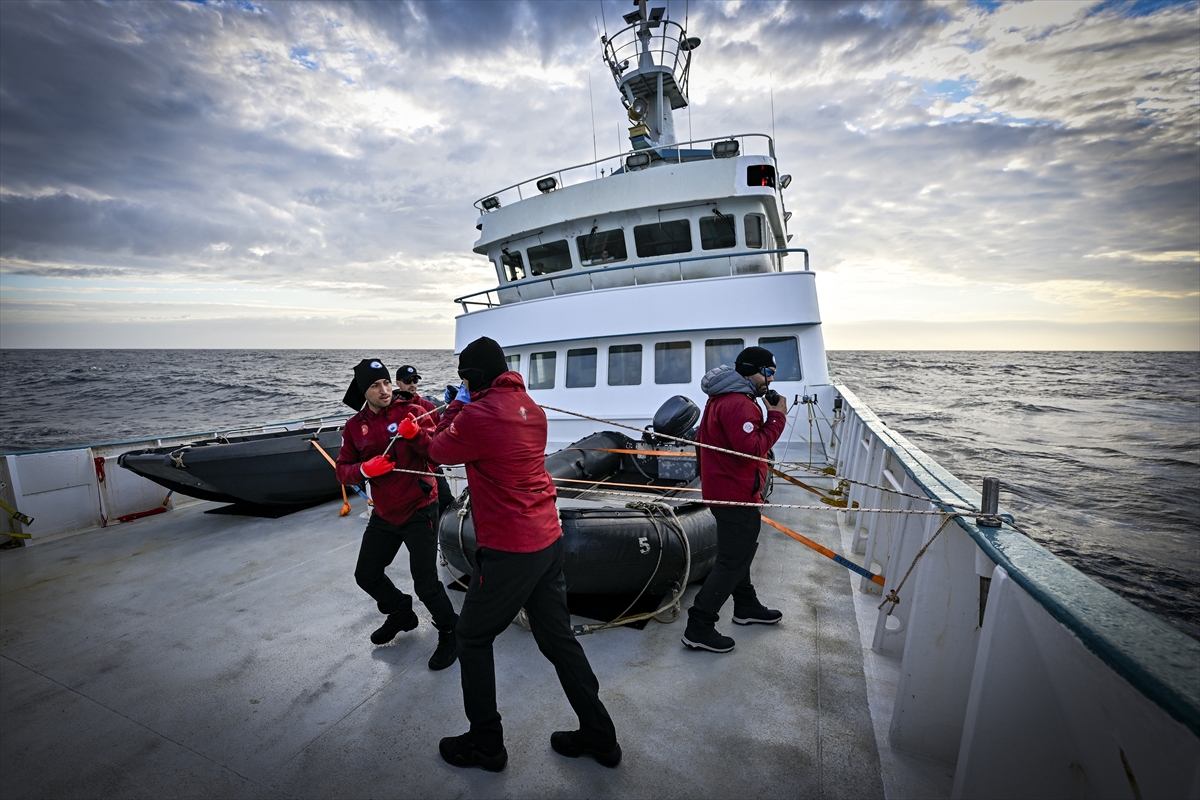
Türkiye's 6th National Arctic Scientific Research Expedition (TASE-VI) has been completed. As part of the expedition, 12 scientists carried out a total of 12 research projects in oceanography, biology, chemistry, atmospheric dynamics, meteorology, geodesy and satellite systems.
Conducted under the auspices of the Presidency, under the umbrella of the Ministry of Industry and Technology and under the management of TÜBİTAK Polar Research Institute (KARE), the expedition's scientific team reached the 82nd parallel north. The research focused on global climate change, threatened ecosystems and the effects of human activities on the region within the framework of the National Polar Research Strategy.
Three foreign researchers from Argentina, Bulgaria and Uruguay also took part in the expedition. The researchers studied Arctic ecosystems, the distribution of bird species native to the region and microplastic pollution in the polar regions.
Effects of glacial retreat on ecosystems studied
Paula Arbisa, a biologist and master's student in earth sciences who joined the expedition on behalf of the Uruguayan Antarctic Institute, studied Arctic fjord ecosystems affected by glaciers. The data obtained was planned to be compared with research findings from Antarctica.
The study aimed to determine the effects of glacial retreat caused by climate change on the condition of ecosystems. The scientists collected samples from seafloor sediments, used small organisms as biological indicators to assess the condition of the ecosystems and analyzed environmental parameters.
Distribution of Arctic bird communities examined
Boyan Miçev, a representative of the Bulgarian Academy of Sciences, researched the structure of Arctic bird communities and the geographic distribution of species found only in the region.
Miçev said that approximately 30 to 40 bird species could be observed in the open sea, that these birds nested on land and went out to sea to feed.
Microplastic pollution in the atmosphere to be measured
Arturo Huber, a researcher at the Argentine Antarctic Institute, studied microplastic pollution in the atmosphere of the polar regions. The research used a system that collected airborne particles on a filter.
Laboratory analyses of the collected samples are intended to determine the concentration of microplastics in the polar regions. Huber said the same method had previously been applied in Antarctica and that the data obtained from the Arctic would be compared with Antarctic research.