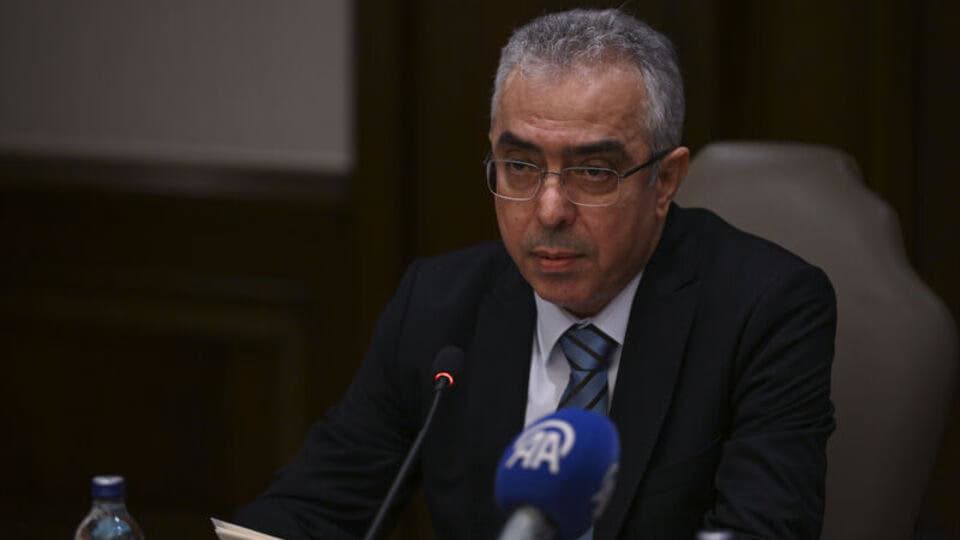
İYİ Party Chairman Müsavat Dervişoğlu attended the final day of the party's "Justice for goodness: Turkish law workshop" at Litai Hotel, where the party's Law Vision Document will be announced, and delivered the closing speech.
Dervişoğlu said the Turkish Law Vision Document, which emerged from the workshop and will be shared with the public in the coming days, will take its place in history, stating, "Every article of this document is the essence of the discussions held in these halls, the experience of these people and the hard-won lessons of this nation. At this workshop, Turkey's fundamental preferences regarding its state structure were laid on the table.
The unitary state structure was confirmed as an undisputed ground for consensus," he said. "Demanding one's right is a duty not only to oneself but also to society."
Stating that in Turkey's geographical, historical and social reality, the unitary state understanding is not merely a preference but was presented as a necessity, Dervişoğlu said, "Protecting the unitary structure is possible with a strong parliamentary balance mechanism. Otherwise, the unitary state is hollowed out, and central authority becomes arbitrary. Participants drew the following three fundamental lines.
The executive being genuinely accountable to the legislature, the presidency being an impartial and non-partisan institution, and the parliament being an institution that genuinely makes and oversees laws, not merely a body of approval. When these three elements are not together, the rule of law is harmed, regardless of the system's name.
Where checks and balances lose their function, those warnings, as Montesquieu said two and a half centuries ago and as I recalled yesterday, come back to life. Power tends to corrupt, and only another power can stop it," he stated.
Dervişoğlu noted that the Turkish Law Workshop discussed ways to re-establish balance with institutional guarantees, saying, "Our workshop addressed the distance between the theoretical framework of the rule of law and its implementation. This distance may have disappointed some, but there is no healing without confronting it. Demanding one's right is a duty of an individual not only to themselves but also to society.
This sentence lies at the center of the rule of law revision debate. The rule of law is an order where citizens can demand their rights and where these demands are met through legitimate and functional mechanisms," he said. "When institutions are strengthened, the space for corruption narrows."
Expressing that when a demand for rights is silenced or goes unanswered, the rule of law remains only in name, Dervişoğlu made the assessment that "The concrete findings highlighted in the session included the lack of a systematic mechanism for complying with European Court of Human Rights rulings, the de facto restriction of constitutional rights guarantees through secondary legislation, and most importantly,
using the discourse of the rule of law sometimes to legitimize the instrumentalization of law. The criminal law session was perhaps the part of our workshop where the most concrete and technical discussions took place. It was not abstract principles but numbers and facts that spoke here." "A law based on transparency has turned into a series of exceptions that disable transparency."
İYİ Party Chairman Dervişoğlu stated that the findings regarding Turkey's public procurement legislation were extremely striking, and he spoke as follows:
The number and scope of the exception provisions added since the Public Procurement Law came into force have practically reversed the spirit of the law. A law based on transparency has been transformed into a series of exceptions that disable transparency. The de facto limits of the Court of Accounts' audit authority were also addressed in this session.
The narrowing of the Court of Accounts' audit over certain public institutions and state-owned enterprises is a fundamental problem that renders the accountability mechanism dysfunctional. Where there is no institution independently auditing where public money goes, a foundation is laid for corruption. Corruption is fed not only by individuals' moral weaknesses but also by institutional weakness.
When institutions are strengthened, the space for corruption narrows. Turkey's reform agenda in this area stands before us as both a political choice and an economic necessity. "Legislation partly exists, but implementation is terribly inadequate."
Drawing attention to the fact that the most heart-wrenching session of the workshop was the gender inequality session, Dervişoğlu said, "The figures were revealed, but it must not be forgotten that behind every figure is a name, a lost life.
The trend of femicides in Turkey, the destructive effect of the perception of impunity on preventive measures, and the implementation practice of protective order decisions were laid on the table in this session with scientific rigor, not emotionally. Legislation partly exists, but implementation is terribly inadequate. A state that cannot protect its most vulnerable citizen cannot claim to be a state of law.
Combating violence against women is not a political choice but the minimum condition of being a state of law. Regardless of political views, everyone agrees that a woman should not be subjected to violence. Then, transforming this consensus into a legal and institutional guarantee is our common responsibility," he said. "A system that rehabilitates a child pushed into crime prevents that child from re-offending."
Noting that a comprehensive assessment of Turkey's children's justice system, covering both legislation and practice, was also made at the workshop, Dervişoğlu said, "The numerical inadequacy of juvenile courts, lack of expert personnel and the still insufficient internalization of the restorative justice approach were among the main findings.
Reform of the children's justice system is not only a humanitarian necessity but also a long-term security and social policy issue. A system that rehabilitates a child pushed into crime largely prevents that child from re-offending ten years later.
Conversely, a system that forces the child to be stigmatized at an early age within a penal process increases the social cost in the long run and darkens a life," he stated. Saying that the most exciting and most challenging agenda item of the workshop was the artificial intelligence, big data and digital transformation session, Dervişoğlu said, "When technology lags behind the law, gaps are created, and these gaps are exploited.
When technology outpaces the law, innovation is hindered. Finding the balance point requires flexibility and foresight far beyond classical legal interpretation. The integration of algorithmic decision-making into the judiciary, protection of personal data, AI-related discrimination, and digital identity rights were tried to be turned into concrete policy proposals in this session."
"The full text of the vision document will be shared in the coming days."
Stating that the report, which is the preface to the Turkish Law Vision Document, is the first concrete fruit of the Turkish Law Workshop, Dervişoğlu included the following statements:
The value of this document will be measured not only by its content but by how it is used. Every major document faces three critical tests. The first test is legitimacy. This document is not the decision of a political party. It is the product of two days of intense work by all stakeholders of Turkey's legal world. Participants from every field of law took part in these sessions. Bar association presidents spoke. Academics objected.
Journalists questioned. Civil society representatives proposed. It is this richness that ensures the document's legitimacy, and legitimacy is the prerequisite for implementation. The second test is sustainability. Many documents of good intention have been written in Turkey, but very few have been implemented. If the fate of this document is to be different, two conditions are required.
First, as a strong advocacy network that will take ownership of the document, every person who emerged from this hall must be a follower and implementer of this document in their own field. Second, as a concrete monitoring mechanism, a structure that assesses the non-implementation of the document's proposals and informs the public must be established. Our third test is political impact. This document will not merely wait on a shelf as an academic reference text.
In Turkey's upcoming political period, it will be a reference point in constitutional debates, electoral law reform and judicial independence issues. As the Chairman of İYİ Party, I assume the political responsibility for this. İYİ Party will continue to defend the proposals of this document before the public, raise its voice in parliament and evaluate government programs within the framework of these criteria.
The full text of the vision document will be shared with the public separately in the coming days, but to understand that document, it is essential to understand the spirit that gave birth to it. The GGC's Stockholm Panel Final Declaration was published: It was stated that the public was not sufficiently informed about the process.