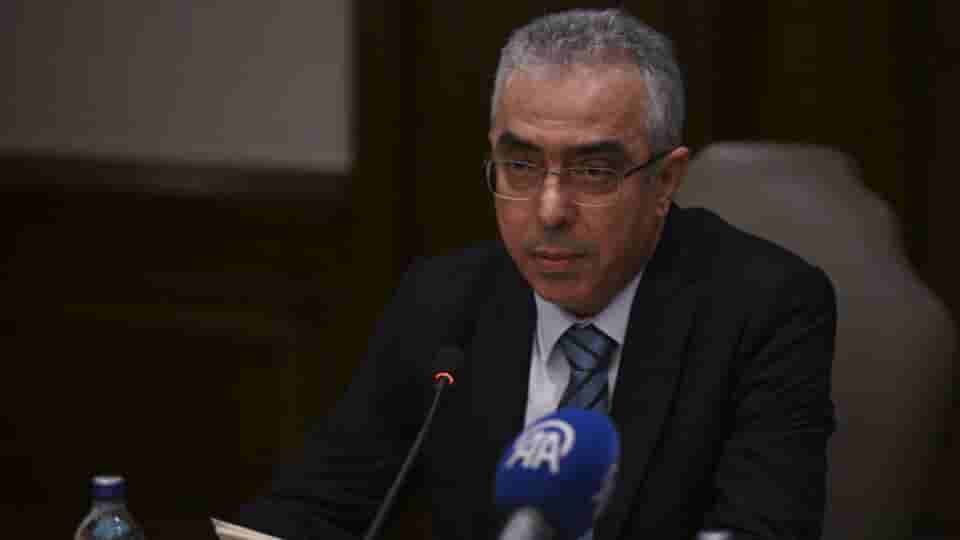
Mehmet Uçum, Chief Advisor to the President and Deputy Chair of the Presidential Council for Legal Policies, assessed the stage reached by the Terror-Free Türkiye process and what he described as efforts aimed at disrupting it. Uçum said the process should be defined not as a “peace process,” but as a “transition process” directed toward the goal of a Terror-Free Türkiye.
New phase with Law No. 7595
According to Uçum’s assessment, the process began with the new approach outlined by President Recep Tayyip Erdoğan during his Ahlat and Malazgirt programs on August 25-26, 2024. The process, given a practical basis through statements by Devlet Bahçeli, advanced through Abdullah Öcalan’s statement dated February 27, 2025, the committee’s work in the Grand National Assembly of Türkiye and the approval votes of 467 lawmakers.
Uçum said a new period began when Law No. 7595 on Strengthening National Solidarity and Social Integration was published in the Official Gazette on August 18, 2026. He said a Monitoring and Evaluation Board had been established under the chairmanship of the Vice President to implement the law, and that the board had held meetings to determine plans and subcommittees.
Stages of the deferral process
Uçum said the deferral procedure set out in the law consists of general conditions, special conditions, assessment, decision, process and outcome stages. He said the general condition was that the findings that the organization’s de facto presence had ended and that its weapons and ammunition had been surrendered must be confirmed by a decision of the National Security Council, which must then be published in the Official Gazette.
Following the announcement, the individuals covered by the law must submit a written application to the competent authorities within six months. Applications may be filed by the individual or through their lawyer. Following the applications, prosecutors, courts and criminal enforcement judgeships will examine whether the applicant falls within the scope of the law, whether they have ties to the PKK/KCK or affiliated organizations, whether the relevant offenses are covered by the law and whether one of the excluded offenses applies.
A deferral decision may be issued if all three conditions are met. If the conditions are not met, the application will be rejected, and the decisions may be challenged. Once the decisions become final, the deferral period will begin; if no terrorism offense is committed during this period, a decision may be issued, depending on the person’s legal status, that no prosecution is warranted, that the case should be dismissed or that the sentence should be deemed served.
Assessment of Öcalan’s role
Uçum argued that debates over Abdullah Öcalan’s status had been detached from the purpose and function of the process. He said the space established in İmralı as a unit attached to the prison building was intended to provide a working environment suited to Öcalan’s role in the process.
Uçum said that in later stages, expanding opportunities for open meetings could also be considered within the perspective of integration with the state and society. He criticized characterizing these opportunities as release or a privilege, and described bringing issues such as Öcalan’s release to the forefront as an approach aimed at disrupting the process.
Claim that the process is being disrupted
Uçum alleged that some individuals and groups had developed criticisms of the process based on their own political agendas, which could cause delays during the assessment stage on the ground. He said DEM’s restructuring and efforts to organize under the names Democratic Republic Movement and Patriotic Left Democracy could intensify debates over position and status.
Uçum argued that these internal debates should not turn into ethnic politics or problematic political rhetoric, and said measures should be taken against such intellectual and practical initiatives in the conduct and management of the process.
Distinction between dialogue and negotiation
Uçum described the Terror-Free Türkiye process as a dialogue process and the work on a new constitution as a negotiation process. He said the interlocutors in the dialogue process were Öcalan, the leaders and cadres affiliated with him, associated organizations and representatives involved in the legal process. He added that the democratic negotiation process encompassed all segments of Turkish society and legitimate political and social representatives.
Uçum argued that approaches to a new constitution and democracy could not be put forward as conditions of the Terror-Free Türkiye process, and said the two processes should not be conflated. In Uçum’s view, the new constitution should be addressed not through ethnic and identity-based politics, but through an approach that encompasses and unites the entire society.
New constitution timetable
Uçum said that during the remaining period of the 28th legislative term of the Grand National Assembly of Türkiye, until the 2028 elections, ideas on the fundamental approaches to a new constitution could be developed and refined. He argued that adopting the new constitution by broad consensus during the 29th legislative term and submitting it to public approval would be both possible and necessary.
At the conclusion of his assessment, Uçum argued that a period of reform would begin once the Terror-Free Türkiye transition was completed. He said the National Security Council’s decision on the findings and confirmation should be adopted and published before the end of 2026, describing it as an important threshold for the process.