- BIST10012,260-0.05%
- USD49.34+0.24%
- EUR55.21-0.01%
- GOLD4,207.90+0.41%
- INTEREST37.00%-1.00
- BITCOIN83,452+2.08%
- October 13, 202618°
- BIST10012,260-0.05%
- USD49.34+0.24%
- EUR55.21-0.01%
- GOLD4,207.90+0.41%
- INTEREST37.00%-1.00
- BITCOIN83,452+2.08%
- October 13, 202618°
Minister Kacır says 20,000 applied for skywatching event and 1,500 were selected
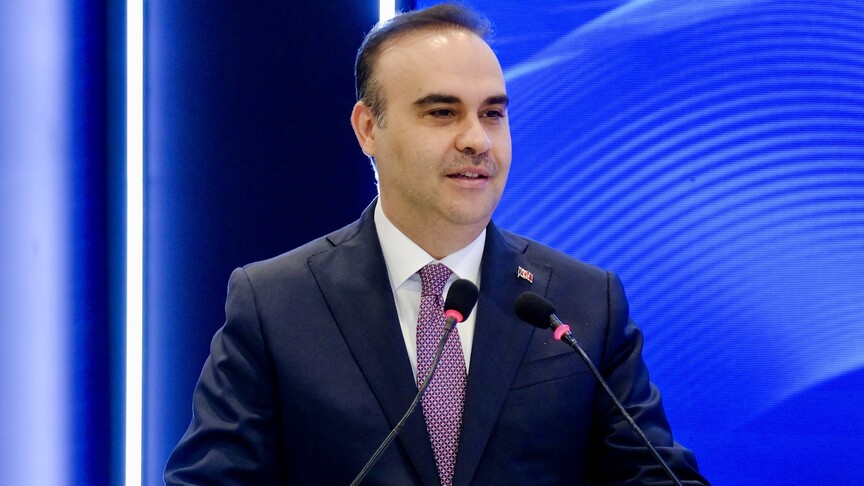
Minister of Industry and Technology Mehmet Fatih Kacır announced that approximately 20,000 people from all 81 provinces applied for the 28th Sky Observation Event, which began at Lake Emre in Afyonkarahisar.


Minister of Industry and Technology Mehmet Fatih Kacır attended the opening of TÜBİTAK's 28th Sky Observation Event, which began at Lake Emre in Afyonkarahisar. Standing out for its low light pollution, broad horizon and atmospheric conditions suitable for sky observations, the event will continue through August 15.
Kacır said they had received approximately 20,000 applications from all 81 provinces for this year's event. Following the evaluation process and a draw, approximately 1,500 sky enthusiasts were selected to attend.
Science and observation program
Talks and workshops will be held as part of the event with the participation of experts in astronomy and space sciences. At workshops prepared by TÜBİTAK experts and science centers, participants will have the opportunity to turn their curiosity into experiments and their ideas into designs.
Kacır said the sky is a gateway to one of humanity's oldest curiosities. He said the work of figures such as Al-Farghani, Al-Jazari, Cacabey and Ali Qushji contributed to astronomy's shared body of knowledge, while research conducted at centers of learning in Baghdad, Samarkand and Istanbul contributed to understanding the movements of celestial bodies and to measuring time and the Earth.
Targets in the space program
Kacır said Türkiye should be moved toward a more independent future through new discoveries and technologies under the National Technology Initiative. He said infrastructure, human resources and technological capabilities in space science and technologies were being developed, adding that the field had become a strategic area of expertise that contributes to Türkiye's development and strengthens independence in critical technologies.
Kacır listed the İMECE, GÖKTÜRK-2 and TÜRKSAT 6A satellites among the indicators of Türkiye's national capabilities in space and said the National Space Program had ushered in a new era in space exploration. He recalled that, under the Turkish Astronaut and Science Mission, Alper Gezeravcı conducted 13 scientific experiments aboard the International Space Station, while Tuva Cihangir Atasever conducted seven scientific experiments during a suborbital research flight.
Kacır said they aimed to reach the Moon in the coming period with a spacecraft equipped with a propulsion system developed using national capabilities. He said independence in positioning and timing information would be strengthened through the implementation of the Regional Positioning and Timing System.
Kacır said Türkiye would gain independent access to space by building a spaceport in Somalia and using its own rockets, spacecraft and spaceport. He added that the 77th International Astronautical Congress, to be held in Antalya from October 5 to 9, would also lay the groundwork for new partnerships.
New call aimed at young people
Kacır said they were working to expand opportunities for young people to develop their skills in science and technology. He announced that a call to be opened by TÜBİTAK tomorrow would support not only national sky observation events but also events organized in different regions of Türkiye by sky enthusiasts, civil society organizations and universities.
Afyonkarahisar Governor Naci Aktaş said talks and workshops would be held during the day, followed by telescope observations at night. TÜBİTAK President Orhan Aydın said sky observation events had been held continuously since 1998.
Türkiye Space Agency President Yusuf Kıraç also highlighted the importance of the goal of independent access to space and of raising space awareness in society. Kıraç said the increase in applications for sky observation events and the International Astronautical Congress to be held in 2026 was encouraging.
Stay Updated with The Turkiye Times
Subscribe to be informed about special news, developments and announcements. We will keep you informed.
By signing up, you agree to our Privacy Policy
















