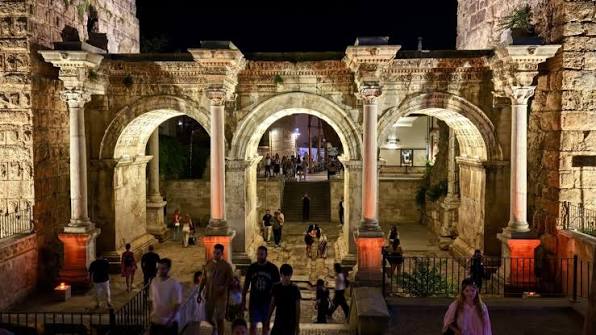
Hadrian’s Gate, located at the entrance to Kaleiçi in Antalya’s Muratpaşa district and popularly known as Üçkapılar, now reflects the city’s historic character at night following the completion of its lighting project.
The structure was built as a monumental triumphal arch on the city walls to commemorate Roman Emperor Hadrian’s visit to Antalya in AD 130. Made largely of white marble apart from its column shafts, the gate is among Antalya’s best-preserved historic structures.
A monumental structure with three arches
Hadrian’s Gate consists of three symmetrical arches. Each arch is 4.15 metres wide and 6.18 metres high; the gate section reaches 8 metres, while the two towers on either side are approximately 15 metres high.
The structure is decorated with rich reliefs and carvings. Its coffered ceiling features flower patterns resembling members of the daisy family, along with fruit and leaf motifs. These decorations are considered to symbolize the crops grown in Antalya and its surroundings in antiquity, as well as the fertility of the region.
Traces of the Roman and Seljuk periods
Towers used for defensive purposes stand on either side of the gate, whose cornice features lion-head figures. The southern tower dates to the Roman period, while the lower section of the northern tower is believed to have survived from antiquity and its upper section was built during the reign of Seljuk Sultan Alaeddin Keykubad I.
For many years, the structure remained behind the city walls, which helped protect it largely from external factors and preserve it to the present day. Hadrian’s Gate was revealed again after the remains of the walls were removed in 1882 and underwent a comprehensive restoration in 1959.
The gate, one of the historic structures most visited and photographed by domestic and foreign tourists in Antalya, remains an important passageway connecting the city’s past with modern life.
Lighting along the city walls will be increased
The architectural details of the structure, illuminated as part of a project carried out by the Antalya Governorship, have become more visible in the evening and at night.
Antalya Governor Hulusi Şahin announced that the lighting project was carried out by the Governorship through the General Directorate of Cultural Heritage and Museums, with its budget covered by the Governorship. Şahin said the lighting process had been completed and that plans were underway to increase lighting along the city walls.