- BIST10011,326-1.33%
- USD50.05+0.05%
- EUR56.25-0.01%
- GOLD4,081.50-0.78%
- INTEREST36.00%-1.00
- BITCOIN75,583-0.53%
- November 6, 202612°
- BIST10011,326-1.33%
- USD50.05+0.05%
- EUR56.25-0.01%
- GOLD4,081.50-0.78%
- INTEREST36.00%-1.00
- BITCOIN75,583-0.53%
- November 6, 202612°
Clash Report says Sudan's AKINCI downed another CH-95 near Nyala
Footage shows a Bayraktar AKINCI UCAV operated by the Sudanese army downing a Chinese-made CH-95 UAV used by the Rapid Support Forces (RSF) near Nyala. Similar engagements recorded since July demonstrate the battlefield impact of the air-combat capability developed during tests in Türkiye.


In Sudan's ongoing civil war, the Turkish-made Bayraktar AKINCI has carried out another air-to-air engagement. Footage published on Nov. 5 by Clash Report, which covers defense and conflict news, shows an AKINCI operated by the Sudanese army downing one of the Chinese-made CH-95 unmanned aerial vehicles in the inventory of the Rapid Support Forces (RSF) near Nyala, the capital of South Darfur state.
No official statement from the Sudanese army or the RSF on the incident could be located. However, this is not the first encounter between AKINCI and CH-95 aircraft. Footage that has emerged since the summer shows that the attack unmanned aerial vehicle (UCAV) developed by Baykar has been used in Sudanese airspace not only against ground targets but also against rival UAVs.
Engagements recorded since July
The first notable footage was published on July 13, 2026. Clash Report said that AKINCI had struck a CH-95 with an air-to-air missile northwest of El Obeid in North Kordofan and had destroyed a second CH-95 on the ground the same day. New footage of an aerial destruction was released in mid-August. Based on infrared seeker-head sections visible in the footage, the Turkish defense website TURDEF assessed that ROKETSAN's EREN loitering munition may have been used in the engagement. A similar engagement was also recorded in September.
International defense media are also closely following developments in Sudan. In an analysis published in August, defense news website SOFX wrote that the Sudanese army had destroyed at least six CH-95s since June 23, with several of them downed in air-to-air engagements. These figures have not been independently verified.
The first part of the 25-second footage shows AKINCI's electro-optical system locking onto a target UAV flying high above the terrain. In the second part, the target is approached in thermal imagery, and the UAV, carrying suspended loads beneath its wings, is seen at very close range. The RSF is known to use Nyala's airport, which it controls, for UAV operations.
It also struck aerial targets during tests
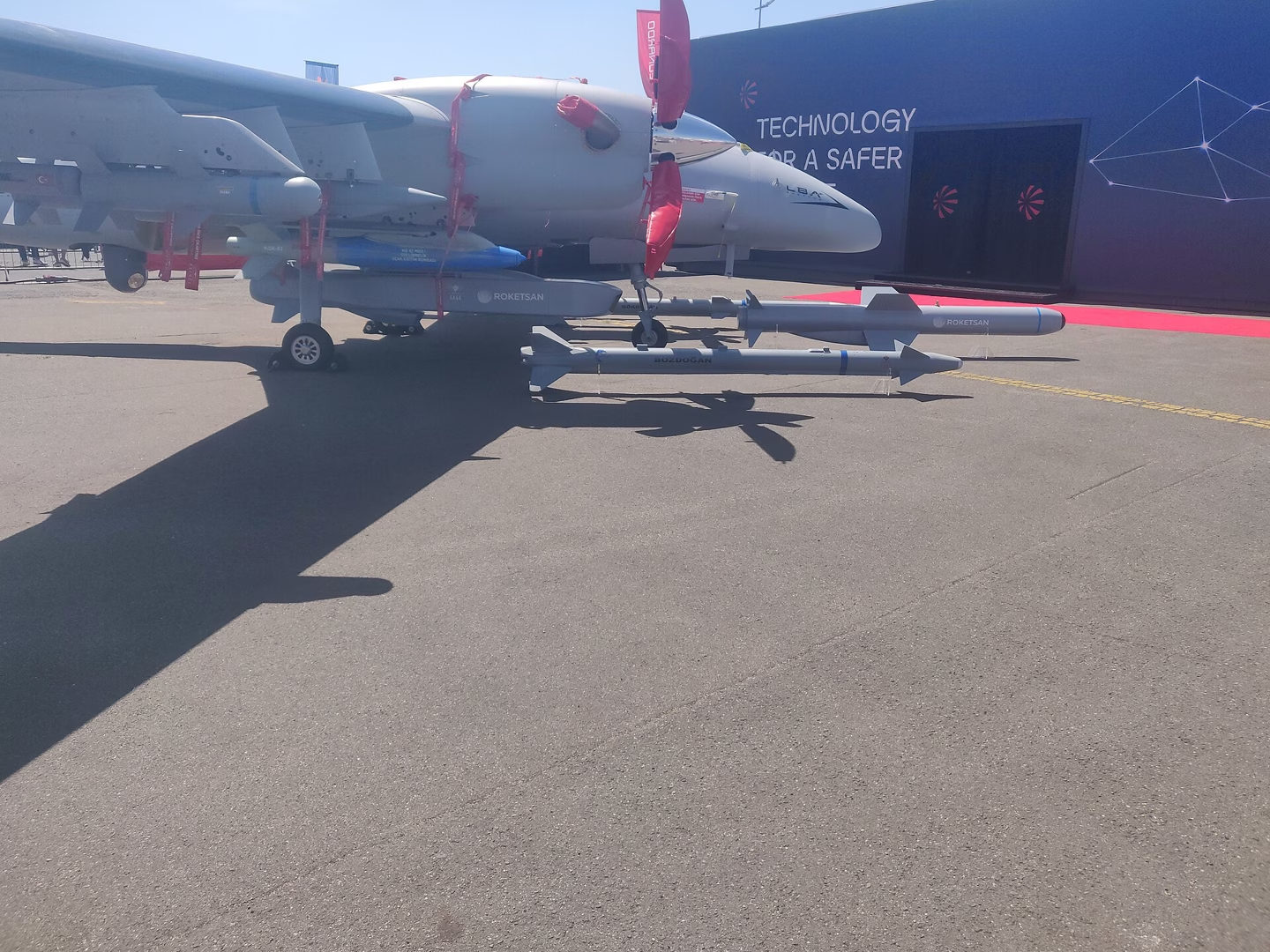
AKINCI's air-combat capability is being expanded step by step through tests in Türkiye. According to Baykar, AKINCI hit a high-speed target UAV with a SUNGUR air defense missile developed by ROKETSAN during a test off Sinop in September. The UCAV took off from the Çorlu Flight Training and Test Center in Tekirdağ and returned to Çorlu along its planned route after the launch over the Black Sea.
AKINCI had previously conducted air-to-air launches with the KEMANKEŞ 1 artificial intelligence-based mini cruise missile, while in a test on February 21, 2026, it destroyed an aerial target UAV with the EREN high-speed multipurpose loitering munition. Baykar said the addition of SUNGUR demonstrated that AKINCI could use nationally developed munitions from different classes against aerial targets. A broad range of munitions, from the MAM family and the İHA-300 supersonic missile to the ÇAKIR cruise missile and TOLUN, has so far been integrated into the national UCAV.
Export agreements with 16 countries
With exports worth $2.2 billion in 2025, Baykar remained the world's largest exporter in the unmanned aerial vehicle segment. The company, which derives 90% of its revenues from exports, has signed export agreements for AKINCI with 16 countries to date. Together with TB2, the number of countries with which Baykar has signed export agreements has reached 39. AKINCI has been in service in the inventory of the Turkish Armed Forces since August 29, 2021.
Nyala is one of the most critical points in the Sudanese war. The capital of South Darfur is among the most important cities held by the RSF. Tens of thousands of people have been killed in the war between the Sudanese army and the RSF, which began in April 2023, while approximately 13 million people have been displaced, according to estimates by the United Nations and international organizations. The Sudanese army also announced in recent days that it had shot down a Chinese-made FH-95-type UAV in West Kordofan.
Video: Clash Report. Photos: Wikimedia Commons
Stay Updated with The Turkiye Times
Subscribe to be informed about special news, developments and announcements. We will keep you informed.
By signing up, you agree to our Privacy Policy