- BIST10012,189-0.50%
- USD49.37+0.07%
- EUR55.21+0.01%
- GOLD4,166.60-0.26%
- INTEREST37.00%-1.00
- BITCOIN83,318+0.27%
- October 14, 202618°
- BIST10012,189-0.50%
- USD49.37+0.07%
- EUR55.21+0.01%
- GOLD4,166.60-0.26%
- INTEREST37.00%-1.00
- BITCOIN83,318+0.27%
- October 14, 202618°
Minister Bolat calls for Türkiye to be treated as an equal partner in production with the EU
Trade Minister Ömer Bolat said at the Türkiye-EU Business Summit in Brussels that the Customs Union should not exclude reliable partners and called for Türkiye to be treated as an equal partner in the production process with the EU.


Trade Minister Ömer Bolat said Türkiye should not be excluded under the Industrial Acceleration Act being debated in the European Union. Bolat said Türkiye shared concerns over the high volume of imports from third countries, but stressed that the solution should not be to exclude reliable partners or the Customs Union.
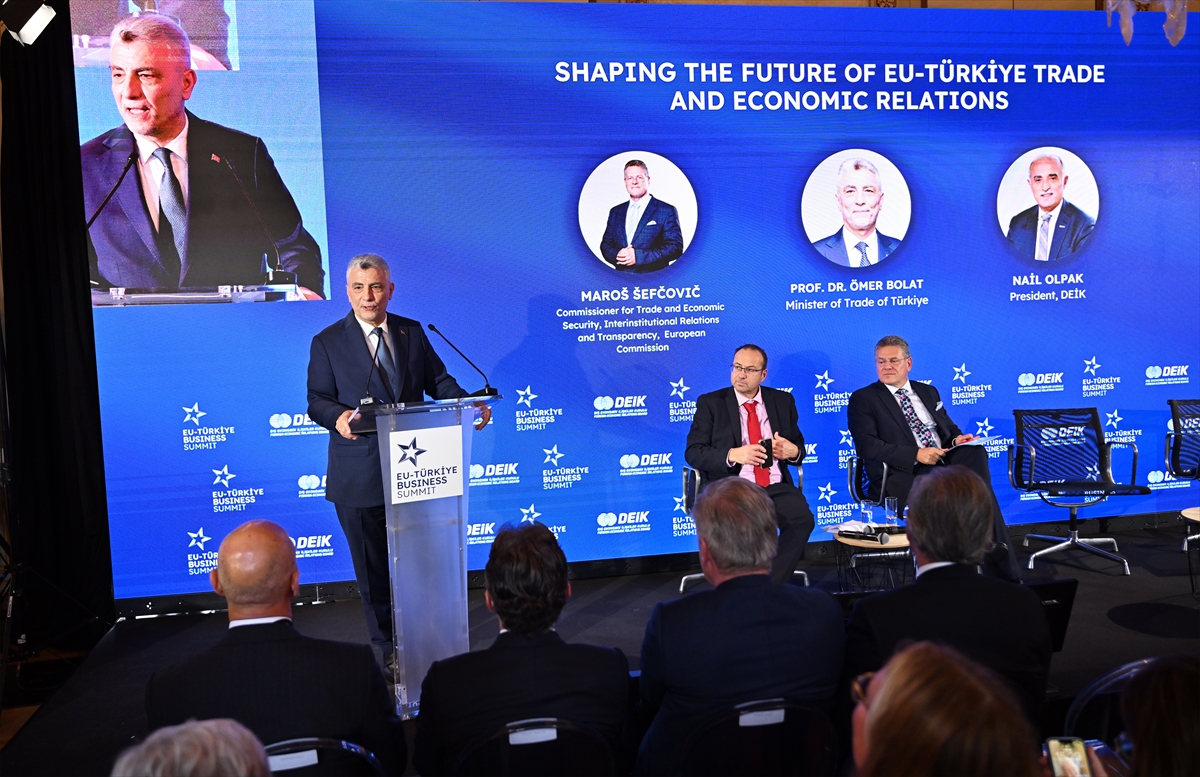
Bolat spoke at the session titled "Shaping the Future of EU-Türkiye Trade and Economic Relations" at the Türkiye-EU Business Summit in Brussels, alongside Maros Sefcovic, the European Commission member responsible for Trade and Economic Security. The session was held in cooperation with the Foreign Economic Relations Board and the European Business Summit.
Customs Union increased trade elevenfold
Recalling that the Customs Union between Türkiye and the EU had been in effect since the beginning of 1996, Bolat said restrictions and measures having equivalent effect between the two sides had been removed under this framework. Bolat said Türkiye had adopted the common external customs tariff regime and achieved comprehensive alignment with EU legislation in competition, state aid, trademarks and patents, and trade policy.
Bolat said the Customs Union had been successful over the past 30 years, announcing that annual total trade had risen from approximately $21 billion to $233 billion last year, an elevenfold increase. He said the arrangement had increased mutual investment, enabled the reciprocal opening of markets for industrial goods exports, and created industrial integration between the two sides.
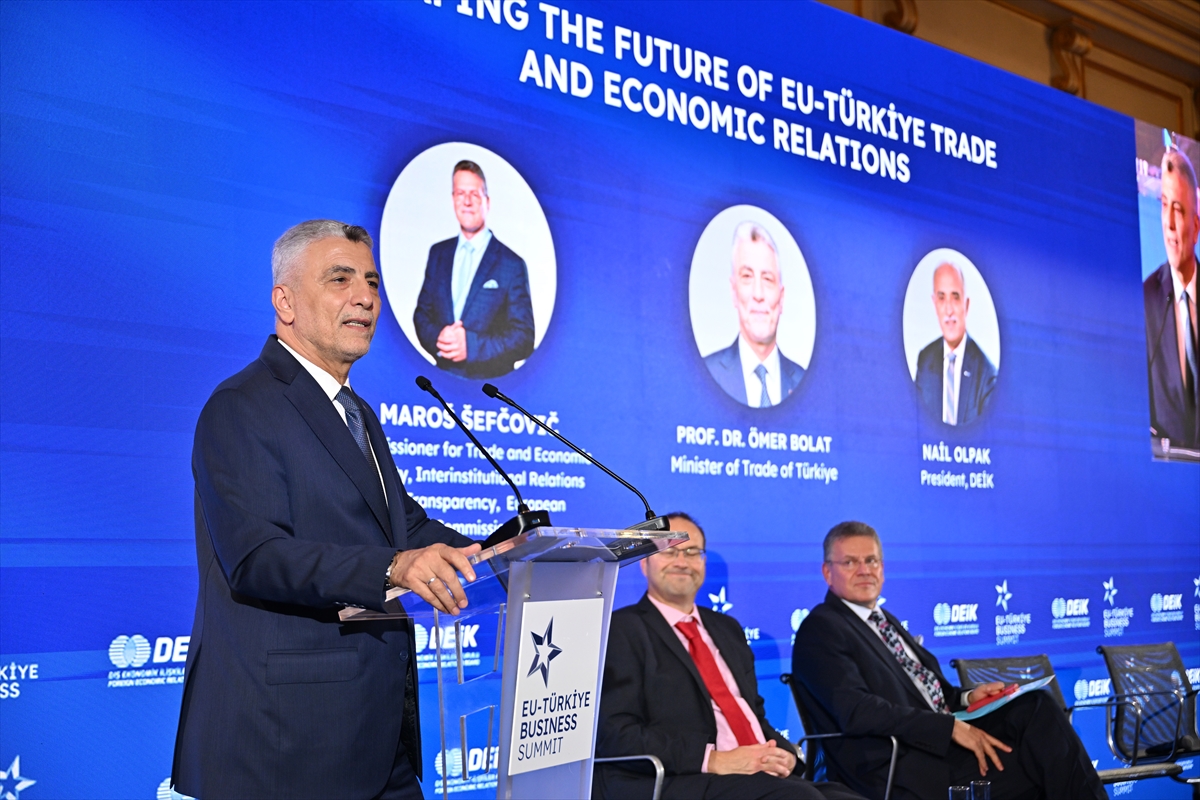
Bolat said approximately 63% of Türkiye's $294 billion stock of foreign direct investment came from EU companies, noting that strong ties existed between businesses in Türkiye and EU member states.
Emphasis on mutual dependence in automotive industry
Bolat said approximately 26% of total Türkiye-EU trade was conducted in the automotive sector, representing $62 billion in trade. Saying that European companies accounted for 75% of Türkiye's automotive industry, Bolat listed Renault, Peugeot, Fiat, the Stellantis Group, MAN, Mercedes-Benz and Bosch among them.
Bolat said EU companies had invested €21 billion in Türkiye's automotive industry and that approximately 1.45 million cars and other motor vehicles had been produced last year. He said 75% of this production was carried out by EU companies, adding that Türkiye's automotive market stood at 1.3 million vehicles annually and that approximately 980,000 vehicles were supplied through imports.
Bolat said total trade between Türkiye and the EU had reached approximately €900 billion over the past five years, equivalent to $1 trillion. He said these figures demonstrated the scale of mutual dependence in supply chains, markets and production.
Call for Türkiye to be accepted as an equal partner
Addressing the debates in the EU under the headings "Made in the EU" and "Made with the EU," Bolat said they wanted Türkiye to be accepted as an equal partner in these projects. Bolat said they respected the idea of an Industrial Acceleration Act and shared concerns over the high volume of imports from third countries, stressing that the solution should not exclude Türkiye and the Customs Union.
Bolat said the Türkiye-EU Customs Union should guide decisions concerning the future of trade. He said such an approach would benefit the EU economies and automotive industry, as well as Türkiye's economy and industry.
Trade dialogue reduces 29 issues to 14
Bolat said they would hold a High-Level Trade Dialogue meeting for the third time in the past two years. Saying they aimed to bring together public officials and private-sector representatives, Bolat said the number of issues under the Customs Union had been reduced from 29 to 14 last year and that further progress would be made in this area.
Bolat also addressed the issue of visas for Turkish citizens, saying Türkiye was the only country among the candidate countries in the enlargement and accession process whose citizens had not yet been granted visa liberalization. He said the phased visa system had eased the difficulties to some extent but was not sufficient.
Sefcovic delivers message on Customs Union
European Commission member Maros Sefcovic said they attached great importance to their partnership with Türkiye at a time of growing global uncertainty. Sefcovic said that despite geopolitical turbulence, security concerns and adverse economic conditions, both sides had maintained their commitment to open and rules-based trade, adding that Türkiye-EU economic relations were developing strongly.
Sefcovic said Türkiye was the only major economy with a Customs Union with the EU, adding that this framework connected European and Turkish companies through integrated supply chains in many sectors. He said creating a stable and secure environment in the Eastern Mediterranean was in the strategic interest of both sides.
Sefcovic said there was significant potential for greater cooperation between Türkiye and the EU and that he was pleased with the intensification of contacts in trade. Emphasizing that the Customs Union should be fully and properly implemented across all member states, Sefcovic said an update would accelerate trade, investment and the integration of supply chains.
Target of $15 billion in trade with Belgium
As part of his contacts in Brussels, Bolat also attended a Türkiye-Belgium high-level roundtable meeting organized in cooperation with the Federation of Enterprises in Belgium and the Foreign Economic Relations Board. Speaking after the meeting, Bolat said they aimed to increase bilateral trade from $9.3 billion last year to $15 billion.
Stay Updated with The Turkiye Times
Subscribe to be informed about special news, developments and announcements. We will keep you informed.
By signing up, you agree to our Privacy Policy